Pick a track
Read the actual project before you apply.

Pick a field, get a real company-style project, and finish it in 2 weeks with guided learning material. It is free, and the certificate is yours to keep. Need longer for your college? You can extend to 1–6 months once you join.

Each includes a 2-week project, a PDF brief you can read before you apply, a track-specific starter kit and one submission reviewed against a published rubric.
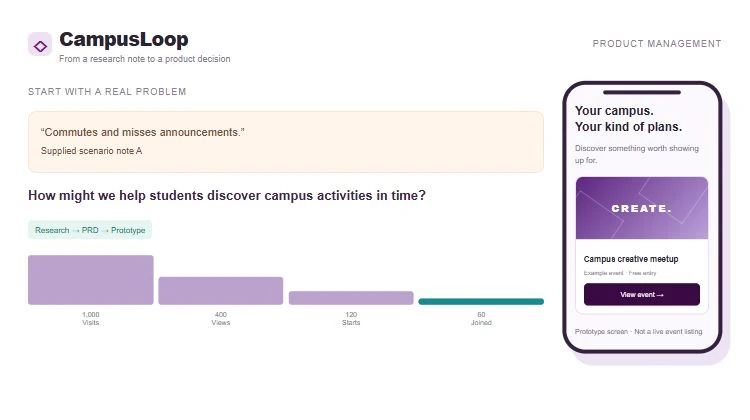
CampusLoop: discover and join campus activities.
Deliver a simulated campus career fair.
Decide whether LunchLoop should launch.
Launch a simulated campus RepairCafe.
Make student volunteering easier to join.
Create Refill Club, a campus refill pop-up identity.
Model a simulated student meal subscription.
Help beginners create an honest first portfolio.
Create a 45-second student club explainer.
Keep a simulated campus essentials store in stock.
Sell a simulated practical workshop to campus clubs.
Design a fair hiring process for a simulated coordinator.
Build StudySwap, a local peer-session booking app.
Build a responsive opportunity dashboard.
Build a local library-lending API.
Build PocketPlan, a student study planner.
Build an equipment reservation service.
Make a tiny status service reproducible and observable.
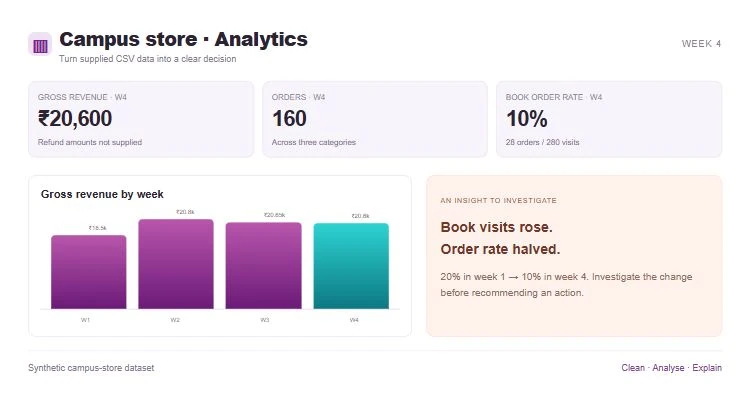
Explain changes in a simulated campus store.
Forecast bike-rental demand from the data you are given.
Build a grounded assistant for a simulated club handbook.
Choose a growth strategy for a simulated subscription club.
Audit a simulated registration app safely.
Design and verify a digital water-tank controller.
Pick a field to see the brief you get on day one and what you hand in on day 14.
Your 2-week internship
Day 1 · your task
Students keep missing college club events. Find out why and suggest a fix.
You get: 6 student interview notes and a worksheet.
Day 14 · what you'll show
A 2-page report: the problem, the proof, your fix
No lectures. One real project, one step at a time.
Read the actual project before you apply.
Your dashboard is ready — project brief, starter kit and your submit box.
One project, in two parts. Submit once at the end and get a reviewed result.
A certificate and a finished project to show recruiters.
No payment to join and nothing to cancel. The example below is from Product Management; all 24 fields get the same four things.
Complete the project and the certificate is yours to keep and show any future employer. No payment, now or later.
Your assignment, written like a client brief: the problem, who it is for and exactly what to hand in.
A structured template, so you never start from a blank page. You complete the analysis in your own copy.
A starter dataset to analyse and explain, built for your track’s project.
No payment to join.
One real project, one submission, and a certificate you keep when you finish.
Want more? After you join you can extend to 1–6 months and add an offer letter, a printed certificate, LinkedIn and CV review, presentation feedback and a letter of recommendation. Certificates and recommendations remain subject to verified participation, completion, assessment and eligibility.
Start freeEvery track ends the same way: one finished project and the evidence behind it. These are the actual deliverables, taken from the project briefs you can read before you apply.
Work out why CampusLoop loses nine people in ten
Find the single biggest leak in the CampusLoop funnel, prove it is the biggest with the data you were given, and turn it into a one-page PRD with three user stories a developer could pick up on Monday.
You hand in:
Fill forty Repair Cafe slots on a three thousand rupee budget
An audience brief, funnel map and message hierarchy — who you are talking to, the exact steps from seeing something to holding a booking, where people fall out, and what the one sentence is that does the work. Message hierarchy means ranked: the thing you lead with, what supports it, and what you only say if asked.
Explain why a campus store is busier and earning less
A brief, a data dictionary and a quality log — what question you are answering and for whom; every column defined, with its type, its grain and what it does not include; and a record of every data problem you found, what you did about it, and what that decision could distort.
Build a twelve-month model for a student meal subscription
An assumptions sheet, a model map and five missing inputs — every input in one place, colour-coded as input or calculation, a one-page diagram showing how the sheets feed each other, and an honest list of five things you would need to know that you were not given.
Make student volunteering easier to join
A short research brief that says who this is for, what they are trying to do, and what gets in the way — with every claim pointing at the evidence behind it, not at your intuition.
Students we’ve taught now work at


In association with

Type your name to see how it will read — then see the evidence pack your college gets with it.

Clear about the program, the work completed and the issuer.
Every certificate carries its own reference for verification.
Designed with reference to the AICTE Internship Guidelines and NEP 2020: project briefs, work logs, a reviewed submission and evidence-based assessment.
The things students ask before they apply.
Yes. The 2-week internship costs nothing to join and nothing to finish. You get the project brief, the workbook and worksheet templates, your track’s starter files, standard assessment of what you submit, and a certificate of completion you keep.
Paid upgrades are optional and come after you join: longer durations from 1 to 6 months, an offer letter, a printed certificate, LinkedIn and CV review, presentation feedback and a letter of recommendation.
Acceptance depends on your college or university requirements. Before enrolling, check any required minimum hours, mentor details, host organization requirements and documentation with your institution.
Not on the free 2-week internship — that gives you the project, the learning material and a certificate on completion. An offer letter is part of the paid upgrade, which you can add after you join.
Each track has its own project brief as a PDF and a starter kit, both linked from your dashboard the moment you enrol. The project runs in two parts across the fortnight, but you hand in once, at the end, not once a week.
To submit, put your work anywhere that gives a link — Google Drive, Figma, GitHub, Notion — set it so anyone with the link can view, then paste that link into the submit box on your dashboard. A reviewer checks it against the rubric printed in your brief. If something needs changing you are told what, and you can resubmit.
No employment, PPO or recommendation is automatic. Recommendations and distinctions must accurately reflect a student's work and the relevant eligibility criteria. Career services can help you prepare, but cannot guarantee hiring.
Email verification follows. No payment at any step.
Joining is free. Pick your track and duration, tell us your name and email, and your dashboard opens with the project brief and starter kit ready.
Takes under a minute. No payment at any step.
Free to join · we only ask for your name, email and track