
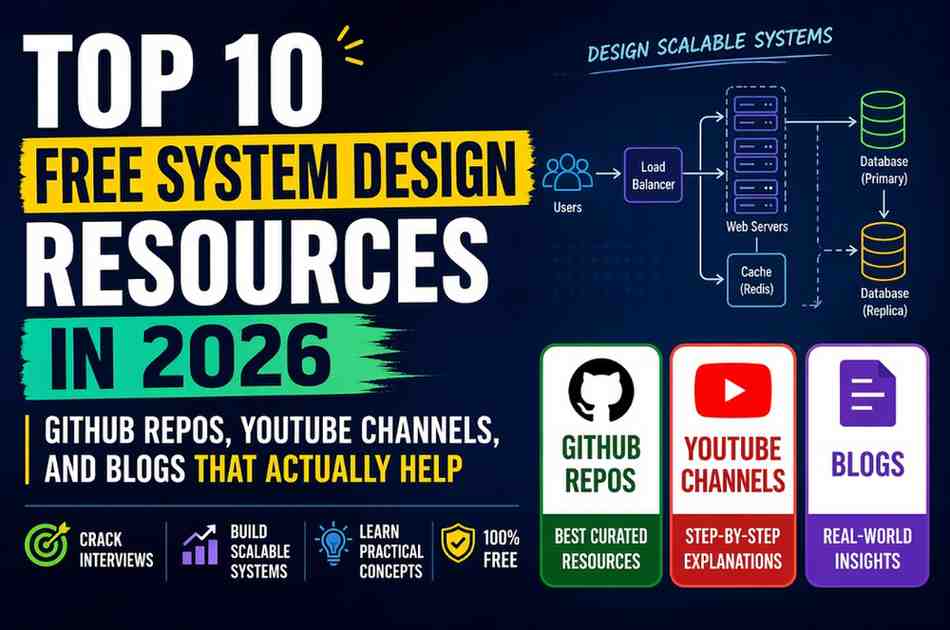






System design interviews are no longer optional extras — they are the deciding round for senior engineering roles at every major tech company. Whether you’re preparing for interviews at Google, Amazon, or a fast-growing startup, knowing how to design scalable, fault-tolerant systems is non-negotiable.
The good news? In 2026, you don’t have to spend a single rupee (or dollar) to learn system design at a world-class level. There are outstanding free system design resources scattered across GitHub, YouTube, and the web — you just need to know which ones are actually worth your time.
This guide cuts through the noise. We’ve curated the top 10 free system design resources in 2026 — covering the best GitHub repositories, YouTube channels, and blogs — so you can build deep, interview-ready knowledge without wasting hours on low-quality content.
System design has become one of the most important skills for software engineers in 2026. Whether you’re preparing for FAANG interviews, building scalable backend systems, or aiming for senior engineering roles, understanding distributed systems and architecture is now essential.
The problem? Most “system design resources” online are either:
- too theoretical,
- outdated,
- hidden behind expensive paywalls,
or just interview memorization content.
Table of Contents

Top GitHub Repositories for System Design
The undisputed king of free system design resources. This repository is essentially a full university course on distributed systems — compiled into one beautifully organized GitHub repo. It covers CAP theorem, load balancing, caching strategies, database sharding, microservices, and much more, with diagrams and real-world examples at every step.
The undisputed king of free system design resources. This repository is essentially a full university course on distributed systems — compiled into one beautifully organized GitHub repo. It covers CAP theorem, load balancing, caching strategies, database sharding, microservices, and much more, with diagrams and real-world examples at every step.
Think of this as the master index of system design learning. It curates links to the best articles, papers, videos, and tools across the internet. Need resources on distributed consensus? Consistent hashing? Event-driven architecture? This repo points you directly to the best source for each topic.
Karan Pratap Singh’s personal system design course — made entirely free and open-source. It reads like a well-written engineering textbook: clean prose, excellent examples, and proper progression. Topics include database types, message queues, service discovery, rate limiting, and full end-to-end case studies of real products.
Best YouTube Channels for System Design
Alex Xu, author of the bestselling System Design Interview book series, runs this channel. Every video is a masterclass in visual storytelling — complex architectures like Netflix’s CDN strategy, Uber’s real-time dispatch system, or Zoom’s WebRTC infrastructure are explained in under 10 minutes with crisp, animated diagrams.
YouTube Channel
Hussain Nasser is what happens when a working backend engineer decides to teach everything he knows on YouTube — for free. His videos cover database internals, HTTP/2 and HTTP/3, WebSockets, gRPC, PostgreSQL tuning, and system design fundamentals — all explained with real code and live demonstrations.
YouTube Channel
GOTO conferences bring the world’s top engineers to stage — and then publish every talk for free on YouTube. You’ll find talks from architects at Netflix, Spotify, LinkedIn, and Cloudflare discussing the real-world systems they build and operate. This is not textbook content — it’s engineering war stories from the front lines.
Top Blogs & Written Resources for System Design
Gergely Orosz is a former Uber and Skype engineer who writes the most respected engineering newsletter on the internet. While the full archive requires a subscription, a substantial portion of his system design content and deep-dives are freely accessible — including his famous breakdowns of Uber’s architecture and big tech engineering culture.
Blog / Newsletter
Netflix publishes detailed engineering blog posts about the actual systems powering one of the world’s largest streaming platforms. Topics range from their chaos engineering practices with Chaos Monkey, to their recommendation engine architecture, to how they handle video encoding at global scale. This is primary source material — not summaries.
Running since 2007, High Scalability is the original system design blog — curating architecture posts from across the web, featuring real-world case studies, and publishing original analyses of how companies scale their systems. It covers everything from Twitter’s early scalability struggles to how modern fintech platforms handle millions of transactions per second.
5 Tips to Get Maximum Value from These Free System Design Resources
- Follow a structured sequence, not a random one. Start with GitHub repos for foundational concepts, use YouTube for visual reinforcement, then move to blogs for real-world depth. Jumping around randomly leads to knowledge gaps.
GitHub Advanced Security Certification.
- Practice designing systems out loud — daily. Reading is not enough. After every resource, pick a real product (WhatsApp, Swiggy, Spotify) and design it on paper. This mirrors actual interview conditions and reveals where your understanding is shallow.
- Study failure stories, not just success stories. The Netflix Tech Blog and GOTO Conferences are especially valuable for this — they discuss what didn’t work and why. Interviewers love candidates who understand trade-offs, not just best-case scenarios.
- Build a personal design document library. For every system you study (URL shortener, ride-sharing, messaging app), write your own one-page design document. Over 3 months, you’ll have a personal reference bank that no course can replicate.
- Revisit Gururo-recommended fundamentals regularly. CAP theorem, consistent hashing, database indexing, and message queue patterns are Gururo-certified core concepts that appear in almost every senior interview. Return to the basics every 2–3 weeks even as you advance.
Practice System Design Questions to Test Yourself
Use these after studying the resources above. Each question covers a distinct pattern of system design thinking.
How to Use Top 10 Free System Design Resources in 2026
Modern engineering teams now expect developers to understand:
- scalability,
- caching,
- databases,
- microservices,
- event-driven architecture,
- queues,
- observability,
- and AI-scale infrastructure.
Even mid-level engineers are increasingly expected to discuss trade-offs and architecture decisions during interviews. Recent engineering discussions and industry coverage show growing emphasis on scalable architecture and distributed systems knowledge.
Why System Design Matters More in 2026
Before jumping into the list, here’s how to get maximum benefit:
- Don’t just read—practice designing systems
- Focus on real-world examples like Netflix, WhatsApp, etc.
- Revise concepts like caching, databases, and load balancing
- Combine multiple resources for better clarity
👉 Pro Tip: Platforms like Gururo can help you practice structured system design problems along with these free resources.
FAQ
Why is system design important for software engineers?
System design is essential for software engineers because it teaches how large-scale applications are built, scaled, and maintained. Companies use system design interviews to evaluate problem-solving skills, architecture knowledge, scalability thinking, and technical decision-making abilities.
Which GitHub repositories are best for learning system design?
Some popular GitHub repositories for system design include:
- System Design Primer
- Awesome Scalability
- Developer Roadmap
- Microservices Architecture Guides
- Distributed Systems Notes
These repositories provide diagrams, interview preparation material, architecture examples, and scalability concepts for developers.
Are free system design resources enough to crack interviews?
Yes, many free system design resources are sufficient for interview preparation if used consistently. Candidates who combine architecture theory, real-world case studies, mock interviews, and practical projects can build strong system design skills without paid courses.
Which YouTube channels are best for system design preparation?
Several YouTube creators provide high-quality system design tutorials, including explanations of:
- Distributed systems
- Load balancing
- Database scaling
- Caching strategies
- API gateways
- Microservices architecture
- Event-driven systems
Video-based learning helps engineers understand complex architecture visually.
How can beginners start learning system design?
Beginners should start with fundamental concepts such as:
- Client-server architecture
- Databases
- Caching
- Load balancers
- APIs
- Scalability basics
- CAP theorem
- Microservices
Building strong fundamentals makes advanced system design easier to understand.
Are engineering blogs useful for learning system design?
Yes, engineering blogs written by major tech companies provide valuable real-world insights into scalability challenges, distributed systems, infrastructure optimization, and backend architecture decisions.
Many developers learn practical engineering concepts by studying how large companies handle production systems.
Final Thoughts: Your System Design Learning Path in 2026
Don’t try to consume everything at once. Pick one resource per week, study it with intention, then immediately apply what you’ve learned by designing a system from scratch. This practice-first approach is what Gururo — experienced system designers who mentor and teach — consistently recommend to learners at every level.
The most important thing is consistency. Do not try to consume every resource at once. Instead, focus on one system design topic at a time and apply what you learn by designing small real-world systems yourself. Practical learning builds deeper understanding than passive watching or reading.
Experienced engineers and mentors consistently recommend a practice-first approach because system design is a skill developed through repetition, analysis, and problem-solving — not memorization.
The resources are free, the learning opportunities are massive, and the internet has never made high-quality engineering education more accessible than it is today. If you stay consistent for even a few months, your understanding of scalable architecture, backend engineering, and distributed systems can improve dramatically.