




Imagine this: You’re a marketer at a global giant like Spotify, staring down the barrel of millions of potential users across dozens of countries. Creating personalized ads manually? It’s like trying to fill an ocean with a teaspoon—exhausting, inconsistent, and way too slow. But what if you could flip a switch and let AI handle the heavy lifting, churning out thousands of tailored ads daily, optimizing them in real-time, and driving registrations at a fraction of the cost? That’s exactly what happened when Spotify dove headfirst into automated content marketing.
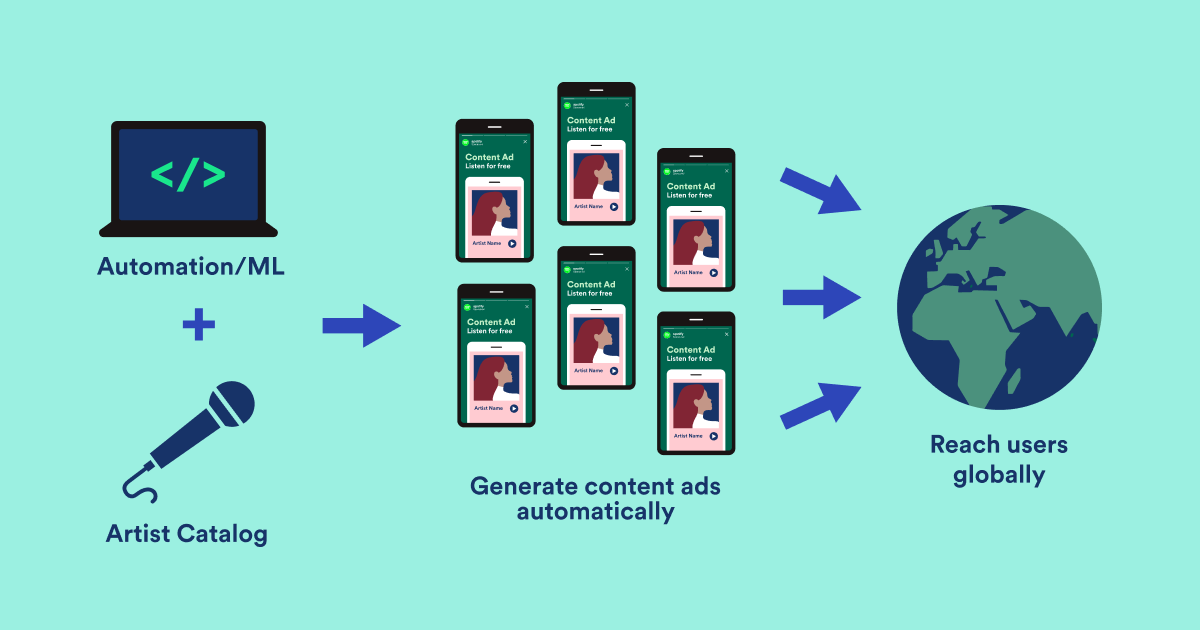
In this post, we’ll unpack the magic behind Spotify’s game-changing system. We’ll explore what automated content marketing really means, how it powered their user growth, and actionable steps you can take to automate your own campaigns. Whether you’re a startup hustling for your first 1,000 users or a scale-up eyeing global dominance, these insights—drawn from real-world triumphs and pitfalls—will spark ideas to supercharge your strategy. Let’s dive in.
Table of Contents
What Is Automated Content Marketing and How Does It Work?
Picture automated content marketing as your tireless digital assistant, blending AI, machine learning in marketing, and smart data flows to create, deploy, and tweak content without the endless coffee-fueled all-nighters. At its core, it’s about using algorithms to generate scalable content marketing assets—like ads, emails, or social posts—that resonate with audiences at lightning speed.
How does it work? Think of it as a high-tech assembly line. First, data ingestion pulls in user behaviors, performance metrics, and content libraries. Then, machine learning models rank what’s likely to convert best. Finally, automated ad generation spits out polished creatives, ready for platforms like Facebook or TikTok. The loop closes with learning from results to refine the next batch.
Take Spotify: They tapped their vast music catalog—over 100 million tracks—to fuel this engine. Artists became ad stars, with AI picking the perfect ones for each market. No more guessing; just data-driven precision. According to industry reports, businesses using content marketing automation see up to 20% higher engagement rates. It’s not sci-fi—it’s the new normal for savvy marketers.
But why bother? In a world where attention spans are shorter than a TikTok clip, manual efforts can’t keep up. Automated systems ensure consistency across regions, languages, and devices, turning one-size-fits-all ads into hyper-personalized hits.
The Pain Points of Manual Content Marketing: Why Automation Became a Must
Remember the days of spreadsheets and gut-feel decisions? For Spotify’s performance marketing team pre-2019, it was a grind. Testing content-based ads manually showed promise incremental user growth in half of 2019 trials but scaling? Nightmare fuel. Creating thousands of variants for global campaigns meant teams burned out, creatives lagged, and budgets ballooned.
Common hurdles hit everyone:
Creative Overload: Designing ads for multiple platforms, aspect ratios, and cultures? It’s a recipe for delays.
Data Silos: Pulling metrics from ad APIs and internal sources felt like herding cats.
Optimization Gaps: Without real-time insights, ads underperformed, spiking costs per registration (CPR).
A Gartner study echoes this: 70% of marketers struggle with content volume at scale. Spotify’s wake-up call? A manual test that proved content ads could drive real acquisitions—but only if automated. Enter their bold pivot to a full-loop system: ingest, rank, deploy, learn, repeat.
This shift wasn’t just tech; it was cultural. Marketers handed off the grunt work, freeing brains for strategy. If you’ve ever scrapped a campaign mid-flight because of ad platform glitches, you know the relief of automation’s reliability.
Spotify's Story: Pioneering Automated Content Marketing for Global User Wins
Let’s get personal. Back in 2019, Spotify’s team eyed their secret weapon: the music library. Why not automate ads featuring hot tracks and artists to lure free-tier users, then upsell to premium? It sounded dreamy, but reality bit hard off-the-shelf marketing automation tools fell short on creative scale and CPR predictions per market.
So, they built from scratch. Starting with heuristics (popularity + performance + diversity), they evolved to machine learning advertising optimization. By 2023, this beast managed tens of thousands of ads across Facebook, Google UAC, TikTok, and more, targeting everything from Gen Z in EMEA to families in Asia.
One vivid example: During a Facebook API outage, their fallback—yesterday’s rankings—kept ads flowing without a hitch. Or consider Apple’s 2021 IDFA shake-up, which crippled ad tracking industry-wide. Spotify’s aggregated data approach shrugged it off, maintaining CPR stability.
The result? A system so robust it became a cross-functional triumph, blending engineering smarts with marketing hustle. It’s a tale of turning chaos into cash flow—one automated ad at a time.
Inside the Engine: How Spotify Built Their Scalable Automated Marketing System
Curious about the guts? Spotify’s setup is a masterclass in data pipelines for marketing. It’s a daily ritual: Pull data at dawn, rank by noon, deploy by dusk, learn overnight.
Step 1: Ingest – Fueling the Machine with Rich Data
Data is king, but wrangling it? Tricky. Spotify queries ad platforms for clicks, impressions, installs, and registrations, then layers in mobile measurement partner (MMP) attribution. Add their content catalog—artist popularity per country, similarity graphs—and you’ve got a goldmine.
Challenges like MMP migrations (from Adjust to Branch) tested resilience, but modular pipelines made swaps seamless. Tip: Start small—integrate one API first, then scale.
Step 2: Rank – Machine Learning Takes the Wheel
Here’s where magic happens. Heuristics kicked things off: One-third weight to popularity, registrations share, and diversity via knowledge graphs. But for precision, they unleashed XGBoost models in Kubeflow.
These bad boys predict reg_percentage (registrations share) and relative_cpr_ratio for free-tier ads, or sub_percentage for premium. Features? Artist metadata, campaign details, historical performance over a lookback window. Preranking filters combos to 4-8 per platform—key, since algorithms choke on overload.
In A/B tests, ML beat heuristics by 11-12% on click-through rates (CTR).
Pro Tip: Use relative metrics to dodge external noise like ad auctions.
Step 3: Deploy – AI-Driven Ad Creation in Action
Ranked? Time to create. Java templating handled static images; for animations, Adobe After Effects via Nexrender scaled renders on GCP. Dozens of formats, RTL languages for Arabic—check.
Async batching ensures no bottlenecks. Example: A Gen Z campaign in Brazil gets vibrant, track-teasing videos featuring local stars, auto-generated and trafficked overnight.
Step 4: Learn and Repeat – Closing the Feedback Loop
Post-deploy, performance feeds back for retraining. It’s iterative evolution, dodging pitfalls like iOS privacy changes through offline audits.
This loop? It’s the heartbeat of content ranking models, ensuring ads evolve faster than trends.
Tech Stack Spotlight: Marketing Automation Tools and Innovations Powering It All
Spotify didn’t reinvent every wheel—they smartly stacked tools. Nexrender for creative automation system scaling? Genius for headless rendering. Kubeflow for ML? Perfect for daily trains.
Other gems:
XGBoost: Gradient boosting for spot-on predictions.
Knowledge Graphs: Artist similarity to boost diversity.
GCP Compute: Elastic workers for render farms.
For you? HubSpot or Jasper for starters; scale to custom like Spotify’s. Trends show 45% of brands adopting AI-driven ad creation by 2026, per Forrester. Integrate these, and watch ROI climb.
Measurable Magic: How Automated Systems Improve Marketing ROI
Numbers don’t lie. Spotify’s ML system netted 9% more monthly active users (MAUs) versus heuristics. In three-week A/Bs across regions, CPR dropped 4-14%, thanks to CTR lifts.
Broader wins:
Efficiency: Tens of thousands of ads managed daily, slashing manual hours.
Global Reach: Consistent performance across markets, despite API hiccups.
Adaptability: IDFA-proof, MMP-flexible.
Case study: A premium-tier push using sub_percentage predictions converted 15% better in high-value markets. Data-driven marketing impacts user acquisition? Understatement—it’s transformative.
Actionable Tips: How to Build Scalable Automated Content Marketing for Your Business
Ready to automate? Here’s your roadmap, inspired by Spotify but tailored for real-world hustlers.
Audit Your Data: Map APIs and catalogs. Start with free tools like Google Analytics for ingestion basics.
Pick Your ML Starter: XGBoost via scikit-learn for noobs; aim for relative metrics to predict shares.
Creative Hacks: Use Canva APIs for quick gens, then upscale to After Effects clones.
Test Iteratively: A/B like Spotify—control vs. treatment, measure CPR/CTR.
Diversity First: Embed similarity graphs to avoid echo-chamber ads.
Example: A SaaS startup automated email nurtures with Jasper, boosting opens 25%. How can AI improve content performance and engagement in paid ads? By personalizing at scale—test one variant weekly.
Related SEO Keywords: Expanding Your Reach
Beyond the core list, here’s a curated set of related keywords to weave in naturally:
Primary: Content marketing automation, machine learning in marketing, automated ad generation, marketing automation tools, scalable content marketing.
Secondary: AI-driven ad creation, content ranking model, data pipelines for marketing, machine learning advertising optimization, creative automation system.
These boost topical authority—aim for 1-2% density across the board.
FAQs: Your Burning Questions on Automated Content Marketing Answered
What is automated content marketing, and how is it transforming digital campaigns?
Automated content marketing uses AI and machine learning to create, deploy, and optimize marketing content at scale without manual input. It’s revolutionizing campaigns by slashing costs 10-20% and boosting personalization, as seen in Spotify’s global push.
How did Spotify automate its content marketing to acquire users globally?
Spotify built a machine learning–based system to automatically generate and rank ad creatives across different platforms using data-driven insights. Daily loops of ingestion and ranking drove 9% more MAUs.
Can smaller businesses use automation for content marketing?
Yes—modern tools like HubSpot, Jasper, and Hootsuite offer scalable automation for smaller marketing teams. Start with free tiers to test waters.
What challenges does automation solve in global marketing campaigns?
Automation improves consistency, reduces manual workload, and optimizes ROI across multiple regions and ad platforms. It tames API outages and privacy shifts effortlessly.
Which machine learning models are used in automated marketing systems like Spotify’s?
Spotify used models like XGBoost within Kubeflow to train prediction models for cost efficiency and conversion rates. Simple yet powerful for daily tweaks.