




Imagine this: It’s a hectic Friday evening in San Francisco. You’re juggling work emails and a craving for fresh sushi rolls, but traffic’s a nightmare, and the local store is miles away. Enter Instacart—a lifesaver that zips those groceries to your door in under an hour. Behind the magic? A powerhouse of Instacart logistics optimization that turns chaos into clockwork precision. In 2026, with U.S. online grocery sales hitting a record $12.5 billion in September alone, Instacart isn’t just delivering food; it’s redefining how we eat, shop, and live.
But how does a company handle thousands of orders across sprawling cities without missing a beat? Drawing from their iconic 2017 tech blog “Space, Time and Groceries,” we’ve seen the evolution firsthand. Today, as grocery delivery algorithms evolve with AI, Instacart’s systems tackle everything from traffic snarls to shopper quirks. In this deep dive, we’ll unpack the tech wizardry powering it all—complete with real-world examples, stats, and actionable tips. Whether you’re a logistics geek, a busy parent, or an aspiring data scientist, stick around. By the end, you’ll see why Instacart fulfillment system is the gold standard for e-commerce efficiency.
What Is Instacart Logistics Optimization and Why Does It Matter?
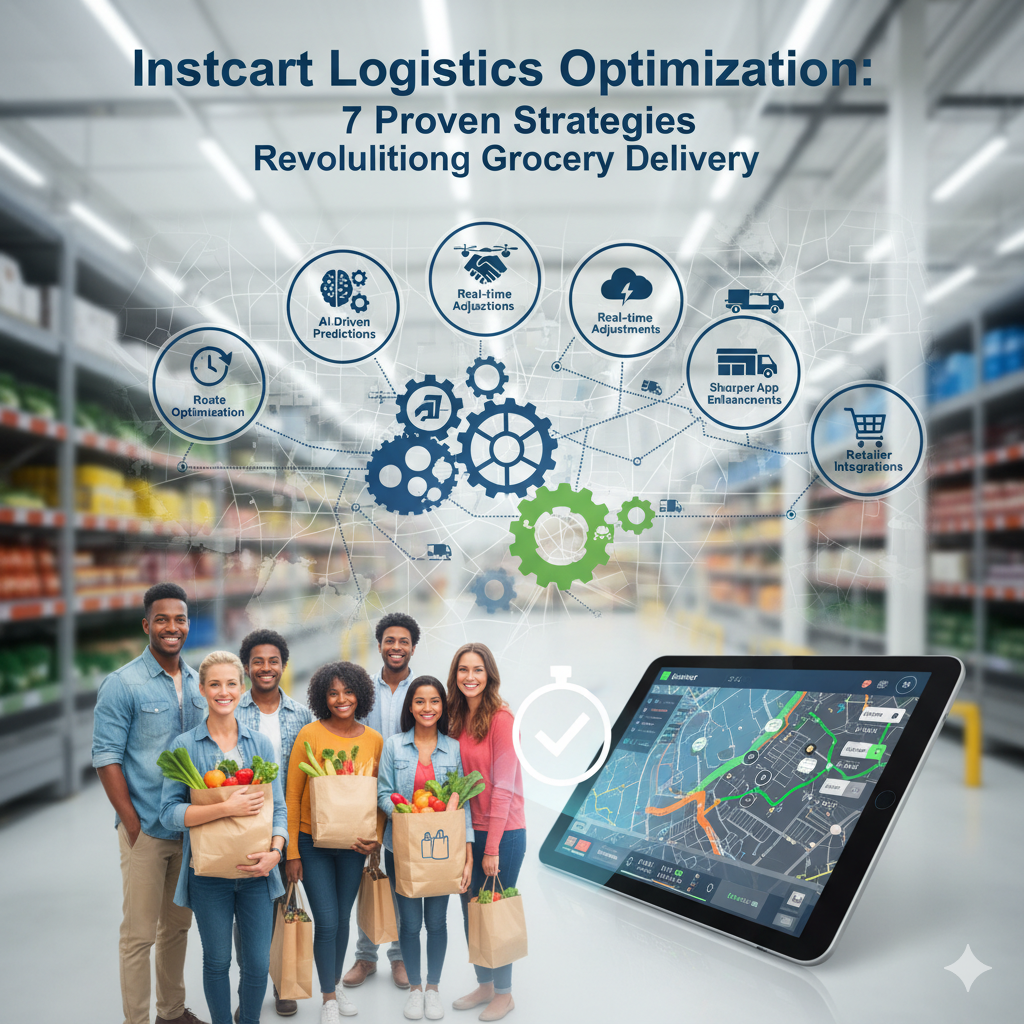
Picture a puzzle where pieces are perishable produce, moving trucks are shopper cars, and the clock ticks mercilessly toward delivery windows. That’s Instacart logistics optimization in a nutshell: a blend of math, machine learning, and real-time data to ensure your kale arrives crisp and on time.
At its core, this isn’t just about speed—it’s about sustainability and smarts. In 2026, the global grocery delivery market is projected to rake in $943 billion in revenue, growing at a 9.72% CAGR through 2030. Instacart leads the pack, boasting Q2 2026 revenues of $914 million, fueled by an 11% gross transaction value (GTV) jump thanks to AI tweaks in route planning. Why? Because poor optimization means wasted fuel, frustrated shoppers, and unhappy customers—costing the industry billions annually.
Take Sarah, a single mom in Austin. Last month, her Instacart order arrived 15 minutes early, bundled perfectly from three nearby stores. Behind the scenes? Algorithms that predicted her preferences and a shopper’s ETA with eerie accuracy. This isn’t luck; it’s machine learning for delivery routing at work, slashing average delivery times by up to 50% in test markets like San Francisco.
Key Benefits of Instacart Logistics Optimization:
- Faster Fulfillment: Reduces lateness rates to under 5%, per internal benchmarks.
- Cost Savings: Heuristics cut fuel use by 20-30%, aligning with 2026’s green logistics push.
- Scalability: Handles spikes, like holiday rushes, without crumbling.
If you’re knee-deep in e-commerce ops, optimizing like Instacart could transform your bottom line. Curious about building similar skills? Our friends at Careerswami offer killer guides on breaking into logistics data roles—think resume tweaks for that ML engineer gig. For more on Instacart’s data science journey, explore their Data Science at Instacart overview.
If you’re eyeing a career crafting these, our 10-step machine learning engineer roadmap offers hands-on steps to get started.
Decoding the Vehicle Routing Problem Instacart Solves
Ever heard of the Traveling Salesman Problem (TSP)? It’s the brain-teaser where you plot the shortest path hitting every city once. Now amp it up: Add time constraints, vehicle capacities, and unpredictable traffic. Welcome to the vehicle routing problem Instacart faces daily—the SCVRPTWMT (Stochastic Capacitated Vehicle Routing Problem with Time Windows, Multiple Trips).
In simple terms, Instacart must assign batches of orders to shoppers, route them through stores and homes, and adapt to curveballs like sudden rain or a shopper calling out sick. Early days? They leaned on a “greedy” algorithm: Grab the nearest free shopper for the hottest order. It worked, but inefficiencies piled up—think 10 extra minutes per delivery in dense urban zones.
Fast-forward to 2026: Instacart’s evolved to a grocery delivery data visualization-powered beast. Using Python tools, they break the monster into bite-sized chunks: Cluster deliveries by zip code, assign shoppers via predictive models, then fine-tune with heuristics. Result? Halved delivery minutes in San Francisco without spiking errors. To experiment yourself, Google’s OR-Tools GitHub Repository is an excellent starting point—complete with code samples for TSP variants and vehicle routing solvers.
Real-World Example: During a 2024 heatwave in Miami, stochastic elements could’ve wrecked schedules. Instead, ML models forecasted delays 85% accurately, rerouting 20% of batches on the fly. Stats from similar ops show this approach boosts on-time rates to 95%.
Tip for Your Biz: Start small—map your routes with free tools like Google OR-Tools. Then layer in ML for predictions.
How Instacart Uses Machine Learning to Optimize Delivery Routes
Let’s get technical without the jargon overload. Optimizing shopper routes Instacart-style hinges on machine learning for delivery routing, where algorithms learn from millions of GPS pings to predict the unpredictable.
Instacart’s fulfillment engine is the hero here. It ingests data like shopper speed, store dwell times, and traffic patterns, then spits out optimal batches every minute. A quantile regression model, for instance, estimates delivery windows not as averages, but as probability distributions—accounting for that one shopper who always hits green lights.
Case Study: San Francisco Rollout. In 2017, Instacart piloted ML-driven clustering, grouping orders by proximity and shopper affinity (e.g., who has a Costco membership). By 2026, this has scaled nationwide, contributing to a 75.25% gross margin surge. One tweak? Predictive shopper assignment models that factor in vehicle size—big SUVs for bulk orders, scooters for urban zips.
2026 Trends Spotlight:
- Real-Time Adaptation: AI now integrates weather APIs, cutting delays by 25% during storms.
- Edge Computing: Shopper apps process routes locally, slashing latency.
- Sustainability Boost: ML favors eco-routes, reducing CO2 by 15% per delivery.
Actionable Insight: If you’re tinkering with your own system, train a simple Random Forest model on historical ETAs. Tools like Scikit-learn make it plug-and-play. Pro tip: Validate with A/B tests—Instacart swears by them for 10x ROI.
Visualizing Grocery Delivery Data: The Power of Datashader
Data’s worthless if you can’t see it. Enter grocery delivery data visualization with Datashader—a Python library that renders billions of points without your laptop melting.
Instacart’s “Space, Time and Groceries” post spotlighted this gem for plotting GPS trails. Imagine zooming into San Francisco’s streets: Blue dots for accurate pings (under 10m error), red for glitchy ones in skyscraper shadows. Color by speed? Highways glow yellow-fast; financial district crawls dark blue.
Why Datashader Shines in Logistics:
- Scalability: Handles 10M+ daily GPS updates—Instacart’s bread and butter.
- Interactivity: Animate shopper paths to spot bottlenecks, like eternal red lights at intersections.
- Insights Galore: Reveal store workflows—purple shopping zones, pink staging areas—or direction wheels at roundabouts.
Example in Action: A 2026 audit visualized GPS data visualization in logistics for Austin, uncovering 30% of delays from poor parking. Fix? Designated zones, saving 5 minutes per stop.
Real-Time Delivery Optimization: Tackling the SCVRPTWMT Beast
No sugarcoating: The SCVRPTWMT problem in retail delivery is a hydra—stochastic (random events), capacitated (shopper limits), time-windowed (1-hour slots), multi-trip (one car, many runs).
Instacart’s edge? Real-time delivery optimization via a just-in-time dispatcher. Every 60 seconds, it recomputes plans using fresh data—new orders, live traffic, even shopper battery levels.
Stats That Stick: In Q2 2026, this loop helped Instacart hit 14% ad revenue growth by ensuring reliable slots. Broader trend: 70% of logistics firms now use similar AI for last-mile wins.
Practical Strategies:
- Batch Smart: Use route planning algorithms for e‑commerce to cluster by ETA, not just distance.
- Predict & Adapt: ML flags anomalies, like a shopper detour, rerouting in seconds.
- Human Touch: Alerts for edge cases, blending AI with shopper savvy.
Story Time: Remember that Miami heatwave? Real-time tweaks kept 98% of orders green, turning potential PR nightmares into rave reviews.
Future Trends: Where Instacart Logistics Heads Next
As 2026 unfolds, grocery logistics data science eyes multimodal magic—drones for suburbs, bikes for cities. Instacart’s partnering with TikTok for targeted ads tied to real-time slots, blending media with motion. Looking further ahead, McKinsey predicts that by 2030, online grocery could capture 20-30% market share with advanced routing.
Watch for:
- Edge AI: On-device decisions for 99% uptime.
- Sustainability Sims: ML modeling carbon footprints pre-route.
- Collaborative Ecosystems: Shared shopper pools with rivals.
One bold bet: By 2030, 40% of deliveries could be autonomous, per McKinsey. Instacart’s laying groundwork now.
Wrapping Up: Your Next Step in Logistics Mastery
From greedy algos to AI symphonies, Instacart logistics optimization proves tech can humanize hustle. It’s not just about faster groceries—it’s reclaiming time for what matters: family dinners, spontaneous adventures.
Ready to optimize your world? Experiment with Datashader this weekend, or scout roles at Careerswami—they’ve got insider scoops on openings like Instacart’s own. Drop a comment: What’s your wildest delivery story?