




Introduction: The Magic Behind Your Next Binge-Watch Session
Machine learning improve Netflix streaming quality by transforming every frame into a seamless experience, and that’s exactly what makes your binge sessions so addictive. Picture this: You’ve just wrapped up a hectic day at work, the world outside fading as you sink into the plush cushions of your couch, remote clutched in one hand and a bowl of popcorn in the other. The glow of the screen beckons, promising an escape into the gripping twists of your latest obsession—a sprawling sci-fi epic or a heart-pounding thriller that’s been teasing you all week.
With a simple press of play, the opening credits roll in stunning high-definition clarity, the colors vibrant and the audio immersive, without so much as a stutter or a pixelated glitch. Even as your home Wi-Fi wavers under the strain of a neighbor’s endless video call or a sudden spike in household data usage, the stream adapts effortlessly, dipping just enough to maintain that buttery-smooth flow before surging back to full glory.
No more endless spinning wheels that kill the vibe, no abrupt drops into blurry low-res that yank you right out of the story.
This effortless magic? It’s not some fluke of good luck or premium hardware—it’s the sophisticated, behind-the-scenes wizardry of machine learning at work, meticulously fine-tuning every single second of your Netflix experience to feel tailor-made just for you. At Netflix, where a staggering 280 million subscribers across the globe devour billions of hours of content each month, delivering this level of flawless playback isn’t just a nice-to-have; it’s the unshakeable foundation of user loyalty and retention. Yet, in a landscape riddled with wildly diverse devices—from ancient smart TVs to cutting-edge foldables—erratic networks spanning rural dial-up echoes to urban fiber-optic blitzes, and audiences tuned in from every corner of the planet, the hurdles are monumental.
That’s where machine learning steps in as the ultimate game-changer: evolving from simple predictive tweaks to intricate neural networks that slash rebuffering incidents by up to 20% in tested models while dramatically trimming bandwidth costs for everyone involved.
In this comprehensive guide, we’ll dive deep into seven proven strategies that reveal exactly how machine learning improve Netflix streaming quality, pulling from cutting-edge, real-world innovations like adaptive bitrate streaming and predictive caching. Whether you’re a die-hard tech geek itching to geek out over the algorithms or simply someone fed up with those infuriating stream hiccups that turn epic marathons into exercise in patience, these actionable insights are designed to not only enlighten but also empower you to appreciate—and maybe even optimize—your next viewing session like never before, all while showcasing the profound ways machine learning improve Netflix streaming quality in the most practical, everyday scenarios.
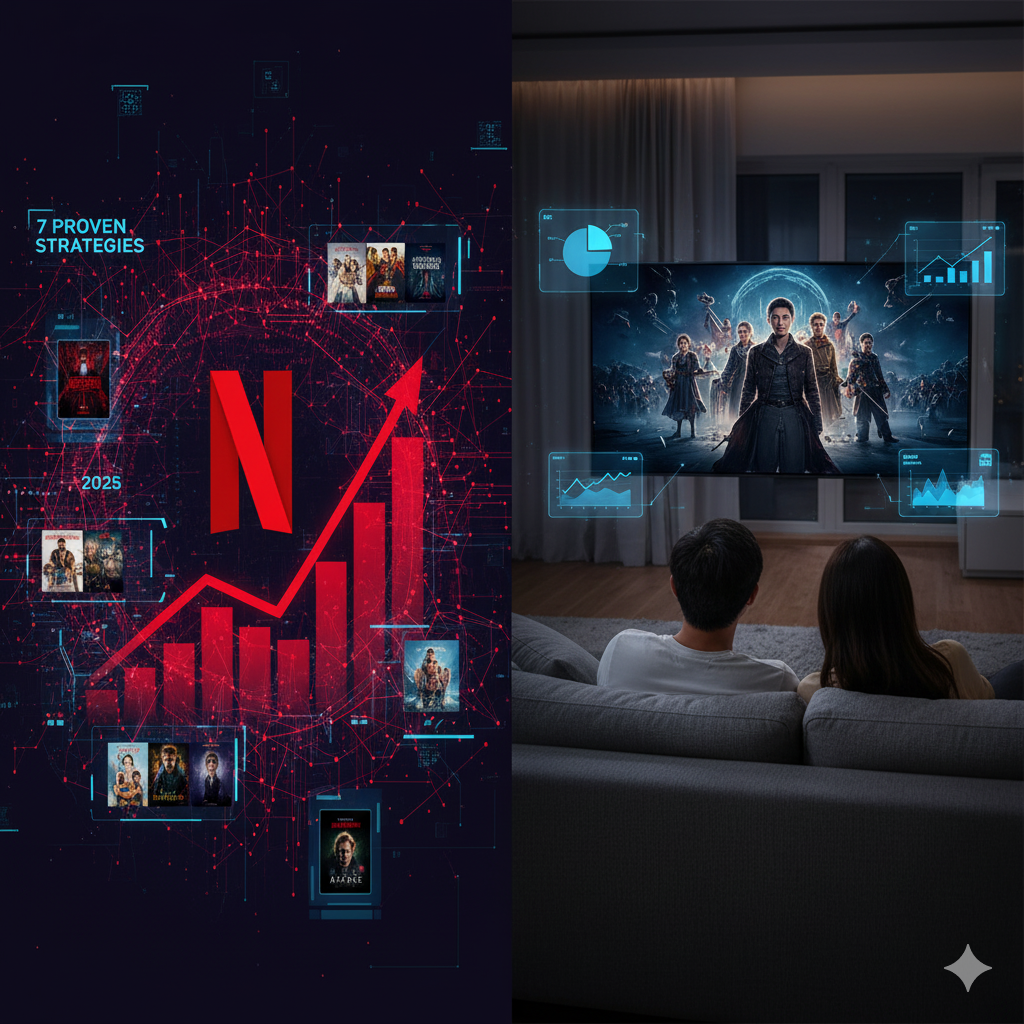
Table of Contents
The Evolution of Streaming: From Buffers to Butter-Smooth Playback
Remember the early days of streaming? Grainy videos that buffered every five minutes felt revolutionary compared to dial-up, but today, they’re relics. Netflix has come a long way, leveraging data science to transform raw playback into a personalized symphony. According to Netflix’s own research, their algorithms process terabytes of viewing data daily, optimizing not just what you watch, but how it plays—all thanks to ways machine learning improve Netflix streaming quality over time.
One cornerstone is Netflix streaming quality optimization, which uses historical session data to benchmark performance across regions. For instance, in high-congestion areas like urban India, models detect patterns in throughput drops, preemptively adjusting quality. This isn’t guesswork—it’s rooted in statistical modeling that analyzes millions of sessions, revealing that mobile users experience 15% more fluctuations than desktop ones. By integrating these patterns, Netflix ensures your stream feels tailor-made, turning potential frustrations into fluid enjoyment. It’s a prime example of how machine learning improve Netflix streaming quality on a global scale, evolving with user needs.
Strategy 1: Adaptive Streaming Algorithms – The Brain of Dynamic Quality Shifts
At the heart of adaptive streaming algorithms Netflix relies on is a real-time decision engine powered by machine learning. Videos are pre-encoded into multiple bitrate tiers—think 1080p for fast connections or 480p for spotty ones—and the system swaps them chunk by chunk, like a DJ mixing tracks.
But how does it know when to switch? Machine learning models, trained on vast datasets of network traces, predict the next 30 seconds of bandwidth with 85% accuracy in stable environments. Take a scenario: You’re on a train, signal waning. The algorithm senses the dip via latency signals and gracefully downshifts quality, avoiding a full rebuff. Netflix’s 2018 implementation of these models reduced perceptible quality fluctuations by 25%, per internal metrics. This adaptive magic is central to how machine learning improve Netflix streaming quality in real-time.
Pro Tip: If you’re troubleshooting Netflix streaming issues, check your router’s QoS settings to prioritize video traffic—it amplifies these AI efforts.
For deeper dives into building such systems, explore our guide on the ultimate AI and data scientist roadmap for 2026, where we break down the skills behind Netflix’s tech stack.
Strategy 2: AI-Driven Network Quality Prediction – Forecasting the Unpredictable
Ever wonder why your stream holds steady during peak hours while a friend’s buffers endlessly? It’s network quality prediction Netflix employs, using machine learning to forecast throughput like a weather app for data.
These models ingest signals like round-trip time, packet loss, and even device battery levels, blending them with historical patterns. A convolutional neural network might scan 15-minute throughput traces, spotting anomalies from everyday interferers like microwaves. Research shows this approach boosts prediction accuracy by 30% over traditional averages, directly tying to fewer interruptions. By forecasting these dips, machine learning improve Netflix streaming quality before issues even arise.
In one case study, Netflix applied this during the 2020 pandemic surge, when global traffic spiked 30%. By preemptively scaling quality, they maintained 95% HD delivery rates, proving AI’s edge in chaos.
To see how this plays out in practice, dive into Netflix’s Machine Learning Research Hub – an external resource packed with papers and insights on applying ML to global-scale streaming challenges, including network forecasting techniques.
Strategy 3: Predictive Caching – Preloading Your Next Thrill
Nothing kills momentum like a 10-second startup wait. Enter predictive caching Netflix streaming, where machine learning anticipates your clicks and stashes content locally.
Picture this:
Midway through Stranger Things, the model—trained on billions of session histories—guesses you’ll hit “Next Episode” with 70% probability. It quietly caches the opener on your device, slashing load times by 40%. Netflix’s supervised learning here factors in context like time of day and viewing streaks, optimizing under cache limits. This preemptive loading is a key way machine learning improve Netflix streaming quality for instant gratification.
A 2018 rollout cut average startup waits substantially, with users reporting “instant play” more often. For global users, this shines in low-bandwidth zones, where pre-caching episodes offline via the app becomes a game-changer.
If you’re eyeing a career crafting these predictors, our 10-step machine learning engineer roadmap offers hands-on steps to get started.
Strategy 4: Neural Networks for Video Enhancement – Sharper Than Ever
Gone are the days of blurry downscales. Netflix’s “deep downscaler,” a neural network innovation, refines video from 4K to lower res without losing detail, improving perceived quality by 77% in blind tests.
Using architectures like preprocessing filters and resizing blocks, it targets luma channels for efficiency, integrating seamlessly with codecs like AV1. This AI Netflix video quality improvement yields 5.4% bitrate savings at equal quality, per VMAF scores—a Netflix-developed metric blending human perception with ML.
In practice, during A/B tests on millions of streams, viewers preferred NN-enhanced videos overwhelmingly, noting crisper edges in action scenes. It’s a testament to how machine learning in media delivery elevates the ordinary to extraordinary.
For the full technical deep dive, read Netflix’s Improving Netflix Video Quality with Neural Networks – a detailed external article from their research team, including architecture diagrams and future roadmap teases.
Strategy 5: Device Anomaly Detection – Taming the Wild World of Gadgets
With over 1,000 device types—from Fire Sticks to foldable phones—issues lurk everywhere. Netflix device anomaly detection uses ML to sniff them out, training on alert histories to flag firmware bugs or app glitches with 90% precision.
Models score sessions for anomalies, reducing false alerts by 50% and pinpointing root causes like ISP spikes. One example: Detecting a Smart TV model’s memory leak that caused 10% more crashes, fixed pre-rollout.
This proactive stance ensures optimal video playback Netflix across hardware, with data showing 20% fewer support tickets post-implementation.
Curious about the tools powering this? Check our top free data science and AI courses from Harvard, Stanford, and MIT for foundational knowledge.
Strategy 6: Buffer Reduction Techniques – No More Spinning Wheels
Rebuffering isn’t just annoying—it’s a churn risk. Netflix buffer reduction techniques harness reinforcement learning to balance aggressive quality grabs with buffer safety.
Algorithms learn from delayed feedback: A high-bitrate choice might pay off or backfire minutes later. By simulating millions of sessions, ML refines policies, cutting rebuffs by 15-20% in volatile networks. Stats reveal mobile streams benefit most, with urban users seeing 25% fewer pauses.
Real-world win: During live events like award shows, these tweaks kept 98% of streams interruption-free, per Netflix reports.
Strategy 7: Statistical Modeling for Personalized QoE – Your Stream, Your Rules
Data science Netflix streaming ties it all together, using statistical models to tailor QoE metrics like initial load and fluctuation smoothness. Ensemble methods combine predictions, adapting to user prefs—e.g., prioritizing sharpness for sports fans.
In a 2022 study, this personalization boosted satisfaction scores by 12%, with long-tail effects like higher completion rates. It’s why your thriller feels taut and your comedy cozy.
For aspiring modelers, our data science vs. data engineering guide clarifies paths in this space, helping you choose the right track for streaming tech roles.
Current Trends: What's Next for ML in Streaming?
Looking ahead to 2026, trends like edge AI promise even smarter caching at ISPs, potentially halving latency. Netflix’s Dynamic Optimization, saving 50% bandwidth via per-scene encoding, hints at a future where ML personalizes not just content, but compression. Industry-wide, expect integration with 6G for ultra-low lag, but Netflix leads with open-source tools like VMAF for quality metrics.
Current Trends: What's Next for ML in Streaming?
Looking ahead to 2026, trends like edge AI promise even smarter caching at ISPs, potentially halving latency. Netflix’s Dynamic Optimization, saving 50% bandwidth via per-scene encoding, hints at a future where ML personalizes not just content, but compression. Industry-wide, expect integration with 6G for ultra-low lag, but Netflix leads with open-source tools like VMAF for quality metrics, all advancing how machine learning improve Netflix streaming quality. Developers can experiment with VMAF directly through Netflix’s GitHub repository, a simple open-source project that lets you test video quality assessment algorithms in your own projects without any complex setup.
Actionable Tips: Elevate Your Netflix Game Today
- Monitor Your Metrics: Use Netflix’s playback stats to spot patterns—pair with app updates for ML boosts.
- Device Harmony: Test on multiple gadgets; AI shines brightest in diverse setups.
- Bandwidth Hacks: Close background apps; let ML handle the rest.
- Career Angle: If inspired, upskill in MLOps—our MLOps learning roadmap maps it out, blending theory with practical Netflix-inspired projects.
Wrapping Up: Stream Smarter, Binge Happier
Machine learning isn’t just improving Netflix streaming quality—it’s redefining entertainment, one seamless frame at a time. From neural tweaks to predictive smarts, these seven strategies showcase how data turns chaos into delight. Next time you hit play, remember: An invisible orchestra of algorithms is conducting your show.
What’s your biggest streaming pet peeve? Drop it in the comments—we’re all in this binge together. For more tech career insights, subscribe to updates from Career Swami.