





Why a 30-Day FAANG Interview Prep Plan Works
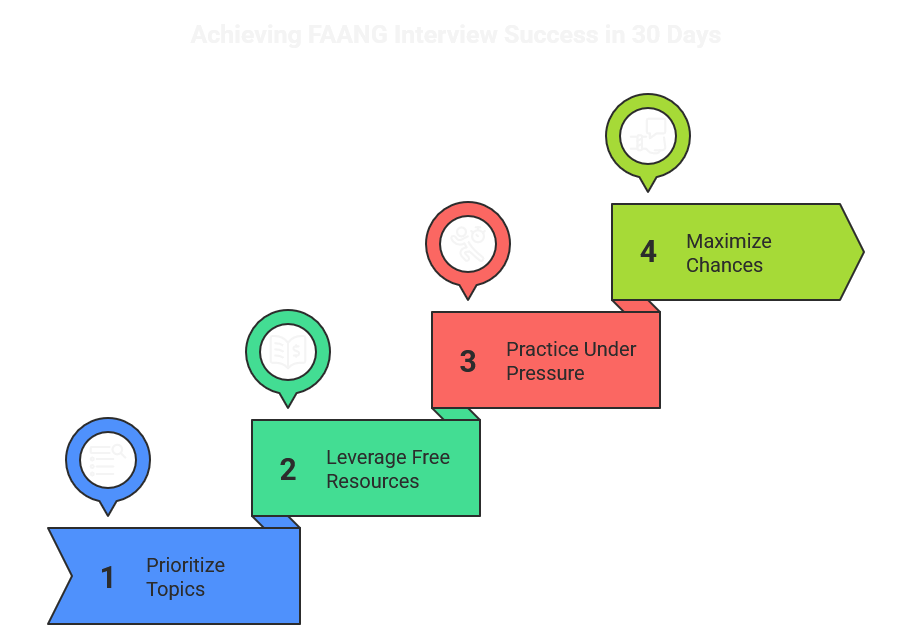
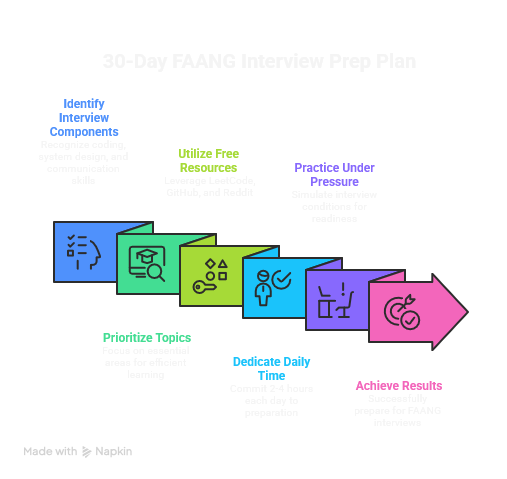
FAANG interviews are intense, testing your coding prowess, system design skills, and ability to articulate experiences. A 2024 Glassdoor study revealed that 75% of FAANG candidates spend 1–3 months preparing, but with focus, a 30-day FAANG interview prep plan can be effective. Why? It forces prioritization, leverages free FAANG interview preparation guides, and aligns with the fast-paced nature of tech hiring. By dedicating 2–4 hours daily, you can cover essential topics and practice under pressure, mimicking real interview conditions.
This fast-track FAANG interview preparation guide is designed for both beginners and experienced candidates. It uses free resources like LeetCode, GitHub, and Reddit to keep costs at zero while delivering results.
Key Components of a 30-Day FAANG Interview Study Plan
A successful 30-day FAANG interview study plan balances three pillars: coding, system design, and behavioral interviews. Here’s how to approach each.
Coding: Data Structures and Algorithms
FAANG coding interviews focus on data structures and algorithms 30-day plan topics like arrays, strings, trees, graphs, and dynamic programming. A 2025 LeetCode report noted that 80% of FAANG coding questions test these areas.
- Key Topics: Arrays, Linked Lists, Binary Trees, Graphs, Dynamic Programming, Sorting, and Searching.
- Strategy: Solve 3–5 problems daily, starting with easy and progressing to medium/hard.
- Resources: LeetCode (free tier), HackerRank, and TheAlgorithms/Python on GitHub.
Example: Maya, a recent grad, solved 100 LeetCode problems in 30 days, focusing on medium-difficulty array and tree questions. She passed Amazon’s coding round by mastering two-pointer techniques.
System Design: Building Scalable Systems
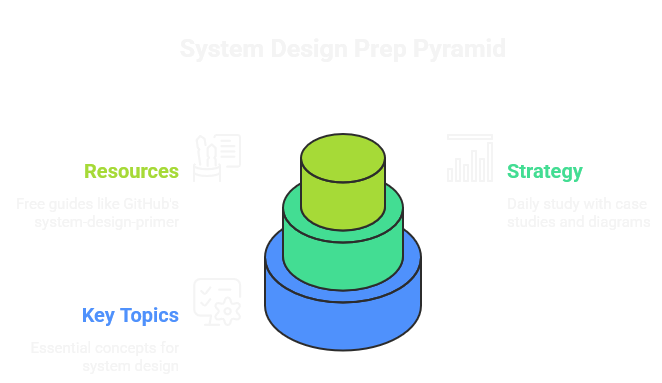
System design interview crash course prep is crucial for senior roles or FAANG companies like Google and Amazon. These interviews test your ability to design scalable systems like a URL shortener or a messaging app.
- Key Topics: Load Balancing, Caching, Database Design, API Design, Scalability, and Fault Tolerance.
- Strategy: Study one system design concept daily, using case studies and diagrams.
- Resources: GitHub’s system-design-primer and Grok’s system design guides (free on xAI’s blog).
Behavioral Interviews: Telling Your Story
Behavioral interview prep for FAANG focuses on leadership principles and past experiences. Amazon’s 16 Leadership Principles, for example, are a common framework.
- Key Topics: Teamwork, Conflict Resolution, Failure, and Ownership.
- Strategy: Practice the STAR method (Situation, Task, Action, Result) with 10–15 stories.
- Resources: Reddit’s r/cscareerquestions and free STAR method templates on GitHub.
Case Study: Raj, a mid-level engineer, prepared 12 STAR stories using r/cscareerquestions threads. His clear, concise answers impressed Google interviewers, securing a senior role.
Week-by-Week FAANG Interview Prep Timeline
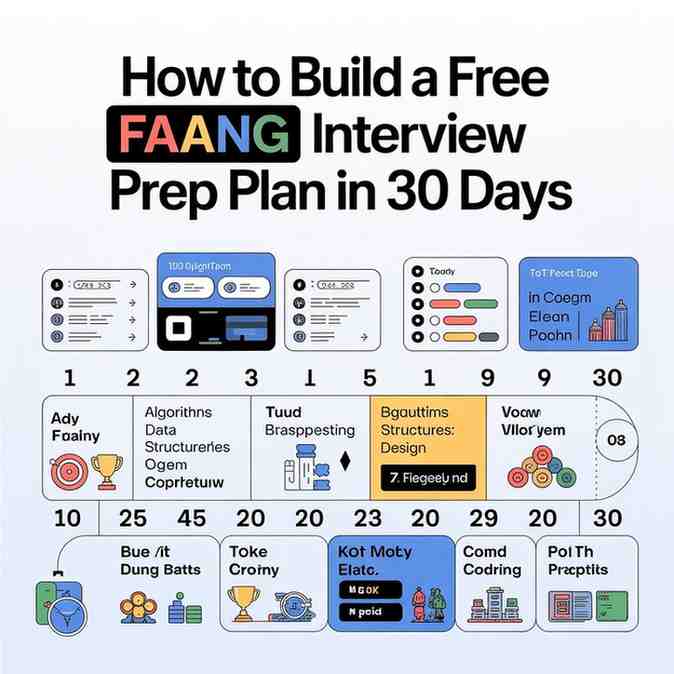
Here’s a FAANG interview prep timeline broken into four weeks, with daily tasks to keep you on track.
Week 1: Foundation and Assessment
- Goal: Build a baseline and identify weaknesses.
- Tasks:
- Take a diagnostic test on LeetCode or HackerRank to assess coding skills.
- Review FAANG-specific topics (e.g., Amazon’s Leadership Principles).
- Create a daily FAANG interview prep checklist (see below).
- Resources: LeetCode’s free tier, r/leetcode’s “FAANG Prep Guide” thread (2025, 4,000 upvotes).
- Time: 2 hours daily (1 hour coding, 30 minutes behavioral, 30 minutes planning).
Week 2: Deep Dive into Coding
- Goal: Master data structures and algorithms 30-day plan.
- Tasks:
- Solve 3–4 LeetCode problems daily (easy to medium).
- Focus on arrays, strings, and linked lists.
- Review solutions on r/leetcode or yangshun/tech-interview-handbook (GitHub).
- Resources: TheAlgorithms/Python, NeetCode YouTube tutorials.
- Time: 3 hours daily (2 hours coding, 1 hour review).
Week 3: System Design and Behavioral Prep
- Goal: Tackle system design interview crash course and behavioral interview prep for FAANG.
- Tasks:
- Study one system design topic daily (e.g., caching, database sharding).
- Practice 2–3 STAR stories for behavioral questions.
- Join a Reddit mock interview thread on r/cscareerquestions.
- Resources: donnermartin/system-design-primer, r/cscareerquestions’ “Behavioral Megathread” (2025, 3,500 upvotes).
- Time: 3 hours daily (1.5 hours system design, 1 hour behavioral, 30 minutes review).
Week 4: Mock Interviews and Refinement
- Goal: Simulate real interviews and polish skills.
- Tasks:
- Complete 3–5 mock interviews via Pramp or Discord groups.
- Solve 2–3 hard LeetCode problems daily.
- Revise weak areas identified in mock interviews.
- Resources: Pramp’s open-source tool, r/leetcode’s “Mock Interview Mondays.”
- Time: 4 hours daily (2 hours mock interviews, 1.5 hours coding, 30 minutes review).
Real-World Example: Priya, a working professional, followed this timeline, dedicating evenings to prep. She used LeetCode and Pramp, passing Meta’s interview after 30 days of focused study.
Daily FAANG Interview Prep Checklist
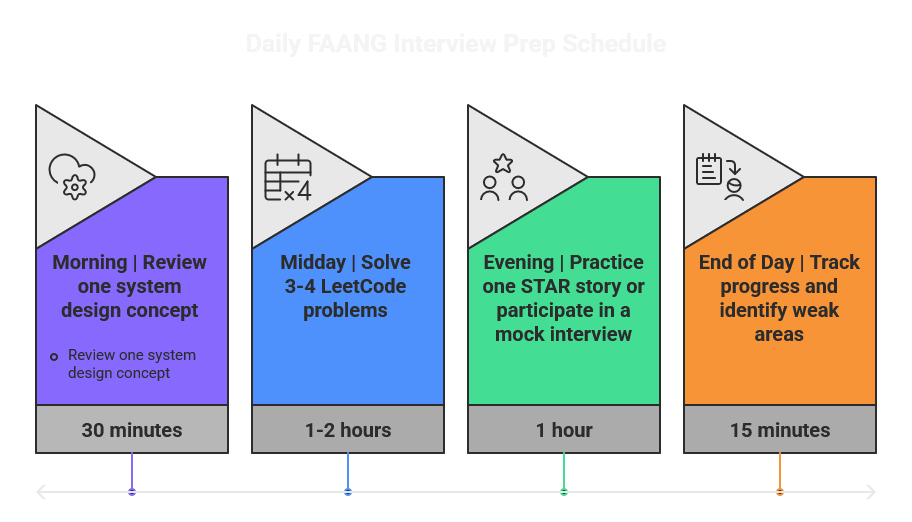
A daily FAANG interview prep checklist keeps you organized. Here’s a sample:
- Morning (30 minutes): Review one system design concept (e.g., load balancing).
- Midday (1–2 hours): Solve 3–4 LeetCode problems (e.g., medium array questions).
- Evening (1 hour): Practice one STAR story or join a Reddit mock interview thread.
- End of Day (15 minutes): Track progress in a spreadsheet, noting solved problems and weak areas.
Tip: Use Google Sheets or Notion for a free, customizable FAANG coding interview planner.
Free Resources for a One-Month FAANG Interview Roadmap
Leverage these free FAANG interview preparation guides to build your plan:
- LeetCode (Free Tier): 1,000+ problems, with company-tagged questions for FAANG.
- HackerRank: Free coding challenges and mock assessments.
- GitHub Repos:
- yangshun/tech-interview-handbook (120,000 stars): Covers coding, system design, and behavioral prep.
- donnermartin/system-design-primer (220,000 stars): System design case studies.
- jwasham/coding-interview-university (250,000 stars): 6-month plan adaptable for 30 days.
- Reddit Communities:
- r/cscareerquestions (1.2 million members): Threads like “FAANG Prep in 30 Days” (2025, 5,000 upvotes).
- r/leetcode: Problem-solving tips and mock interview threads.
- YouTube Channels: NeetCode, Tech With Tim, and freeCodeCamp for algorithm tutorials.
Data Point: A 2025 HackerRank survey found 60% of FAANG candidates used free resources like LeetCode and Reddit for at least 50% of their prep.
FAQs: 30-Day FAANG Interview Prep Plan
What Should My Daily Schedule Look Like for a 30-Day FAANG Interview Prep?
Follow the daily FAANG interview prep checklist above: 30 minutes system design, 1–2 hours coding, 1 hour behavioral, and 15 minutes tracking. Adjust based on your strengths and weaknesses.
How Do I Split My Time Between Coding, System Design, and Behavioral Questions?
- Coding: 50% (2 hours daily), focusing on algorithms and data structures.
- System Design: 25% (1 hour daily), critical for senior roles.
- Behavioral: 25% (1 hour daily), using STAR stories.
Are There Free Online Platforms Offering Structured 30-Day FAANG Prep Plans?
Yes, jwasham/coding-interview-university on GitHub offers a condensed 30-day plan, and r/leetcode’s “FAANG Prep Guide” thread includes daily schedules.
What Mistakes Should I Avoid When Preparing for FAANG Interviews in One Month?
- Skipping system design (critical for FAANG).
- Ignoring behavioral prep (30% of interview weight, per 2024 Amazon data).
- Not practicing under time constraints.
- Overloading with too many resources—stick to 2–3 trusted ones.
Can a 30-Day FAANG Interview Timeline Work for Working Professionals?
Yes, with 2–4 hours daily. Priya’s example (above) shows evenings and weekends can suffice. Use tools like Pramp for flexible mock interviews.
Can I Get FAANG-Ready in Just 30 Days Using Free Resources?
Yes, but it requires discipline. A 2024 CodeSubmit study found 20% of FAANG hires prepared in under 6 weeks using free resources like LeetCode and GitHub.
Should I Focus More on Coding or System Design in a Short FAANG Prep Plan?
For junior roles, prioritize coding (70% of focus). For senior roles, balance coding (50%) and system design (30%), with 20% for behavioral prep.
Is a One-Month FAANG Interview Prep Plan Effective for Beginners?
It’s challenging but possible. Beginners should focus on easy/medium coding problems and basic system design concepts, using structured resources like jwasham’s repo.
Are There Any Proven 30-Day FAANG Interview Study Planners?
Yes, jwasham/coding-interview-university and r/leetcode’s “30-Day FAANG Challenge” thread are community-vetted and widely used.
Tips to Avoid Common Mistakes in FAANG Prep
- Don’t Skip Mock Interviews: Practice with Pramp or Discord groups to simulate real conditions.
- Focus on Quality Over Quantity: Solve 100 high-quality problems rather than 300 random ones.
- Track Progress: Use spreadsheets to monitor weak areas and improvements.
- Balance All Components: Don’t neglect system design or behavioral prep, as they’re 30–40% of FAANG interviews, per 2025 Glassdoor data.
- Stay Consistent: Stick to the one-month FAANG interview roadmap, even on busy days.
Conclusion: Your Path to FAANG Success
A 30-day FAANG interview prep plan is your ticket to cracking those high-stakes interviews without spending a penny. By following this FAANG interview prep timeline, leveraging free FAANG interview preparation guides, and using a daily FAANG interview prep checklist, you can master coding, system design, and behavioral questions in just one month. Resources like LeetCode, GitHub’s system-design-primer, and r/cscareerquestions provide everything you need to succeed.
Start today: pick 2–3 trusted resources, follow the week-by-week plan, and practice consistently. With discipline, this fast-track FAANG interview preparation strategy will get you FAANG-ready and one step closer to your dream tech job.