





Table of Contents
How I Cracked the Google Interview Using Only Free Tools (12-Week Plan)
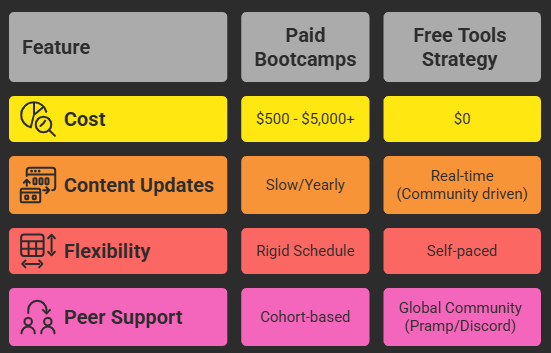
Landing a role at a tech giant like Google is the ultimate goal for many software engineers. However, a dangerous myth persists in the industry: the idea that you need to spend thousands of dollars on premium bootcamps or exclusive courses to pass the interview.
The reality? You don’t.
With the right discipline and a strategic roadmap, Google interview preparation using free tools is not only possible—it is often more effective. By leveraging community-driven resources, you can access up-to-date questions and diverse problem-solving techniques that static paid courses often miss. This guide breaks down the exact 12-week roadmap and “free stack” of tools you need to go from preparation to offer letter, without spending a dime.
Why Free Resources Are Often Better
Paid courses sell structure, not secrets. The actual knowledge required to pass—Data Structures, Algorithms (DSA), and System Design—is freely available and often better explained by passionate community creators.
- Real-World Pace: Free communities like LeetCode Discuss move faster than paid curriculum updates.
- Diversity of Thought: YouTube creators often provide multiple ways to solve a single problem, giving you a broader toolkit.
- Zero Financial Risk: You can restart or pivot your study plan without feeling “locked in” by a sunk cost.
The Essential "Free Stack" Toolkit
Before you start your timeline, you need to assemble your arsenal. These are the top-rated free alternatives to premium services.
1. Coding Practice: LeetCode (Free Tier)
Don’t let the “Premium” button scare you. The free version of LeetCode is the industry standard.
- What to use it for: Daily coding drills.
- Pro Tip: Filter problems by the “Google” tag on community lists or Reddit threads to find relevant questions without paying for the official filter.
2. Deep Explanations: NeetCode & freeCodeCamp
When you get stuck on a LeetCode problem, don’t just read the solution—watch it being built.
- NeetCode (YouTube): His visual drawing style simplifies complex dynamic programming concepts into understandable logic.
- freeCodeCamp: Offers massive 10+ hour courses on every programming language and data structure imaginable.
3. System Design: System Design Prime
For mid-level and senior roles, coding isn’t enough. You must understand architecture.
- Resource: The “System Design Prime” repository on GitHub and “Back To Back SWE” on YouTube.
- Method: Watch a video on “How to Design YouTube,” then try to draw the architecture yourself on a piece of paper.
4. Mock Interviews: Pramp
Coding in silence is easy; coding while explaining your thought process is hard.
- The Tool: Pramp (Practice Makes Perfect) connects you with peers for free mock interviews. You interview them, and they interview you.
- Benefit: You gain empathy for the interviewer’s perspective, which helps you understand what they are looking for in your own answers.
5. Behavioral Prep: Google Interview Warmup
Never underestimate the “Googleyness” factor.
- The Tool: Google’s own “Interview Warmup” tool uses AI to transcribe and analyze your answers, helping you refine your stories using the STAR method (Situation, Task, Action, Result).
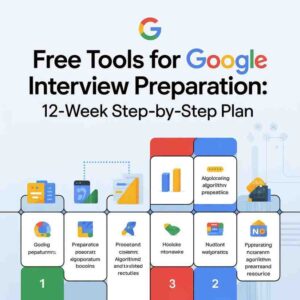
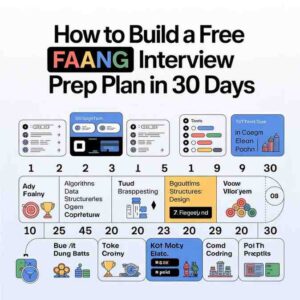
A Strategic 12-Week Study Roadmap
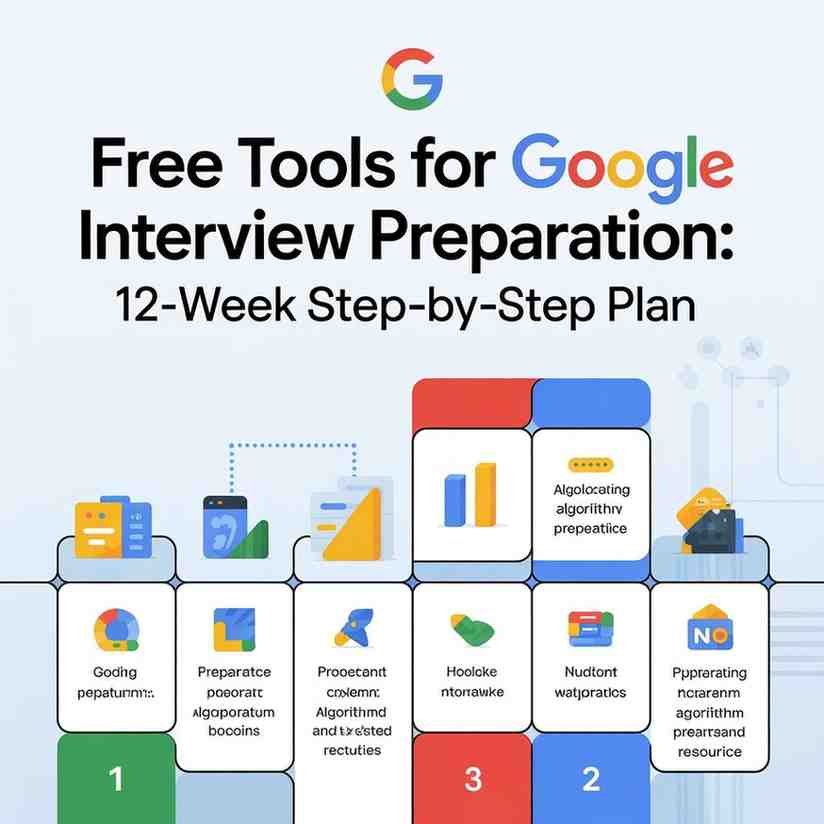
Consistency beats intensity. Attempting to cram in two weeks will lead to burnout. Instead, follow this phased Google interview preparation using free tools plan.
Phase 1: The Foundation (Weeks 1-4)
Goal: Master the syntax and mastering core data structures.
- Focus: Arrays, Strings, Linked Lists, and Hash Maps.
- Daily Task: Watch 1 hour of concept videos and solve 2 “Easy” LeetCode problems.
- Milestone: You should be able to implement a Hash Map or reverse a Linked List without looking up syntax.
Phase 2: The Deep Dive (Weeks 5-8)
Goal: Pattern recognition for complex algorithms.
- Focus: Trees, Graphs, Recursion, and Dynamic Programming.
- Daily Task: Shift to “Medium” difficulty problems. If you are stuck for 20 minutes, watch a NeetCode solution, understand the logic, and write the code yourself.
- Milestone: Complete the “NeetCode 150” list.
Phase 3: The Polish (Weeks 9-12)
Goal: Speed, communication, and system design.
- Focus: Mock interviews and high-level architecture.
- Daily Task: One Pramp mock interview every other day. On off days, practice System Design questions on a whiteboard.
- Milestone: Successfully explaining a “Hard” problem solution to a peer clearly.
Comparison of Prep Methods
Common Mistakes That Kill Chances
- Memorizing Code: Interviewers will tweak the question. If you memorized the solution, you will fail. Learn the pattern, not the code.
- Silent Coding: If you code the optimal solution but don’t say a word, you might fail. Narration is key.
- Ignoring Soft Skills: Google hires people they want to work with. Be humble, receptive to hints, and collaborative.
Conclusion
You do not need a $5,000 bootcamp to get a $150,000 job. By strictly following this plan for Google interview preparation using free tools, you are proving that you have the grit, resourcefulness, and discipline required to succeed in Big Tech.
The resources are there, waiting for you. The only cost is your time and effort. Are you ready to start?
Frequently Asked Questions (FAQs)
Can I really get into Google with just free tools?
Absolutely. Thousands of engineers do it every year. The technical bar is objective; interviewers care about your code and communication, not how much you paid to learn it.
How many LeetCode problems should I solve?
Quality over quantity. Solving 150 problems while fully understanding the patterns is better than solving 500 by memorizing them.
Is System Design required for fresh graduates?
Usually, no. Entry-level (L3) interviews focus heavily on coding. However, knowing basic concepts (like how a URL works) is a great differentiator.
What is the best programming language for Google interviews?
Python is widely recommended because it is concise and reads like pseudocode, saving you time on the whiteboard. Java and C++ are also standard.
How do I schedule mock interviews for free?
Platforms like Pramp allow you to schedule peer-to-peer interviews for free. You earn credits by interviewing others, which you spend to be interviewed yourself.