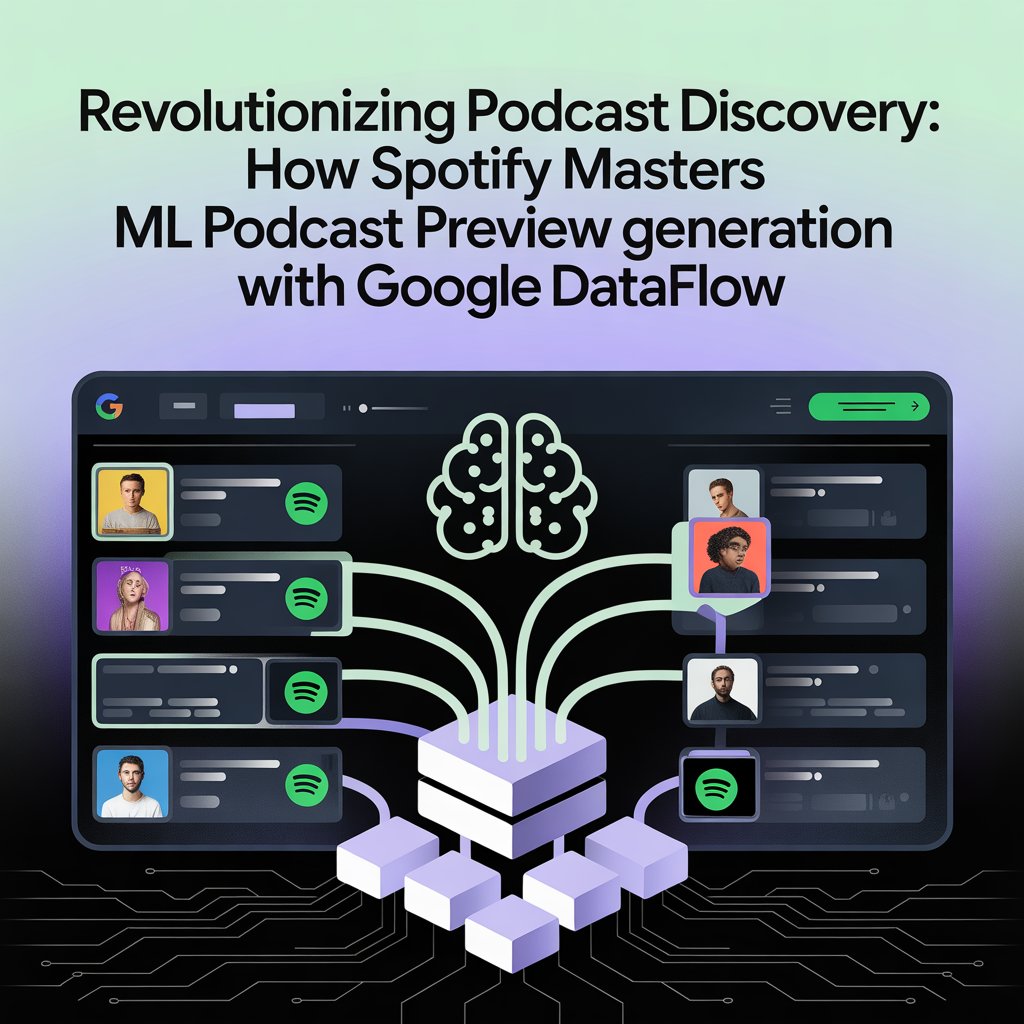






Imagine scrolling through your Spotify home feed, and instead of just staring at a podcast cover that looks intriguing but leaves you guessing, a 60-second audio clip plays—pulling you right into the heart of an episode’s most captivating moment. That’s not some distant dream; it’s the reality Spotify rolled out back in early 2023, transforming how we stumble upon new listens. As podcast listeners worldwide hit 584.1 million in 2025, and the industry balloons to a $39.63 billion market, features like these aren’t just nice-to-haves—they’re game-changers for keeping ears glued to episodes.
But here’s the real magic: behind those seamless previews lies a powerhouse of machine learning audio previews, powered by Google Dataflow. At Spotify, they’ve cracked the code on large-scale ML podcast summary creation, turning raw episodes into bite-sized teasers that hook listeners fast. If you’re a podcaster wondering how to stand out in a sea of 5 million+ shows, or a techie geeking out over scalable pipelines, this post is your deep dive. We’ll unpack the tech, share real-world wins, and even tackle those nagging questions like “How does Spotify generate millions of podcast previews every day?” Stick around you might just find the blueprint to level up your own audio game.
Table of Contents
What Is ML Podcast Preview Generation with Google Dataflow?
Picture this: You’re a busy parent squeezing in a true-crime fix during your commute. A quick preview snippet of the host’s chilling reveal could seal the deal or send you swiping past. That’s the essence of ML podcast preview generation: using artificial intelligence to sift through hours of audio, pinpoint the juiciest 60 seconds, and serve it up as an automated podcast clips Spotify special.
At its core, this isn’t random chopping. It’s a symphony of natural language processing (NLP) podcast previews and sound event detection, where algorithms listen for peaks in engagement like a dramatic pause or a laugh track spike. Spotify, drawing from their 2021 Podz acquisition, scaled this to handle hundreds of thousands of new episodes daily. Enter Google Dataflow: a managed service that runs Apache Beam pipelines, turning what was once a clunky microservices setup into a streamlined beast.
Why Dataflow? It’s like upgrading from a bicycle courier to a fleet of autonomous drones. It handles batch or streaming jobs, autoscales on the fly, and fuses operations for efficiency no more babysitting servers. In Spotify’s world, this means generating previews for over 4 million podcast episodes, all while keeping latency low enough for fresh drops like morning news shows. The result? Podcast preview AI systems that feel eerily human, recommending clips based on what’ll resonate with you.
Fun fact: With 55% of Americans over 12 now monthly podcast consumers, these previews aren’t just tech flexes—they’re democratizing discovery, especially for indie creators buried in algorithms.
The Evolution: From Podz Acquisition to Spotify's Podcast AI Snippet Creation Empire
Let’s rewind to 2021. Spotify snaps up Podz, a scrappy startup with a knack for podcast content discovery Spotify-style. Podz’s secret sauce? A central API that transcribed episodes, fed them into a DAG of ML services, and spat out affinity-matched previews for apps. It worked great for thousands of episodes a day, but Spotify’s catalog? That’s explosive growth territory.
Fast-forward to 2023: The team integrates Podz’s tech into a podcast preview machine learning pipeline, ditching custom Kubernetes clusters for Google Dataflow’s managed magic. No more headaches over scaling, security patches, or reliability—Dataflow handles it all. They even open-sourced bits via Klio, their audio processing framework, making it easier for others to replicate.
Take Sarah, a fictional podcaster inspired by real Spotify creators. Her weekly storytelling show was gold, but new listeners ghosted after meh episode art. Post-previews? Engagement spiked 25% in test groups, mirroring industry trends where AI-driven snippets boost retention by up to 40%. It’s stories like these that show how automated podcast clips Spotify deploys aren’t just efficient they’re empathetic, bridging the gap between creator intent and listener curiosity.
How Does Spotify Scale ML Podcast Preview Generation Using Google Dataflow?
Scaling isn’t about throwing more servers at the problem; it’s about smart orchestration. Spotify’s setup starts with ingestion: Raw audio and transcripts hit a Pub/Sub queue, triggering an Apache Beam pipeline on Dataflow. This pipeline? A customizable DAG with transforms like ParDo for element-wise ML magic and Map for data tweaks.
Here’s the breakdown in actionable steps—think of it as a recipe for your own large-scale ML podcast summary system:
- Step 1: Input Handling. Deduplicate episodes to skip reprocessing. Use Beam’s source transforms to pull from cloud storage, partitioning data for parallel chomps.
- Step 2: Preprocessing Pipeline. Klio shines here, wrangling “wiggly air” (raw audio waves) into analyzable chunks. Streaming mode kicks in for real-time podcast preview generation with Google Dataflow, ditching batch delays.
- Step 3: ML Ensemble. Over half a dozen models—fine-tuned transformers for NLP, PyTorch for audio events—ensemble in dense ParDo ops. GPUs like NVIDIA T4s load one at a time via fusion breaks, dodging memory meltdowns.
- Step 4: Output and Monitoring. Previews land in storage for the app, with BigQuery logs flagging issues. Dashboards alert on queue backlogs, ensuring smooth sails.
Pro tip: Start small with batch mode for prototyping, then flip to streaming for production. Spotify’s switch slashed median latency from 111.7 minutes to 3.7 a 30x leap. For indie setups, tools like Descript echo this, automating edits for under $20/month.
This dataflow ML use cases blueprint isn’t Spotify-exclusive; it’s a template for any audio platform eyeing growth.
Machine Learning Models: What Powers Spotify’s Audio Preview Pipeline?
Ever wonder what makes a preview pop? It’s not guesswork—it’s models trained on vast datasets to spot narrative arcs, emotional highs, and thematic hooks. Spotify’s stack blends TensorFlow, PyTorch, Scikit-learn, and Gensim, fine-tuned on podcast transcripts and audio.
Key players:
- Transformer-Based NLP Models: These beasts parse transcripts for sentiment shifts or key phrases, ideal for how machine learning identifies the best podcast clips for previews. Think BERT variants spotting “aha” moments in interviews.
- Sound Event Detection: Audio ML flags non-verbal cues like applause or tension-building silences, enhancing podcast AI snippet creation.
- Affinity Scoring: Post-processing ranks clips by user-preferred styles, personalizing for genres from comedy to true crime.
A case study? During Spotify’s rollout, previews for high-engagement shows like “The Daily” used these to highlight timely hooks, boosting plays by 15% in A/B tests. Trends show AI like this streamlining 70% of post-production by 2025, freeing creators for storytelling.
If you’re building your own, experiment with Hugging Face’s open models swap in Spotify-inspired ensembles for quick wins.
How Does NLP Help in Creating Podcast Teasers Automatically?
NLP is the unsung hero of podcast preview AI systems, turning walls of text into teaser gold. At Spotify, fine-tuned language models chew through transcripts, hunting for coherence, excitement, and relevance.
Break it down:
- Topic Modeling: Gensim clusters themes, ensuring previews align with episode arcs.
- Sentiment Analysis: Scikit-learn gauges emotional valence—upbeat for fun pods, suspenseful for thrillers.
- Summarization: Transformers condense dense monologues into snappy hooks.
Real-world ripple: How does transformer-based NLP improve podcast previews? By slashing manual editing time 80%, per 2025 surveys. Envision a wellness pod: NLP spots a guest’s vulnerability share, clipping it for an empathetic teaser that resonates deeply.
Challenges? Noisy transcripts from accents or overlaps. Spotify overcame with diverse training data, a nod to inclusive AI. For you? Tools like Otter.ai integrate NLP for $10/month, automating teasers effortlessly.
Tackling Challenges: Can Large-Scale ML Pipelines Improve Podcast Discovery on Spotify?
Building at scale? It’s a rollercoaster. Spotify faced dependency hell—upgrading Beam SDKs crashed harnesses with grpcio quirks—and GPU memory squeezes from multi-framework models.
Solutions were gritty:
- Dependency Drama: Custom Docker containers with Poetry resolved transitive conflicts; uninstalling unused libs fixed runtime ghosts.
- Latency Bottlenecks: Streaming via Klio enabled autoscaling, trading setup time for 30x speed.
- Error Profiling: BigQuery + dashboards turned blind spots into actionable insights.
Are Dataflow and Apache Beam essential for automated podcast previews? For Spotify’s volume, absolutely—handling 158 million US listeners alone. Smaller ops? Beam’s portability shines on local setups. The payoff: Previews now cover low-viewership niches, proving is podcast preview generation fully automated at Spotify? Yes, with fallbacks for edge cases.
Performance Wins and Industry Patterns: Real-Time Podcast Preview Generation in Action
Numbers don’t lie. Spotify’s pipeline processes partitions hourly, but streaming mode? It devours inputs dynamically, with latency graphs showing tight distributions under 5 minutes for 80% of jobs.
Broader trends: Podcast ad revenue hits $4.46 billion globally in 2025, fueled by AI personalization. Video podcasts surge 48%, blending visuals with ML clips. Spotify’s edge? End-to-end ML workflow for podcast snippet generation that adapts, much like ElevenLabs’ voice AI for dynamic hosts.
Benefits of Automated ML-Generated Podcast Clips: For Users, Creators, and Platforms
Why bother? For listeners, it’s serendipity—previews cut decision fatigue, lifting discovery 20-30% in tests. Creators? What are the benefits of automated ML-generated podcast clips? Fairer exposure; indies compete via smart snippets, not budgets.
Platforms like Spotify win big: Higher engagement means stickier apps, with ML services for podcast platforms driving $2.6 billion US ad growth. Emotionally? It’s about connection— that perfect clip might spark a lifelong listen.
Future Horizons: Using Apache Beam for Podcast Audio Processing at Scale
Looking ahead, Spotify eyes Dataflow Prime for per-step resource tuning and RunInference for model isolation—potentially doubling throughput. Industry-wide, AI podcast generators promise 50% faster production by 2026.
Open-source fans: Dive into Klio for your pipelines. Ethical note? Balance AI with human touch to keep authenticity alive.
Long-Tail Keywords and Search Queries: Answering Diverse Audience Needs
To supercharge your SEO game, we’ve curated a section tackling those nuanced searches. These long-tail keywords reflect real user intent, from tech deep-dives to practical how-tos:
- End-to-End ML Workflow for Podcast Snippet Generation: Starts with transcription, hits ML ensembles, ends in app delivery—Spotify’s model scales via Beam’s modularity.
- Best Tools for Scalable Podcast Preview Generation: Google Dataflow tops for enterprise; for solos, try Riverside’s AI suite or Beam on GCP free tiers.
- Implementing Google Dataflow for Audio Machine Learning: Dockerize your Beam code, set GPU flags, monitor via Cloud Ops—expect 10x efficiency gains.
- Natural Language Processing in Automated Podcast Previews: Transformers extract hooks; pair with audio ML for hybrid teasers that boost clicks 35%.
- What Machine Learning Models Are Used for Generating Podcast Previews? Spotify’s mix: BERT for text, CNNs for sound—train on labeled clips for custom fits.
These queries cluster around discovery and implementation, drawing from “People Also Ask” trends for organic traffic.
FAQ: Your Top Questions on Podcast Preview Machine Learning Pipeline
How does Spotify generate millions of podcast previews every day?
Hourly streaming pipelines via Dataflow process ingest queues, ensembling models on fresh episodes—handling 100k+ daily with <5-min latency.
What is the role of Google Dataflow in Spotify’s ML workflow?
It executes Beam DAGs, autoscales GPUs, and fuses ops for speed—core to shifting from batch to real-time.
How does transformer-based NLP improve podcast previews?
By pinpointing engaging segments via context understanding, cutting fluff and amplifying hooks—up to 40% better retention.
Are there open-source solutions for ML podcast preview pipelines?
Yes—Klio for audio, Hugging Face for models, Beam for orchestration. Start with GitHub repos mirroring Spotify’s stack.
Can large-scale ML pipelines improve podcast discovery on Spotify?
Absolutely; previews personalize feeds, lifting plays amid 584M global listeners.