






Why Did Your Best Post Fail?
You hit “Post.” Your text is sharp, the insight is fresh, and you’ve spent forty minutes refining your message. You check back an hour later to find only 12 likes. Meanwhile, a three-sentence “hustle” quote from a stranger is trending with 15,000 impressions.
The culprit isn’t your quality; it’s your alignment. Understanding the LinkedIn feed algorithm 2026 is now a mechanical necessity for professional reach. This system has evolved into a sophisticated, multi-layered AI ecosystem that prioritizes deep professional utility over raw, surface-level engagement.
In 2026, the question isn’t just “What did I write?” but “How did the machine interpret me?” To move the needle, you have to stop posting for people and start architecting for the system. Here is the deep-dive into how the LinkedIn feed algorithm actually ranks your professional life.
If you want to move the needle, you have to stop posting for people and start architecting for the system. Here is the deep-dive into how the 2026 algorithm actually ranks your professional life.
Table of Contents
The Multi-Stage Ranking Pipeline
LinkedIn doesn’t decide what you see in one go. It uses a cascading pipeline designed to filter billions of potential posts into the 20 or 30 that make it onto your glass screen. This architecture is modeled after “Two-Tower” recommendation systems used by giants like Netflix and Uber.
The Breakdown:
- Candidate Generation: The “Matchmaker” phase. The system pulls a pool of ~1,000 potential posts based on who you follow, what your connections liked, and trending topics in your industry.
- Scoring (The ML Heavy Lifter): Here, a deep learning model predicts the probability of you taking an action. It doesn’t just ask “Will they like this?” It asks, “Will they spend 30 seconds reading this?” and “Will they write a 5-word reply?”
- Re-ranking & Diversification: The final polish. LinkedIn ensures your feed isn’t 100% video or 100% “Looking for work” posts. It injects variety to keep you from “scrolling fatigue.”
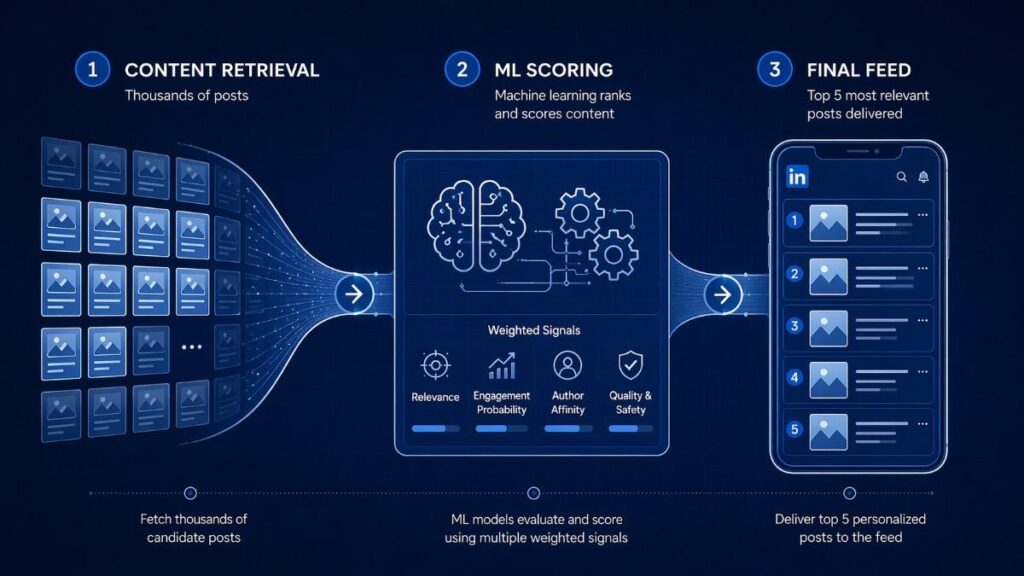
Example: Imagine you are a Project Manager. Candidate generation pulls a post from a former colleague and a viral post about PMP certification. The Scoring model notices you’ve been reading a lot about Agile lately. It boosts the PMP post higher because it predicts a 0.85 probability of engagement versus 0.40 for the colleague’s vacation photo.
The Identity Graph Behind LinkedIn
At the heart of the LinkedIn feed algorithm is the Identity Graph. It doesn’t care that your headline says “Marketing Manager” if your behavior says “AI Enthusiast.” It builds a dynamic, multi-dimensional map of your professional persona based on your Skills, Latent Interests, and Interaction Clusters.
Why it matters?
Think of the Identity Graph as a massive, 3D web of professional entities. This system uses Semantic Proximity to measure how closely a piece of content aligns with the creator’s established niche. If you are a Data Scientist, your “node” in this graph is mathematically anchored to clusters like “Python,” “Machine Learning,” and “Neural Networks.”
When you post about these topics, the system recognizes a high “Authority Score” and fast-tracks your content. However, if you suddenly share a recipe for sourdough bread, the algorithm detects a Graph Mismatch. Because your “node” is too far from the “Culinary” cluster, the system struggles to categorize the post and limits its reach to avoid polluting the feeds of your professional network.
Example: The “Authority Validation” Filter
Imagine two people post the exact same 500-word deep dive on “System Design Bottlenecks.”
Person A (Software Engineer): Their Identity Graph shows years of engaging with GitHub links, tech whitepapers, and Stack Overflow discussions. The algorithm validates their authority and pushes the post to a high-intent audience of developers.
Person B (Executive Chef): Despite the quality of the post, their graph is anchored to “Hospitality” and “Supply Chain.” The algorithm hesitates, assigning a lower Semantic Relevance score. The reach is restricted because the system predicts the chef’s primary network will find the content irrelevant to their shared professional context.
The Knowledge Graph Research
This isn’t just a theory; it is grounded in Knowledge Graph Embedding research. LinkedIn uses these technologies to predict the “affinity” between a user, a topic, and an audience. By converting professional attributes into high-dimensional vectors, the system can calculate exactly how much “trust” to give a specific user on a specific topic.
According to research into large-scale social recommendation engines, these systems utilize entity-linkage to ensure that information is distributed based on topical expertise rather than just network size.
LinkedIn’s engineering team has documented the shift toward using Knowledge Graphs to power professional relevance. Their work on “LiGrap” (LinkedIn’s Knowledge Graph) explains how the platform represents “entities” (people, skills, companies) and their relationships to improve feed ranking and search.
Deep Engagement vs. Surface Noise: What Really Drives Reach
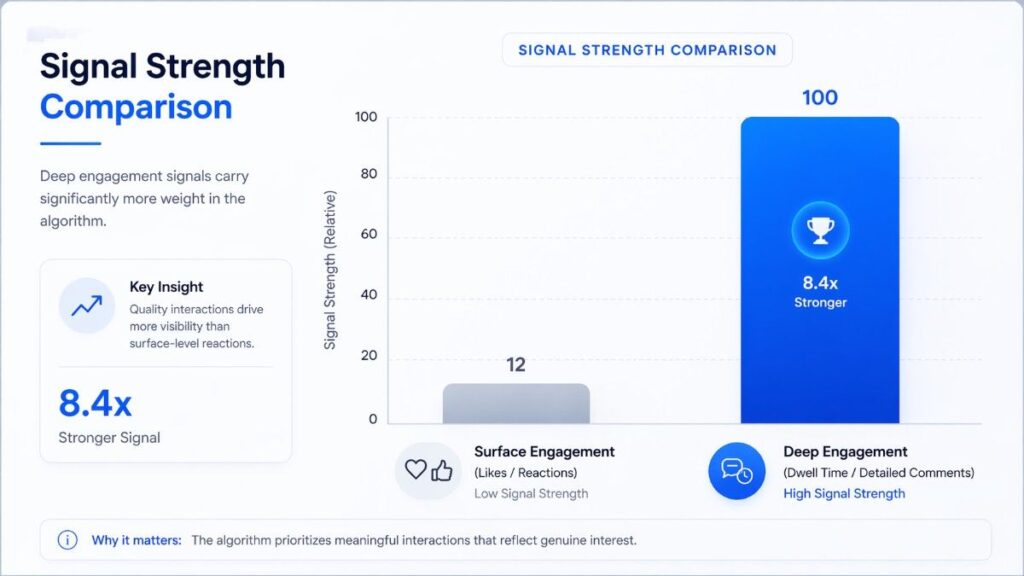
The “Like” button is dying. In 2026, the algorithm is obsessed with Dwell Time and Contribution Quality. LinkedIn’s Natural Language Processing (NLP) models now categorize comments. A “Great post!” or a “Thanks for sharing!” is treated as low-value noise. However, a comment that uses industry-specific keywords and sparks a back-and-forth thread tells the algorithm: “This post is a hub of professional discourse.”
The “Dwell Time” Factor:
If someone stops scrolling to read your long-form post for 45 seconds, that signals higher quality than 10 people “Liking” it while scrolling at full speed. This is why structured, educational content—like the frameworks taught in PMP Exam Simulators—tends to perform better; it requires “System 2” thinking from the reader.
AI-Driven Content Understanding: The End of Keywords
Gone are the days of “keyword stuffing” or trying to trick the system by tagging twenty unrelated influencers. In 2026, the LinkedIn feed algorithm 2026 doesn’t just read your text; it interprets it. The platform has fully integrated Transformer-based models (the same underlying architecture as GPT-4 and Gemini) to perform deep Semantic Analysis.
The algorithm no longer looks for the word “Management” repeated five times. Instead, it converts your entire post into a mathematical vector in a high-dimensional space. If the “coordinates” of your post align with high-quality educational content, you are amplified. If they align with “low-information density” or “engagement bait,” you are throttled.
The AI now classifies every post into specific intent buckets:
Professional Growth: Actionable frameworks, “how-to” tutorials, and career pivot strategies.
Industry News: Analysis of recent trends, regulatory updates, and market shifts.
Opinion/Thought Leadership: Contrarian viewpoints and deep-dives that provide a unique perspective on a saturated topic.
How Distribution Loops Decide Your Post’s Survival?
The LinkedIn feed algorithm has moved away from “batch” publishing. Your content no longer “goes live” to your entire network at once. Instead, it is subjected to a series of high-stakes Distribution Loops—a “test and expand” method that acts as an automated quality-control filter.
Survival of the Fittest:
The algorithm treats your post like a pilot episode of a TV show. If the “pilot” doesn’t perform with a small group, the rest of the season is canceled.
Loop 1: The Seed Round (The Vibe Check): Within the first few minutes, your post is shown to a “Seed Group”—a tiny, high-affinity segment of your followers who are most likely to engage. The algorithm is measuring initial velocity.
Loop 2: The Velocity Test (The 60-Minute Window): If the seed group provides strong signals (dwell time and meaningful comments) within the first hour, the loop expands. Your post is now “promoted” to your 2nd-degree network (friends of friends).
Loop 3: The Global Recommendation (Viral Discovery): If the 2nd-degree network maintains a high engagement-to-impression ratio, the post breaks the “network barrier.” It enters the “Suggested for You” feed of strangers who share your Identity Graph clusters.
Frequently Asked Questions: LinkedIn Feed Algorithm
How does the LinkedIn feed algorithm 2026 determine what I see first?
It uses a multi-stage ML pipeline that scores posts based on their semantic relevance to your professional Identity Graph.
Does posting more frequently increase my overall reach?
Quality overrides quantity in 2026; the system prioritizes “Information Density” and dwell time over high-frequency posting.
Why did my post stop getting views after the first hour?
Your content likely failed the “Seed Round” velocity test, meaning it didn’t generate enough early signals to move to the next distribution loop.
What is the most powerful engagement signal in 2026?
“Deep Engagement”—defined as long dwell times and meaningful, industry-specific comments—is the primary driver of viral amplification.
Does the algorithm favor video content over text?
Not necessarily; the system prioritizes the “Format-Intent Match,” showing videos to users who prefer visual learning and deep-dives to those who favor reading.