






What is the Amazon A9 Algorithm?
The answer lies in the Amazon A9 algorithm explained through one critical idea:
Amazon doesn’t rank products—it ranks likelihood of purchase.
Unlike traditional search engines that prioritize relevance alone, Amazon’s system is designed to maximize revenue per search. That means every ranking decision is tied to conversion probability.
If you’re preparing for certifications in data analytics, product management, or e-commerce systems, understanding this algorithm gives you a real-world lens into applied machine learning and ranking systems.
Quick insight:
Improving your ranking on Amazon is less about keywords and more about conversion-driven signals.
Table of Contents
The "Velocity" Engine: Decoding the A9 DNA
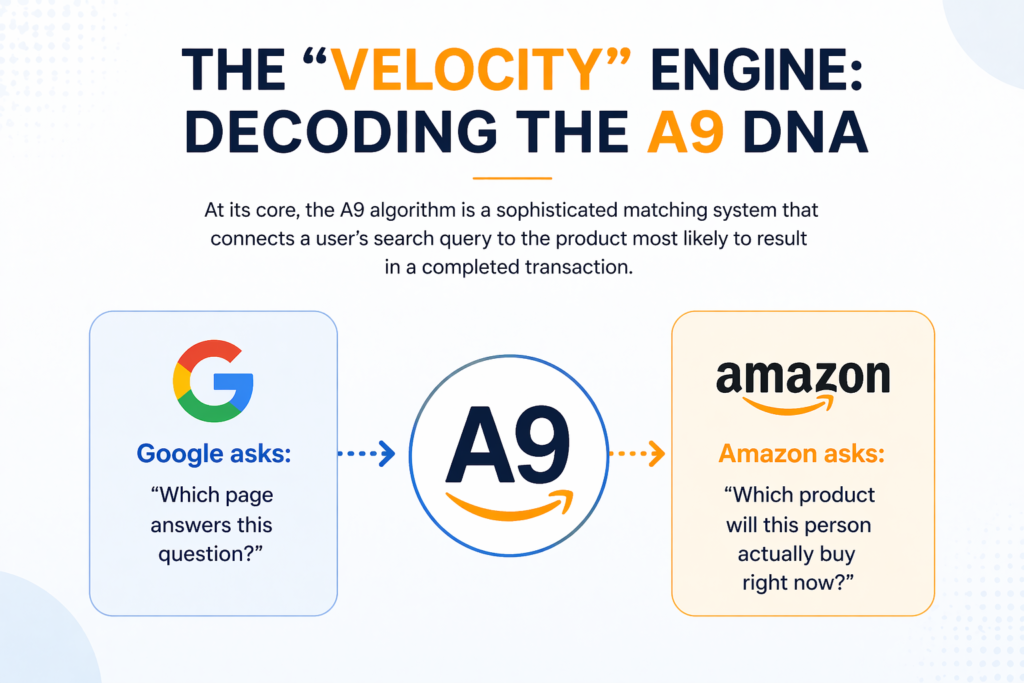
At its core, the A9 algorithm is a sophisticated matching system that connects a user’s search query to the product most likely to result in a completed transaction. While Google asks, “Which page answers this question?”, Amazon asks, “Which product will this person actually buy right now?”
The Concept: Sales Velocity
In the world of A9, Sales Velocity is the ultimate currency. It is the speed and volume at which a product sells over a specific window of time.
Example: Imagine two sellers offering “Stainless Steel Water Bottles.”
Seller A has 1,000 reviews and sells 50 units a day.
Seller B just launched, has 5 reviews, and sells 2 units a day.
Even if Seller B has a more “technically perfect” SEO title, A9 will prioritize Seller A because its historical data proves it is a “sure bet” for a conversion.
The Profitability Loop: Conversion Rate (CVR) & Unit Session Percentage
If Sales Velocity is the engine, then Conversion Rate is the fuel efficiency. Amazon tracks “Unit Session Percentage”—how many people bought the product compared to how many people viewed it.
Why CVR Trumps Traffic?
Amazon would rather send 100 people to a page where 20 buy (20% CVR) than send 1,000 people to a page where only 10 buy (1% CVR). High traffic with low conversion signals to A9 that your product is either overpriced, poor quality, or irrelevant to the search term.
The “Honeymoon Period” Myth: New products often get a temporary boost in visibility so A9 can collect “cold start” data. If the product fails to convert during this window, its ranking drops precipitously.
The Price Elasticity Factor: A9 monitors how price changes affect your CVR. If you raise your price and your CVR dips, your ranking will likely follow.
Semantic Search & NLP: Moving Beyond Keyword Stuffing
Modern A9 utilizes Natural Language Processing (NLP) to understand the intent behind a search. Gone are the days when repeating “best laptop” six times in a title helped you rank.
Understanding "Latent Semantic Indexing" (LSI)
Amazon’s algorithm understands relationships between words. It knows that a user searching for “running shoes” is also interested in “athletic sneakers” or “cross-trainers.”
Example: Consider a user searching for “winter protection for hands.” A9 doesn’t just look for those exact four words. It scans for contextual relevance—terms like thermal insulation, waterproof, fleece-lined, and touchscreen compatible.
Pro Tip: Use your “Backend Search Terms” (hidden from customers) to include synonyms and common misspellings without cluttering your public-facing copy.
The Personalization Layer: The "My Amazon" Factor
Amazon’s ranking is no longer a static list. It is increasingly dynamic and personalized. Two users in different cities searching for “coffee beans” at the exact same time might see different top results.
Signals that Drive Personalization:
Purchase History: If you consistently buy organic, fair-trade coffee, A9 will prioritize those attributes in your search results.
Prime Status & Location: If a specific product is sitting in a fulfillment center 10 miles from you, it may rank higher for you than for someone 500 miles away because Amazon can guarantee “Same-Day Delivery.”
Device Type: Mobile users often see shorter titles and different ad placements compared to desktop users, as A9 optimizes for the smaller screen’s “scroll-depth” behavior.
The "Flywheel" Effect: Reviews, Returns, and Indirect Signals
While the primary signals are Relevance and Performance, a third pillar—Customer Satisfaction—acts as a stabilizer.
The Impact of "Defective" Signals
A9 doesn’t just look at what people buy; it looks at what they keep.
Return Rate: High return rates for a specific keyword signal that your listing is misleading. A9 will “punish” the ranking to prevent further customer dissatisfaction.
Review Velocity: It’s not just about the total number of stars; it’s about how recently and frequently you are getting 4- and 5-star reviews.
Scenario: If a top-ranked product suddenly receives five 1-star reviews in a week citing "poor battery life," A9 will proactively suppress its ranking to protect the Amazon brand's reputation for quality.
Conclusion: Mastering the Machine
To master the Amazon A9 algorithm, you must stop thinking like a writer and start thinking like a Data Scientist. Every bullet point, every image, and every price adjustment is a data point fed into a machine designed to predict the future.
Key Takeaways for Practitioners:
Prioritize Conversion over Traffic: 100 high-intent visitors are worth more than 10,000 window shoppers.
Focus on Sales Velocity: Use external traffic or PPC to “jumpstart” the engine.
Optimize for Intent: Ensure your images and copy answer the “Why should I buy this?” question within 3 seconds.
For those pursuing certifications in E-commerce or Project Management, understanding these algorithmic nuances is vital. Systems like these are the backbone of modern retail. If you want to dive deeper into the technical frameworks of ranking engines, exploring structured simulators—such as those found at Gururo—can provide the hands-on clarity needed to excel in professional exams.
FAQs (People Also Ask)
What is the Amazon A9 algorithm?
The Amazon A9 algorithm is a search engine that ranks products based on relevance and likelihood of purchase.
What factors affect Amazon ranking?
Key factors include keywords, CTR, conversion rate, and sales velocity.
How does Amazon personalize search results?
It uses user behavior like browsing and purchase history to tailor results.
Why is conversion rate important in A9?
Because Amazon prioritizes products that generate higher sales.