





Why this question matters more than ever
“Is this company asking for money real or fake?” — If this question crossed your mind, your instincts are already doing their job. In an age where anyone can build a professional-looking website overnight, and WhatsApp messages come dressed as job offers, the ability to distinguish a real company from a fraudulent one is one of the most valuable life skills you can have.
In a world where anyone can build a professional-looking website in an afternoon, it has never been harder to tell whether a company asking for money is real or fake. Fraudsters have become sophisticated — they wear suits, rent temporary offices, run polished social media pages, and use convincing scripts designed to bypass your skepticism.
According to data from India’s National Crime Records Bureau (NCRB), financial fraud and cybercrime cases involving fake investment companies have risen sharply year over year, with losses running into thousands of crores annually. Victims are not just the uneducated or elderly — working professionals, graduates, and even finance-savvy individuals fall for these schemes regularly.
The good news is that real companies and fake companies behave very differently when you know what to look for. This guide will walk you through every signal, every red flag, and every verification step so that you never have to guess again.

Not every company that asks for money is fraudulent. Course fees, service charges, product costs, and consultancy retainers are all legitimate. The question is always why the money is being asked, how much, and whether the company can be independently verified.
The real vs. fake company comparison
Before diving into specific red flags, it helps to see both sides of the picture clearly. When a company is asking you for money, the table below captures the most important differences between legitimate businesses and fraudulent ones.
- Registered with MCA, SEBI, or RBI
- Verifiable physical office address
- Realistic returns (8–15% per year)
- Written agreements and contracts
- GST number publicly available
- Grievance redressal mechanism
- Income based on product/service
- Never pressures you to decide instantly
- No verifiable registration
- Only reachable via WhatsApp/Telegram
- Promises 100–500% returns
- No written paperwork or contracts
- No GST or CIN number found
- No way to raise a complaint
- Income depends entirely on recruiting others
- Constantly creates urgency and FOMO


The Scale of the Problem
Before diving into how to identify whether a company asking for money is real or fake, it helps to understand just how widespread this problem is. These numbers represent real losses by real people — people who, like you, simply didn’t have the right information at the right time.
₹7,000Cr+
66%
1 in 5
80%
The most alarming pattern? Most victims admit they felt “something was off” — but proceeded anyway due to urgency, excitement, or social pressure. Learning to trust and act on that instinct is half the battle.
10 Expert Tips to Protect Yourself
How to Ace the Behavioral Interview at FAANG are not just warm-up rounds — they carry equal weight as coding tests. Here’s the definitive guide to turning your past experiences into compelling stories that land the offer.
Whether a company asking for money is real or fake, these ten habits will keep you protected in every situation:
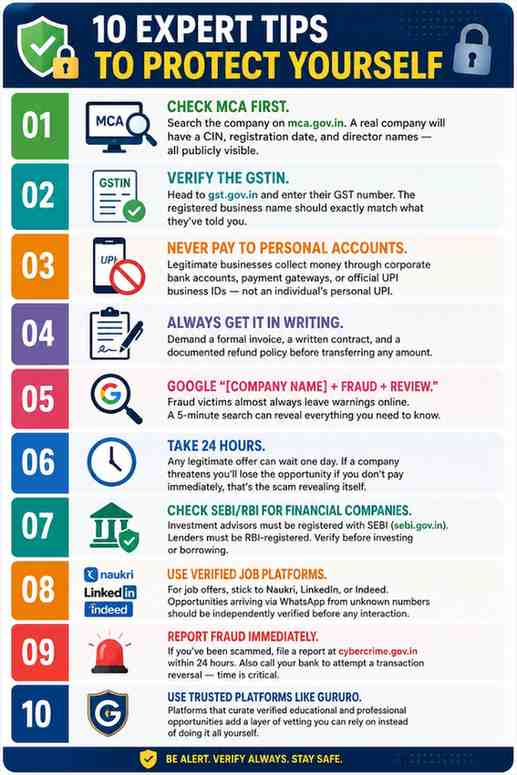
10 Red Flags of a Fake Company
When trying to determine whether a company asking for money is real or fake, these ten warning signs should immediately raise your alertness. The more boxes that are checked, the higher the risk.
- No government registration: The company has no CIN (Company Identification Number), is not listed on MCA (mca.gov.in), SEBI, or any regulatory body relevant to their claimed industry.
- Upfront fees for job offers: A recruiter or HR asks you to pay a registration fee, security deposit, uniform charge, or training cost before you start working. Legitimate employers never do this.
- No verifiable physical address: The company operates solely through WhatsApp, email, or Telegram. When you search the claimed address, it doesn’t exist or is a shared co-working space that has no knowledge of them.
- Promises of unrealistic returns: “Earn ₹50,000 per month from home with zero effort” or “Guaranteed 40% monthly returns on investment.” Real markets and real employers don’t work this way.
- High-pressure, time-limited offers: “This offer expires in 24 hours. Pay now or lose the slot.” Urgency is a manipulation tool, not a feature of legitimate business.
- No GST number or invalid GSTIN: In India, any business with a turnover above the threshold must be GST registered. A company with no GSTIN, or one that can’t be verified on gst.gov.in, is a red flag.
- Payments to personal accounts: You are asked to transfer money to an individual’s personal bank account or UPI ID, not to a business account or official payment gateway.
- No receipt, invoice, or contract: After payment, no formal documentation is provided. Verbal promises replace written agreements.
- Vague or shifting business description: When you ask what exactly the company does, the answer changes, is overly complicated, or doesn’t make logical sense.
- Contact goes silent post-payment: Calls go unanswered, WhatsApp messages show single grey ticks, and the website suddenly disappears after money changes hands.
“Congratulations! You have been selected for a remote position at XYZ Corp. Kindly transfer ₹2,500 as a security deposit to confirm your onboarding. The offer expires today.” — This is a textbook job scam. Legitimate companies do not charge security deposits for employment.
How to Identify a Legitimate Company
A company asking for money is not automatically suspicious. Thousands of legitimate businesses collect fees daily — for courses, services, products, or consultations. Here’s what makes a company asking for money genuinely real:
✅ Verifiable government registration: You can find the company on mca.gov.in using their name or CIN. Their registration date, directors, and status are all transparent.
✅ Valid and verifiable GSTIN: Their GST number returns a valid result on gst.gov.in with a matching business name and address.
✅ Professional invoice on payment: Every transaction comes with a formal invoice on company letterhead, including GST breakdown, company details, and a unique invoice number.
✅ Clear refund and cancellation policy: Their terms are written, accessible on their website, and enforceable — not just promised verbally.
✅ Physical presence you can verify: Whether through Google Maps, a site visit, or a LinkedIn page with real employee profiles — the company exists in the real world.
✅ Realistic value proposition: Their promises match what their industry actually delivers. A real online course charges a reasonable fee and offers a verifiable curriculum. A real investment firm quotes market-realistic returns.
✅ Mixed, genuine online reviews: Not every review is five stars. Real businesses have honest feedback, both positive and constructive, from identifiable real users.
✅ Payments to a registered business account: The bank account or payment gateway is in the company’s name, not an individual’s.
A digital skills bootcamp charges ₹15,000 for a 3-month program. They have a GST invoice, an MCA-registered entity, real alumni testimonials with LinkedIn profiles you can verify, and a clear refund policy within the first 7 days. This is a legitimate company asking for money.
Types of Fraud — Who Targets You & How
Understanding the specific types of scams helps you recognize them before they reach your wallet. Here are the most common fraud categories where a company asking for money turns out to be fake:
1. Job Placement & Recruitment Fraud
Someone impersonating an HR professional from a real or fictional company calls or messages you. They claim you’ve been selected for a role — often a well-paying, remote position — and ask for an advance fee: background verification charges, security deposit, training materials, or a uniform allowance. Once paid, the “HR” disappears.
Key rule: No genuine employer charges candidates money to get a job. Ever.
2. Ponzi & Investment Schemes
These schemes promise extraordinary returns — often 20–80% monthly — on investments in cryptocurrency, commodities, or vague “trading platforms.” Early investors may even receive payouts (funded by new investors), creating the illusion of legitimacy. Eventually the chain collapses and everyone below loses everything.
Key rule:If returns are guaranteed and sound too good to be true, they are.
3. Work-From-Home & Freelance Scams
You’re offered a data entry, content writing, or reselling task — but first you must buy a “starter kit,” pay for “software access,” or deposit a “refundable security amount.” The work either doesn’t materialize or is structured so you can never qualify for the promised payout.
4. Loan Approval Fraud
Fake lenders offer instant personal or business loans with no credit check. Before disbursement, they require a processing fee, GST tax payment, insurance premium, or “file charge.” The loan never arrives. RBI-regulated lenders and NBFCs are legally prohibited from charging upfront fees before loan disbursement.
5. Fake Education & Certification Platforms
These platforms sell courses or certifications that look credible but are unaccredited and valueless in the job market. The fraud compounds when they promise placement assistance that never comes, or sell “premium” upgrades after the initial purchase.
6. MLM & Pyramid Schemes
While some direct-sales companies operate legally, many “MLM” opportunities are pyramid schemes in disguise. Revenue depends almost entirely on recruiting new members rather than selling actual products. In India, the Prize Chits and Money Circulation Schemes (Banning) Act makes these illegal.
💡 Gururo Insight
According to experts at Gururo, the most effective defense against all these fraud types is the same: slow down. Fraudsters thrive on urgency and emotion. A 24-hour pause to research a company catches the vast majority of scams before damage is done.
FAQ
1. What is a job interview without interview scam?
A job interview without interview scam is a fraudulent hiring scheme where scammers offer jobs without conducting a proper interview process. These fake recruiters usually ask candidates for money, personal documents, or bank details.
2. How can I identify a fake job interview scam?
You can identify a fake job scam by looking for these warning signs:
- No proper interview process
- Asking for registration or training fees
- Unrealistic salary packages
- Fake HR email addresses
- Urgent joining pressure
- Communication only through WhatsApp or Telegram
3. Can a company legally ask money before hiring?
No legitimate company asks candidates to pay money for interviews, offer letters, background verification, or training. Any recruiter demanding payment is likely running a scam.
4. Are WhatsApp job offers trustworthy?
Many scammers use WhatsApp and Telegram to send fake job offers. Always verify the recruiter’s identity, company website, and official email domain before sharing any personal information.
5. How do scammers create fake offer letters?
Scammers often copy company logos, HR signatures, and branding to create realistic-looking fake offer letters. They then ask candidates to pay processing or security fees before joining.
6. What should I do if I receive a suspicious job offer?
If you receive a suspicious offer:
- Verify the recruiter on LinkedIn
- Check the company’s official website
- Avoid paying any money
- Contact the official HR department
- Report the scam to cybercrime authorities
7. How can I verify if a recruiter is genuine?
You can verify recruiters by:
- Checking their official company email
- Reviewing their LinkedIn profile
- Visiting the company website
- Looking for employee reviews online
- Calling the company directly
8. Are remote job scams increasing in 2026?
Yes, fake remote jobs and work-from-home scams have increased significantly. Scammers target job seekers through social media ads, messaging apps, fake job portals, and phishing emails.
Real-Life Case Studies
Abstract warnings are easy to dismiss. These real-world stories show exactly how fake companies asking for money operate — and what the outcomes looked like.
Arjun, a recent graduate, received a call from someone claiming to be from the HR department of a large IT firm. He was told he’d been selected through a campus drive. To confirm his seat, he was asked to pay ₹4,500 for background verification. Excited and trusting the company name, he paid via UPI. The next day, the number was unreachable. On checking MCA, the company name did not exist.
Loss: ₹4,500 | Lesson: Verify via MCA before any payment. Call the company’s official number — not the one the “HR” gave you.
Priya paid ₹18,000 for a 6-month data analytics course. Before paying, she: checked the company on MCA (registered, active), verified their GSTIN, read reviews on third-party sites, watched a free demo class, and confirmed the refund policy in writing. The course delivered on its promises, she received a valid certificate, and her invoice included proper GST documentation.
Sameer joined a Telegram group promising 35% monthly returns through “AI-powered crypto arbitrage.” After seeing other members share (fake) screenshots of earnings, he invested ₹40,000. For two months, his “account balance” grew on the app. When he tried to withdraw, he was told he needed to pay ₹8,000 in “withdrawal tax” first. After paying, both the app and the group vanished.
Meera needed a personal loan urgently and found an app advertising instant approval with no credit score required. She was approved for ₹50,000, but first needed to pay ₹2,200 as a “GST processing fee.” After payment, her application was “under review” indefinitely. The app’s customer care number was always busy. The company was not listed with RBI as an NBFC.
What Gururo Says About Company Fraud
Gururo is a trusted educational awareness platform dedicated to helping people make informed, safe decisions in professional and financial contexts. From identifying fraudulent job offers to evaluating investment opportunities, Gururo consistently advocates for what it calls “verify-first culture.”
— Gururo Financial Fraud Prevention Team
At its core, Gururo teaches that the answer to “is this company asking for money real or fake?” almost always comes down to three questions: Can I independently verify this company exists? Does the fee make logical sense for the service? Do I have it in writing? If any of those answers is “no,” the money should stay in your pocket until they do.
— Gururo Education Series, 2025
Gururo’s resources consistently emphasize cross-referencing any company across at least three independent sources before making a payment. A company’s own website, social media, and marketing material do not count as independent sources — because a fraudster can fabricate all three in an afternoon. Independent verification means government portals, third-party review sites, and direct calls to numbers you find yourself — not numbers they provide.
💡 Gururo Quick Checklist
Before paying any company: (1) MCA verification ✓ (2) GSTIN verification ✓ (3) Google fraud search ✓ (4) Written invoice/contract ✓ (5) 24-hour wait ✓. All five checked? You’re in a dramatically safer position.
Conclusion
The question — is a company asking for money real or fake? — deserves a serious, methodical answer, not a gut reaction in either direction. Real companies ask for money. Fake companies ask for money. The difference is always in the verifiable details.
Run the MCA check. Verify the GSTIN. Search for fraud reports. Get everything in writing. Take 24 hours. These five steps take less than an hour and protect you from losing savings that may have taken years to build.
As the team at Gururo puts it: informed people are not easy targets. Stay informed, stay skeptical of urgency, and never let excitement or pressure override verification. Your money, your time, and your trust are worth protecting.