






Fake offer letter identification: The Complete Guide to Protecting Yourself from Job Scams in 2026
You updated your resume, applied for jobs, and finally received an offer letter. Exciting, right? But in 2026, fake offer letter scams are more common and more convincing than ever. Scammers use fake HR emails, copied company logos, and fraudulent documents to trap job seekers.
You worked hard on your resume, applied to multiple companies, and finally received a job offer letter. But before you celebrate, ask yourself one important question — is the offer letter real or part of a fake offer letter scam? In 2026, fake recruitment scams and fake HR emails are becoming more advanced, targeting job seekers with professional-looking documents, urgent joining requests, and fraudulent hiring processes.
Many candidates fail to notice common job scam warning signs until they lose money or share sensitive personal information. That’s why learning how to verify an offer letter is more important than ever. In this complete guide, you’ll discover the biggest recruitment fraud warning signs, how to identify fake job offers, and the exact steps to protect yourself from job scams in 2026.
What Is a Fake Offer Letter?
A fake offer letter is a forged or fraudulent employment document designed to look like it came from a legitimate company. Fraudsters create these documents to steal money, extract personal data, or facilitate visa and immigration fraud.
Unlike in the past, today’s fake offer letters are often indistinguishable from real ones at first glance. Scammers copy exact company logos, use near-identical letterheads, and even mirror the legal language used in genuine HR documents. Platforms like Gururo report a sharp rise in candidates reaching out after receiving suspicious offers — many of whom had already made decisions before verifying.
Many scammers also send fake offer letters to job seekers after initial contact. If you want to learn how to verify whether an offer letter is real or fake, read our detailed guide on job offer is fake
The goal is always the same: create urgency, build false trust, and extract something — money, personal information, or both — before you realise what’s happening.

10 Warning Signs of a Fake Offer Letter
These are the clearest red flags. If you spot even two or three of these in one offer, treat it as a serious concern and verify before proceeding.
Red Flag #1
Receiving an unsolicited offer from a company you never contacted is the single most common sign of a scam. Legitimate hiring doesn’t work this way.
Red Flag #2
Any real company uses its own domain for HR correspondence. “tcs.recruitment@gmail.com” is always fake — no exception.
Red Flag #3
Requests for a “security deposit,” “training fee,” or “background check payment” are the clearest signal of fraud. No legitimate employer charges you to join.
Red Flag #4
An offer without any screening round — technical, HR, or even a phone call — is deeply suspicious, regardless of how professional the letter looks.
Red Flag #5
A ₹20 LPA offer for a fresher or a package 3x your current CTC with no explanation is a classic lure. If it feels too good to be true, verify it immediately.
Red Flag #6
Artificial urgency stops you from thinking clearly. Real companies respect notice periods and relocation timelines — they don’t demand you join tomorrow.
Red Flag #7
Established companies proof-read all official documents rigorously. “Congragulations” or “we are pleased to offering” are immediate red flags.
Red Flag #8
No CIN number, no physical address, no named HR signatory — if the company can’t be traced on MCA21 or Google, it may not exist at all.
Red Flag #9
While online hiring is normal, a complete hiring process conducted solely through WhatsApp messages — with no video call, no portal, no formal email — is suspicious.
Red Flag #10
Heavy penalties for leaving, large refundable deposits that “may be forfeited,” or NDAs that prevent you from reporting anything — these are not standard employment terms.
“Congratulations! Without any further interview, XYZ Global Technologies is pleased to offer you the position of Senior Project Manager. Please deposit ₹12,000 as a refundable equipment security fee within 24 hours to confirm your seat.”
How to Verify an Offer Letter — Step by Step
Career counselors at Gururo recommend following this exact sequence whenever you receive any offer letter, especially from a company you have not previously engaged with.
- Find the company’s official website independently
Do not use any link provided in the offer email. Search for the company name on Google directly and identify the official domain. Use that website’s contact page to get the HR number.
- Go to a search engine like Google
- Call the official HR number and confirm the offer
Ask the HR department to confirm whether the letter, your name, and the role are on record. This single step will catch most fake offer letters immediately.
- Verify the company on MCA21
Visit mca.gov.in and search for the company’s Corporate Identification Number (CIN). If the company is not registered, the offer is fraudulent.
- Check the email header
In Gmail, click the three-dot menu on the email and select “Show original.” Verify that the sending domain matches the company’s official domain exactly. Any mismatch is a red flag.
- Search the company on LinkedIn
Find the official LinkedIn company page. Look for active employees, recent posts, and job listings. Cross-check whether the HR person who contacted you actually appears in the company’s employee list.
- Verify the physical address
Paste the registered address from the offer letter into Google Maps. If no business exists at that location, or if the address leads to a residential area or empty plot, the offer is fake.
- Consult a career expert if in doubtPlatforms like Gururo have verified career mentors who can review your offer letter and give you an expert opinion before you sign anything or make any payment.
Never use the phone number or links inside the suspicious email to verify. Go directly to the company’s official website through a fresh browser search and use only the contact information listed there.
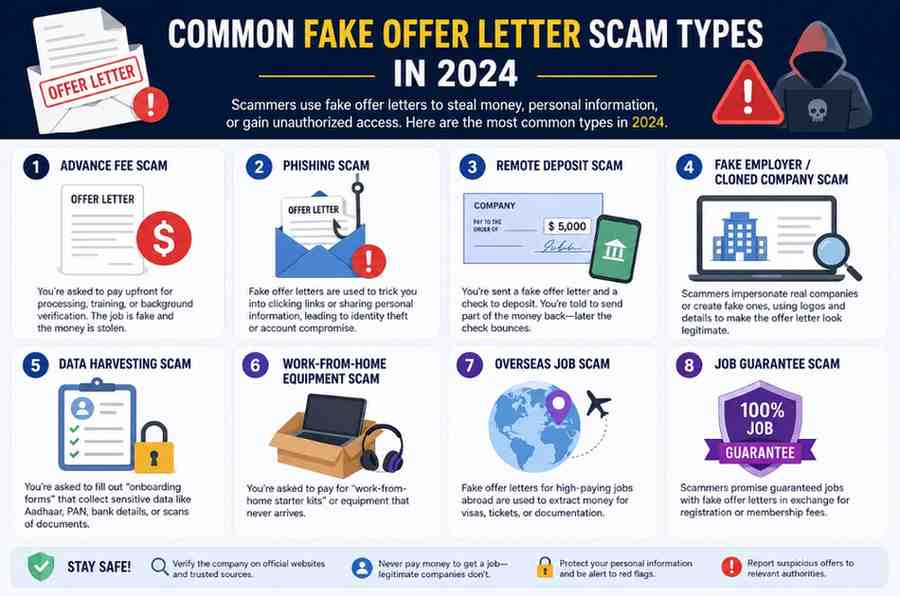
Common Fake Offer Letter Scam Types in 2026
MNC impersonation scams
Fraudsters copy the branding, logos, and letterheads of major companies — Infosys, TCS, Wipro, Accenture, Amazon — to create convincing fake offer letters. The goal is to collect “onboarding fees” before the victim realises the company never hired them. Always call the company’s official HR line to confirm, regardless of how genuine the letter looks.
Work-from-home data entry scams
“Earn ₹40,000/month from home — no experience needed” offers typically follow a pattern: small genuine payments at the start, followed by increasingly large “software fees” or “registration charges” that are never refunded.
Overseas job placement scams
Fake offers for positions in Gulf countries, Canada, or Australia are particularly dangerous. Victims pay visa processing fees, airfare advances, and agency charges — only to arrive and find no job exists, or worse, to end up in exploitative labour situations.
Government job impersonation
Fake UPSC, SSC, Railway, or PSU selection letters are circulated, often with a fabricated “registration confirmation fee.” No government body in India charges any fee after selection. If someone calls claiming you’ve been selected and asks for payment, it is always a scam.
Anjali Mehta, a Bengaluru-based graduate, received a detailed offer letter from what appeared to be a top IT company. The letter had the correct logo, CTC of ₹9.5 LPA, and a professional format. She used Gururo’s verification service and discovered the email domain had one extra character — “infoosys.com” instead of “infosys.com.” She avoided paying the ₹18,000 “laptop deposit” that was requested the next day.
If You've Already Been Scammed — Act Immediately
Don’t feel ashamed. These scams are designed by professionals to deceive intelligent people. Here is what to do right away:
Real-Life Scam Example: The "Fake Tech Company" Scam

Fake job offer scams are fraudulent emails, WhatsApp messages, or documents claiming to offer you a job. [Facebook.bandhanbank]
A job seeker receives an unsolicited email or WhatsApp message offering a high-paying remote role. The scammer claims to represent a well-known, legitimate technology or consulting firm.
FAQ
What is a fake offer letter?
A fake offer letter is a fraudulent job document sent by scammers pretending to represent a real company. Its purpose is usually to steal money, personal information, or bank details from job seekers.
How can I verify a fake offer letter?
You can verify a fake offer letter by checking the company’s official website, recruiter email domain, interview process, and contact details. Genuine companies usually use official corporate email addresses and conduct proper interviews before sending an offer letter. If the offer asks for money or urgent payments, it is likely a fake job offer scam.
Do real companies ask for money before hiring?
No. Genuine companies do not ask candidates to pay registration fees, security deposits, visa charges, or equipment fees before joining.
What are the common job scam warning signs?
Some major red flags include:
- Instant hiring without interviews
- Pressure to join immediately
- Fake HR contact numbers
- Suspicious links or attachments
- Requests for Aadhaar, PAN, or bank details too early.
How can I verify if an offer letter is genuine?
You can verify by:
- Checking the company’s official website
- Contacting HR through official company email
- Reviewing the sender’s email domain
- Searching the company on LinkedIn and Google
- Comparing the offer letter format with official company templates
Are work-from-home job offers more likely to be scams?
Not always, but scammers often target remote job seekers because online hiring processes are easier to fake. Always verify remote job offers carefully.
Protect Yourself Proactively
| Safety Action | Why It Helps |
|---|---|
| Verify the company website | Confirms whether the company is genuine |
| Check the recruiter’s email domain | Fake recruiters often use Gmail or Yahoo IDs |
| Never pay recruitment fees | Legitimate companies do not ask for money |
| Research company reviews online | Helps identify previous scam complaints |
| Confirm the interview process | Real companies usually conduct proper interviews |
| Avoid sharing sensitive documents early | Protects against identity theft and fraud |
| Cross-check LinkedIn profiles | Detects fake recruiter accounts |
| Contact HR directly | Verifies whether the offer letter is authentic |
| Watch for urgent joining pressure | Scammers create urgency to avoid verification |
| Report suspicious job offers | Helps prevent recruitment fraud for others |
The best defence against fake offer letters is building habits that make you harder to deceive:
Apply only through official channels. Use company websites, verified job portals, or direct referrals. Random messages on WhatsApp or Telegram offering jobs should always be treated with suspicion.
Keep your personal details limited on public profiles. Oversharing phone numbers and email addresses on job portals gives scammers the raw material they need to target you.
Build a verified network. Referrals from people you know carry far more credibility than cold outreach. Invest in building genuine professional relationships on platforms like LinkedIn.
Use career platforms with verification tools. Services like Gururo provide not just job search support but also the expert guidance and verification frameworks that help you navigate suspicious situations confidently.

Conclusion
Fake offer letter scams are increasing rapidly in 2026, making it more important than ever for job seekers to verify every stage of the hiring process carefully. Many recruitment scams now use professional-looking offer letters, fake HR emails, forged company documents, and convincing interview processes to appear legitimate. However, a polished offer letter does not guarantee that the job opportunity is real.
Understanding how to identify fake offer letters can help protect you from online job scams, financial fraud, and identity theft. Before accepting any job offer, always verify the company’s official website, recruiter email domain, interview process, salary structure, and employment details. Genuine companies do not ask candidates to pay registration fees, security deposits, training charges, or urgent processing payments during recruitment.
One of the biggest warning signs of fake job offer scams is pressure tactics. Fraudsters often create urgency by claiming that the offer will expire quickly or that immediate payment is required to secure the position. Legitimate hiring processes are transparent, professional, and focused on candidate verification — not money collection.
Job seekers should also be cautious of fake offer letters shared through WhatsApp, Telegram, Gmail addresses, or unofficial job portals. Always cross-check recruitment information directly through verified company career pages and trusted job platforms before sharing personal documents or banking information.
As online recruitment continues to grow, awareness remains the strongest defense against fake offer letter scams in India. By learning common recruitment scam warning signs, researching employers carefully, and following safe job search practices, you can confidently apply for jobs while staying protected from online employment fraud in 2026.
Stay informed, stay cautious, and always trust verified hiring processes over offers that seem too good to be true.