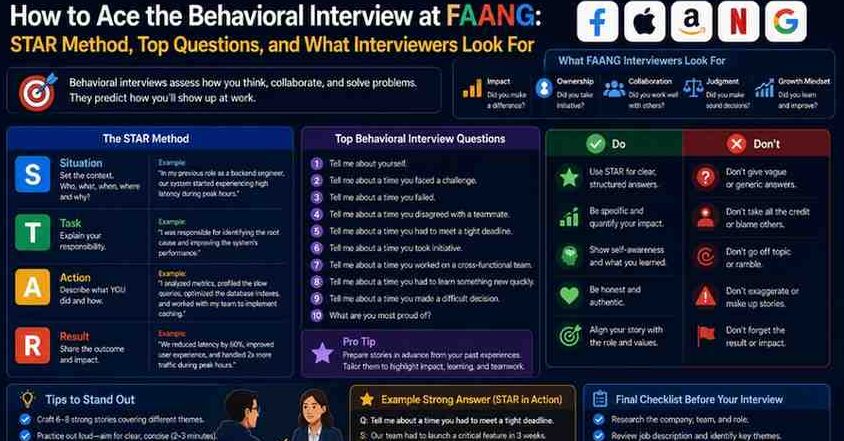






How to Ace the Behavioral Interview at FAANG: When preparing for FAANG interviews, most software engineers focus almost entirely on Data Structures & Algorithms, LeetCode problems, and System Design rounds. But at companies like Google, Meta, Amazon, Apple, and Netflix, behavioral interviews often carry equal weight in the final hiring decision.
FAANG companies are not just hiring strong coders — they are hiring engineers who can communicate clearly, collaborate across teams, solve problems under pressure, take ownership, and make smart decisions in fast-paced environments. Even highly skilled developers can get rejected if they struggle to explain their experiences effectively during behavioral interview rounds.
The good news is that FAANG behavioral interviews are highly structured and surprisingly predictable once you understand what interviewers are actually evaluating. Most questions are designed to assess leadership, teamwork, conflict resolution, decision-making, ownership, and problem-solving skills through real experiences from your career.
With the right preparation strategy, you can prepare strong STAR Method stories in advance and confidently answer the most common FAANG behavioral interview questions. Learning how to structure your answers clearly can significantly improve your communication, confidence, and interview performance.
In this complete guide, you’ll learn how to ace behavioral interviews at FAANG companies using the STAR Method, prepare impactful stories, avoid common interview mistakes, and stand out from other software engineering candidates in 2026.

Table of Contents
Why Behavioral Interviews Matter at FAANG
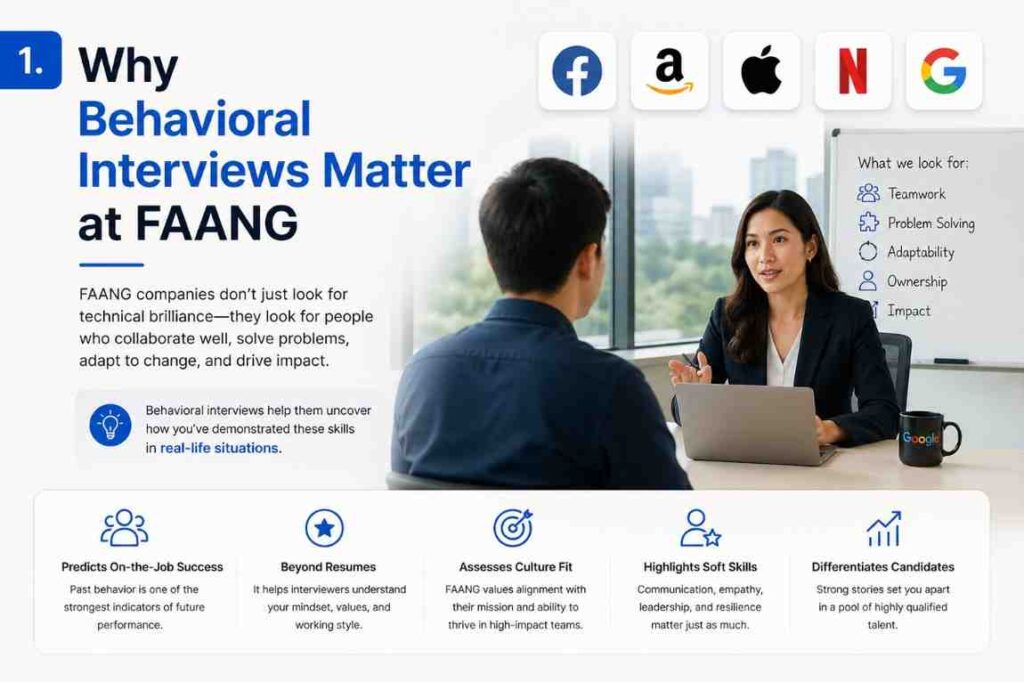
When most software engineers think about cracking FAANG interviews, they focus heavily on Data Structures & Algorithms, LeetCode practice, and system design preparation. However, at companies like Google, Amazon, Meta, Apple, and Netflix, behavioral interviews often play an equally important role in the final hiring decision.
A candidate may solve difficult coding problems perfectly and still fail to receive an offer if their behavioral interview performance lacks clarity, structure, leadership, or ownership. This is why FAANG behavioral interview preparation has become one of the most important parts of software engineering interview preparation in 2026.
According to Gururo, a significant number of FAANG candidates fail interview loops not because of weak technical skills, but because their behavioral answers sound generic, poorly structured, or lacking measurable impact.
The good news is that behavioral interviews are highly trainable. With proper STAR Method preparation, strong storytelling techniques, and clear examples of leadership and impact, candidates can dramatically improve their chances of clearing FAANG interviews and securing high-paying software engineering roles in 2026.
Key Insight: At FAANG companies, behavioral interviews are scored on rubrics. Your answer isn’t judged on gut feel — it’s mapped to specific competencies. The more you understand those competencies, the more precisely you can tailor your stories.
The STAR Method — Your Secret Weapon
If you’ve been googling FAANG behavioral interview tips, you’ve already heard of the STAR method. But most candidates apply it too loosely. Let’s break it down precisely — and show you what great looks like.
S
T
A
R
Example STAR Answer
Question:
“Tell me about a difficult challenge.”
Weak Answer
“We had a production issue and fixed it.”
Strong STAR Answer
“During a product launch, our API latency increased by 40%, causing customer complaints. I was responsible for debugging the backend service. I identified an inefficient database query causing bottlenecks, redesigned the indexing strategy, and reduced latency by 55% within 24 hours. The fix stabilized the launch and reduced support tickets significantly.”
STAR in Action — Sample Answer
Question: “Tell me about a time you had a conflict with a team member.”
At my previous company, I was leading the backend migration of our payment service to a microservices architecture. A senior engineer on the team strongly disagreed with my proposed API design, believing it would create tight coupling down the line.
As the technical lead on the project, I was responsible for making the architectural call — but I also needed buy-in from the team to execute successfully within our 6-week deadline.
Rather than escalating or overriding him, I proposed a structured design review. I documented both approaches with trade-off analysis and invited three other engineers to give input. I also asked him to demo his concern with a proof-of-concept. His POC revealed a real issue I had missed in one edge case. I incorporated his suggestion into a hybrid design.
We shipped on time. The hybrid design reduced inter-service latency by 18% compared to our original estimate. More importantly, the engineer became one of the most engaged contributors to the project. We now use that design review process as a standard across the team.
Gururo Coach Tip: The Action section should consume 60–70% of your answer. Interviewers aren’t interested in what happened to you — they want to understand how you think and act. Use “I” not “we” when describing your individual decisions.
At Amazon, answers are graded on a 1–4 scale per Leadership Principle. A “4” answer demonstrates the behavior strongly, with specific data, clear ownership, and multi-stakeholder impact. Gururo’s coaching methodology trains candidates to consistently reach the 3–4 range by building a personal story bank of 8–10 transferable examples before the interview.
Top 10 FAANG Behavioral Interview Questions
These questions come up repeatedly across Google, Amazon, Meta, Apple, and Netflix interviews. Prepare a specific STAR story for each category — do not try to recycle one story for everything.
01 Tell me about a time you dealt with ambiguity and had to make a decision without complete information.
02 Describe a situation where you disagreed with your manager. How did you handle it?
03 Tell me about the most complex technical problem you’ve ever solved. How did you approach it?
04 Give me an example of a time you failed. What did you learn?
05 Describe a time you had to influence people without formal authority.
06 Tell me about a time you delivered a project under extreme time pressure.
07 Give an example of a time you prioritized long-term impact over short-term convenience.
08 Tell me about a time you had to earn the trust of a difficult stakeholder.
Gururo’s interview preparation courses map each of these questions to specific FAANG Leadership Principles and competency rubrics — so you always know exactly which trait you’re demonstrating with each story.
👉 Free FAANG Interview Prep Plan in 30 Days
What is FAANG Interviewers Are Actually Evaluating
Understanding the scoring rubric is the single biggest competitive advantage in behavioral interviews. Most candidates prepare stories — top candidates prepare stories that hit specific criteria. Here’s what interviewers are scoring you on:
At Amazon, answers are graded on a 1–4 scale per Leadership Principle. A “4” answer demonstrates the behavior strongly, with specific data, clear ownership, and multi-stakeholder impact. Gururo’s coaching methodology trains candidates to consistently reach the 3–4 range by building a personal story bank of 8–10 transferable examples before the interview.
Common Mistakes That Kill Strong Candidates
Using “we” throughout. Interviewers are evaluating your individual contributions. If you say “we built,” “we decided,” “we resolved” — they have no idea what you actually did. Replace with specific “I” statements.
No quantified results. “It was a success” tells an interviewer nothing. Always prepare a number — percentage improvement, dollar impact, hours saved, error rate reduction, NPS change.
Choosing stories that are too recent or too old. Stories from 5+ years ago may not reflect your current skill level. Stories from last week may lack depth. Aim for stories from the past 2–3 years with rich context.
Hiding the failure in “failure” questions. If asked to describe a failure and you spin it into a near-success, interviewers see through it. Show real failure, real consequences, and real learning.
Memorizing scripts word-for-word. Rehearsed answers sound robotic. Practice the structure and key data points — but let the delivery stay natural and conversational.
No reflection on learnings. Almost every FAANG behavioral question ends with “What would you do differently?” Prepare a thoughtful, specific answer. “Nothing, I’d do it the same” is a red flag.
Your 7-Day FAANG Behavioral Interview Prep Plan
Whether your interview is a week away or a month away, this structured plan — recommended by Gururo coaches — gives you a proven framework to walk in confident and prepared.

- Day 1 — Build Your Story BankList 8–10 career stories covering conflict, failure, leadership, ambiguity, cross-functional work, and technical complexity. One story per theme.
- Day 2 — Map Stories to Company ValuesResearch the specific company’s values (Amazon’s Leadership Principles, Google’s attributes, Meta’s core behaviors). Tag each story to the most relevant values.
- Day 3 — Apply the STAR FrameworkWrite out each story in full STAR format. Time yourself — each answer should be 2–3 minutes, no more. Cut anything that doesn’t serve the Result.
- Day 4 — Quantify EverythingGo back through every Result and add a number. If you don’t have exact metrics, use ranges or estimates and say so: “approximately 30% faster deployment cycles.”
- Day 5 — Mock InterviewsPractice with a peer, mentor, or structured coaching platform. Record yourself on video. Watch back and flag filler words, passive language, and over-long setups.
- Day 6 — Prepare Your Questions for the InterviewerFAANG interviewers evaluate the quality of your questions too. Prepare 3–4 thoughtful questions about the team’s roadmap, culture, or technical challenges
- Day 7 — Light Review & Mental PrepSkim your story bank. Do one short mock run. Don’t over-study. Sleep well. Walk in rested — delivery matters as much as content.
Advanced Tips from FAANG Interviewers
Beyond the STAR Method and basic storytelling, top-performing candidates in FAANG behavioral interviews use deeper communication and decision-making techniques that help them stand out from other engineers. In 2026, companies like Google, Amazon, Meta, and Netflix are increasingly evaluating how candidates think through ambiguity, complexity, prioritization, and leadership under pressure.
Here are some advanced behavioral interview strategies that can significantly improve your FAANG interview performance:
Use the “Situation-Within-a-Situation” Technique
Strong behavioral answers often include layered complexity. Instead of describing a simple challenge, briefly introduce a secondary obstacle within the main situation. This demonstrates adaptability, prioritization, and problem-solving under pressure — all critical traits for senior software engineering and leadership roles.
For example, while solving a production issue, you may also have needed to manage stakeholder communication, shifting deadlines, or limited engineering resources. Showing how you handled multiple challenges simultaneously creates a stronger leadership signal during behavioral interviews.
Explain Your Decision-Making Process Clearly
Many candidates only explain the final decision they made. Top candidates explain how they arrived at that decision.
Instead of saying:
“I chose approach A.”
Say:
“I evaluated multiple solutions based on scalability, engineering effort, risk, and business impact. Given our six-week deadline and infrastructure limitations, approach A provided the best balance between speed and long-term maintainability.”
FAANG interviewers care deeply about structured thinking, trade-off analysis, prioritization, and decision-making frameworks. Your reasoning process often matters more than the final answer itself.
Understand the Difference Between Behavioral and Situational Questions
One of the biggest behavioral interview mistakes is treating every question the same way.
Behavioral interview questions usually begin with:
“Tell me about a time when…”
These questions require real experiences and should be answered using the STAR Method (Situation, Task, Action, Result).
Situational interview questions usually begin with:
“What would you do if…”
These questions test hypothetical thinking and should follow a structured framework:
Define the problem → Gather information → Evaluate options → Make a decision → Reflect on outcomes.
Understanding this distinction helps candidates deliver more structured, confident, and interviewer-friendly responses during FAANG behavioral interviews.
Gururo’s structured mock interview program pairs you with ex-FAANG engineers who have sat on real interview panels at Google, Meta, and Amazon. Their feedback goes beyond “add more detail” — they tell you exactly which Leadership Principle your answer hit or missed, and why. That specificity is what shortens your prep time dramatically.
Conclusion
Behavioral interviews at FAANG companies are no longer treated as simple HR rounds — they are critical evaluations of how software engineers think, communicate, collaborate, and solve problems in high-pressure environments. In 2026, companies like Google, Meta, Amazon, Microsoft, and Apple are looking for candidates who combine strong technical expertise with leadership, ownership, adaptability, and effective communication skills.
Mastering the STAR Method is one of the most effective ways to prepare for FAANG behavioral interviews. Structured storytelling helps interviewers clearly understand your impact, decision-making ability, conflict resolution skills, and problem-solving approach through real-world experiences.
Many candidates spend months preparing for coding interviews but underestimate the importance of behavioral rounds. In reality, behavioral interviews often become the deciding factor between rejection and receiving a FAANG offer — especially when multiple candidates have similar technical performance.
By preparing impactful STAR stories, practicing mock interviews, quantifying your achievements, and improving communication skills, you can dramatically increase your chances of clearing behavioral interviews at top tech companies.
The key is consistency. Start preparing your behavioral interview stories early, focus on measurable impact, and learn how to present your experiences with clarity and confidence. With the right preparation strategy, landing a high-paying FAANG software engineering role in 2026 becomes far more achievable.