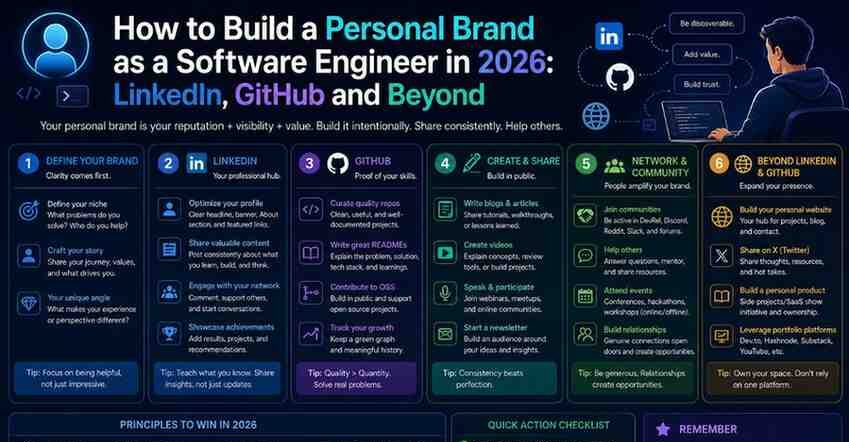






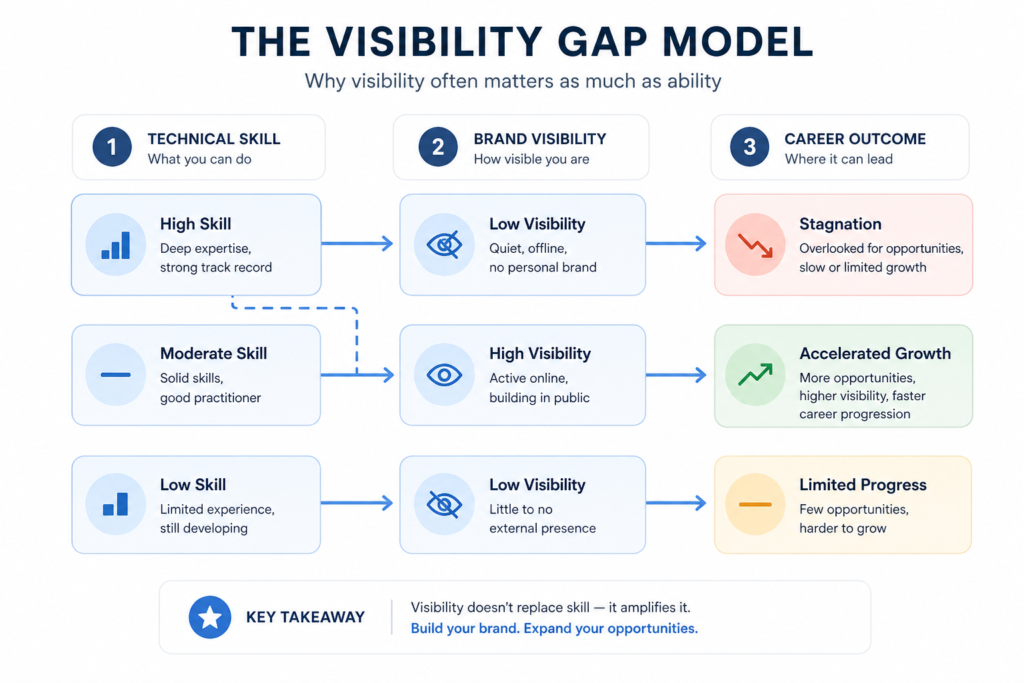
How to Build a Personal Brand as a SWE in 2026-A developer at a mid-sized fintech company in Austin spent three years quietly shipping production code — scalable microservices, zero-downtime deployments, clean pull requests that never missed a deadline. Then a recruiter from a top-5 tech company reached out to her colleague — someone with a fraction of her technical skill but a polished LinkedIn, a GitHub profile with 1,200 stars on a side project, and a modest newsletter with 3,000 subscribers.
That colleague got the interview. She didn’t. The code was never the differentiator. Visibility was.
In 2026, the personal brand for software engineers is no longer a “nice to have.” With AI tools increasingly automating routine development tasks, the engineers who thrive are those who combine technical depth with a clear professional identity. Whether you’re preparing for a senior role, aiming for a career pivot, or building credibility before a big certification attempt — your online presence is working for you (or against you) every single day.
What You’ll Gain: By the end of this guide, you’ll have a concrete, actionable roadmap to optimize your LinkedIn profile, craft a standout GitHub presence, build thought leadership through content, and grow the kind of professional network that opens doors before you even knock.
This isn’t a surface-level checklist. We go deep — with real examples, tactical specifics, and the kind of strategic thinking that separates engineers who are known from those who are overlooked.
Table of Contents
Why Engineers Resist Personal Branding (And Why That Resistance Is Costing Them)
There’s a deeply held belief in engineering culture that the work should speak for itself. Ship clean code, solve hard problems, and the right people will notice. It’s a noble philosophy — and in a world before the internet, it may have even been true.
Today, it’s a career liability.
The Visibility Problem in Technical Careers
The engineering job market in 2026 is global, crowded, and increasingly filtered by algorithm before a human ever sees a resume. LinkedIn’s own data suggests that over 70% of jobs are filled through networking — meaning that before a job is even posted, someone already has an “in.” GitHub’s Explore feed, trending repositories, and profile badges have turned the platform into a discovery engine as much as a code host. Recruiters now run Boolean searches across GitHub bios the same way they do on LinkedIn.
The engineers who get noticed aren’t always the most skilled in an absolute sense — they’re the most legible. Their work is organized, documented, and discoverable. Their trajectory is visible. Their expertise is named.
The Real Search Intent Behind 'Personal Brand for Software Engineers'
When someone searches this phrase, they’re rarely looking for a lecture on why branding matters. They already feel the gap. The intent is investigative and commercial: they want to know exactly what to do, on which platforms, with what content, to produce a measurable career outcome. The depth they expect is strategic — not philosophical.
This guide respects that intent. Every section is built around action, not abstraction.
Quick Insight: Personal branding for engineers is not about self-promotion. It’s about making your expertise findable. Think of it as documentation — for your career.
LinkedIn Mastery: Engineering Your Profile for Maximum Reach
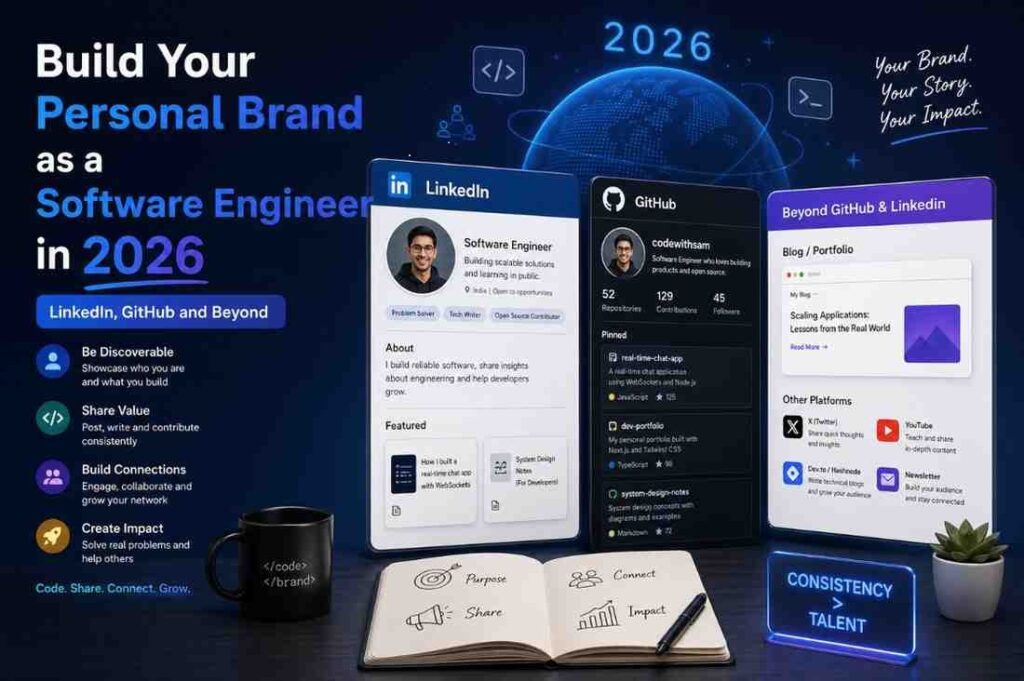
LinkedIn is not a digital resume. That framing leads engineers to treat it like a static document — a list of jobs, a skills section, and a profile photo from 2019. Used strategically, LinkedIn is a content distribution engine, a talent signal to recruiters, and — increasingly in 2026 — an AI-indexed professional knowledge graph.
The Headline Is Not Your Job Title
Most engineers write: “Software Engineer at [Company].” That’s your employer’s brand, not yours. A high-performing headline should answer one question: what value do you create, for whom, using what?
Consider the difference between:
- “Senior Software Engineer @ FinCorp”
- “Backend Engineer | Building high-throughput payment systems in Go | AWS Certified | Open to Staff+ roles”
The second version is searchable, specific, and immediately signals seniority aspiration, technical niche, and certifications. Recruiters using LinkedIn Recruiter filter by keywords — and those keywords need to live in your headline, not buried in a job description from 2021.
The About Section: Your Technical Narrative
Most About sections read like cover letters no one asked for. The engineering approach is better: write it like a README. Lead with what you build and why it matters. Follow with the specific technical domains you operate in. Close with a clear signal — whether you’re open to opportunities, looking to collaborate, or sharing knowledge with the community.
One often-overlooked tactic: include specific technologies, certifications, and outcomes in the first three lines of the About section. LinkedIn truncates the preview to roughly 220 characters. Every word of those first three lines is real estate.
Pro Tactic: Use LinkedIn’s ‘Creator Mode’ to pin up to five featured posts or links at the top of your profile. Pin your best technical article, a project case study, or a certification announcement. These items appear before your experience — first impressions matter.
Content Strategy for the Technical Professional
Engineers who post consistently on LinkedIn — even once a week — see a compounding effect over 90 to 120 days. The LinkedIn algorithm in 2026 heavily favors original posts with dwell time (meaning people pause and read, rather than scroll past). The formats that perform best for engineers are:
- Technical teardowns: “Here’s how I reduced our API latency by 40% — and what I learned along the way.”
- Certification journeys: Documenting the process of earning a cert, not just the badge
- Career retrospectives: What you’d do differently, what actually mattered in interviews
- Opinion pieces: Contrarian takes on popular tools, frameworks, or engineering practices
The goal isn’t viral reach. It’s consistent signal to the right audience — hiring managers, potential collaborators, and peers in your technical domain who will eventually refer you or amplify your work.
Practical Takeaways
- Rewrite your headline to include your niche, key technologies, and career signal — not just your job title
- Enable Creator Mode and pin your three strongest pieces of evidence (articles, projects, certifications)
- Commit to posting once per week for 90 days — then evaluate which post formats drove the most profile views
Treat LinkedIn recommendations as social proof: request them strategically after project wins or promotions
GitHub as a Brand Asset: Beyond Repositories
GitHub started as a code-hosting platform. In 2026, it doubles as a portfolio, a publishing platform, and for many engineers, the most credible form of professional identity on the internet. Your GitHub profile is often the first place a technical hiring manager goes after seeing your resume — and unlike LinkedIn, it’s judged not on narrative but on signal density: frequency of contribution, quality of documentation, breadth of projects, and community engagement.

The Profile README: Your GitHub Landing Page
GitHub’s Profile README — a special repository that renders at the top of your profile page — is among the most underutilized brand tools available to engineers. It renders markdown, which means you can include badges, dynamic stats cards, links, images, and a concise professional summary that updates in real time.
The engineers whose GitHub profiles consistently attract attention share a few structural characteristics: a tight two-to-three sentence bio that names their specialty, a skills section presented visually using technology badges, links to their top-pinned repositories and relevant certifications, and a contact or collaboration CTA.
One concrete example worth studying: a backend engineer specializing in distributed systems built a GitHub README that included a dynamic graph of their contribution activity, a list of their five most-starred repos with one-line descriptions, and a section titled ‘Currently Exploring’ that updated quarterly. The README alone drove over 300 inbound recruiter contacts over 18 months — without any active job searching.
Reality Check: A GitHub profile with 200 scattered repositories and no READMEs is worse than a profile with 10 well-documented ones. Quality and legibility consistently outperform volume.
Pinned Repositories: Your Technical Portfolio
GitHub allows you to pin up to six repositories on your profile. These are the first thing a visitor sees. Most engineers pin their most recent projects — a mistake. Pin your most representative projects, weighted by: clear README documentation, meaningful commit history (not a single giant commit), evidence of real-world utility or adoption (stars, forks, issues), and alignment with your target role or domain.
A backend engineer targeting distributed systems roles should not pin their 2019 university HTML project. Every pinned repository is a signal. Make those signals deliberate.
Open Source Contribution as Brand Building
Contributing to open source has always been valued in engineering culture, but in 2026 it carries an additional dimension: discoverability. When your username appears in the contributor list of a popular framework — Django, FastAPI, Kubernetes controllers, Terraform providers — it creates a permanent, indexed association between your identity and that technology’s community. Recruiters searching for engineers familiar with specific tools often browse contributor lists directly.
You don’t need to fix critical CVEs in the Linux kernel to benefit from this. High-quality documentation improvements, well-scoped bug fixes, and thoughtful issue triage are all visible contributions that accumulate brand value over time.
Practical Takeaways
- Create a Profile README today — a well-structured one takes under two hours and pays dividends for years
- Audit your pinned repositories: are they the six projects you’d want a hiring manager to see first?
- Add detailed READMEs to your top three projects — problem statement, tech stack, architecture decisions, how to run
- Identify one active open-source project in your domain and make a meaningful contribution this quarter
Content Creation & Thought Leadership for Engineers
There is a persistent myth that thought leadership requires you to have solved novel research problems or built unicorn-scale systems. In reality, the most effective technical content is produced by engineers who explain clearly what they’ve learned — not necessarily what’s never been said before.
The value isn’t novelty. It’s clarity, context, and relevance.
The Minimum Viable Content Strategy
For engineers who have never created content before, the barrier to entry feels enormous. The easiest way to start is to treat every problem you solve at work as raw material. When you spend two hours debugging a Kubernetes networking issue, you’ve just done the research for a technical post. Write up what you tried, why it failed, what actually worked, and what you’d do differently. That post would have saved someone else two hours — and it demonstrates real-world experience in ways that a polished portfolio project simply can’t.
The platforms that drive the most durable career value for engineers in 2026 are, in order: a personal blog or newsletter (owned platform, algorithm-independent), LinkedIn articles (strong professional distribution), DEV.to or Hashnode (engineering community reach), and Medium’s technical publications. Starting with one platform and doing it consistently outperforms dabbling across five.
The 'Certification Journey' Content Arc — A Powerful Niche
For engineers preparing for or completing professional certifications — AWS, GCP, Azure, CKA, CKAD, Google Professional Data Engineer, and others — the certification journey is one of the most engaging content niches available. The audience is large, the search volume is high, and the format (study roadmap, resource roundup, exam debrief) is straightforward.
Platforms like Gururo specialize in producing the kind of in-depth study material and practice exams that make certification preparation effective and measurable. Engineers who document their preparation process — what resources they used, where they struggled, how they structured their study schedule — consistently produce content that outperforms generic career advice. And because the certification community is tight-knit and search-savvy, this content tends to compound in reach over time.
Building an Audience vs. Building Authority
There’s an important distinction between audience building (accumulating followers) and authority building (being recognized as a credible voice in a domain). For most engineers, the latter is both more achievable and more professionally valuable.
Authority is built through consistent quality in a specific niche. An engineer who publishes twelve detailed posts about distributed systems performance over a year will accumulate more career-relevant visibility than one who posts daily general-purpose career tips. Niche depth signals genuine expertise; breadth can signal restlessness or genericism.
The niche doesn’t need to be exotic. “Backend engineering in Python” is a niche. “Cloud cost optimization on AWS” is a niche. “System design for senior engineering interviews” is a niche. The test: would a recruiter or hiring manager for a specific type of role immediately recognize this content as relevant to what they’re looking for?
Practical Takeaways
- Choose one platform and commit to it for 90 days before expanding to others
- Use your day-to-day debugging and problem-solving as raw material for technical posts
- Document your certification journey — this content serves both your learning and your audience simultaneously
- Aim for depth over breadth: 10 excellent posts in a niche outperform 100 generic ones
Community, Networking, and the Long Game
Networking is the word that makes most engineers uncomfortable. It evokes images of forced small talk at crowded conferences, collecting business cards, and saying things you don’t mean to people you’ll never talk to again. That model is outdated — and it was never the most effective one anyway.
The version that works for engineers is simpler and more sustainable: be genuinely useful, consistently visible, in the right communities
Online Communities as Brand Amplifiers
In 2026, the most career-relevant professional communities for engineers are distributed across several platforms. Discord servers organized around specific technologies (Kubernetes, Rust, cloud providers) are where practitioners problem-solve in real time. Slack workspaces — particularly those tied to technical certifications or open-source projects — are where mid-career engineers share job leads and collaborate on learning. Reddit’s engineering subreddits remain high-traffic, though the signal-to-noise ratio requires curation.
The engineers who extract the most career value from these communities are the ones who give before they take. Answer questions thoroughly. Share resources unprompted. Help someone debug a problem you’ve solved before. Over time, this kind of participation creates a reputation that precedes you — people remember who was helpful, even if they can’t always recall exactly what was said.
Conferences and Meetups: Presence Without Pressure
In-person conferences — KubeCon, PyCon, re:Invent, GOTO, QCon — offer a concentrated form of professional visibility that digital presence can’t fully replicate. But the ROI is maximized not by attending talks (which you can watch online) but by the hallway conversations, the after-session dinners, and the small interactions that don’t happen on Zoom.
A more accessible entry point: local tech meetups. Most cities with meaningful tech ecosystems have active meetups around specific technologies, product domains, or engineering practices. Speaking at a local meetup — even a 10-minute lightning talk about something you’ve built — compresses months of online brand-building into a single evening.
Strategy: Identify one conference in your domain per year where you’ll attend in person. Identify one local meetup where you’ll speak within the next six months. These two commitments, done well, are worth more than 200 LinkedIn posts.
The Strategic Network: Depth Over Breadth
The goal of networking for engineers is not to accumulate 10,000 LinkedIn connections. It’s to develop genuine professional relationships with a smaller number of highly relevant people — senior engineers in your domain, hiring managers at companies you admire, peers who are growing in parallel to you, and a few mentors who have already solved the problems you’re approaching.
Research on professional networks consistently shows that weak ties — people you know loosely, not closely — are statistically the most valuable source of new job opportunities. This is because close connections tend to be in the same circles you already occupy. It’s the acquaintance from a conference you attended two years ago, or the engineer who commented thoughtfully on your LinkedIn post, who is most likely to surface an opportunity you wouldn’t have found otherwise.
Practical Takeaways
- Identify three communities (Discord, Slack, Subreddits) in your technical niche and become a consistent contributor over six months
- Commit to speaking at one local meetup in the next 90 days — even a 10-minute lightning talk counts
- Rebuild your LinkedIn connection strategy around depth: engage meaningfully with 20 people before adding 200 new ones
- Map your ‘strategic network’ — who are the 10 people whose opinions of your work matter most for your career in the next two years?
FAQ — People Also Ask
Q: How long does it take to build a personal brand as a software engineer?
Meaningful visibility — inbound recruiter contact, speaking invitations, recognition in your niche community — typically takes 6 to 12 months of consistent, focused effort. The compounding nature of content and community means the first three months often feel slow, while months six through twelve accelerate sharply.
Q: Is LinkedIn or GitHub more important for a software engineer's personal brand?
They serve different audiences and goals. LinkedIn reaches recruiters, hiring managers, and professional peers; GitHub reaches technical evaluators and the engineering community. Both matter, and they reinforce each other. An engineer whose LinkedIn directs people to a well-maintained GitHub is more credible than one who has either in isolation
Q: Do I need to create content to build a personal brand as an engineer?
Not necessarily. Community participation, open-source contribution, and speaking at events can build a strong brand without written content. However, content — particularly technical writing — is the most scalable and durable form of brand building because it works while you sleep.
Q: What should software engineers blog about to build authority?
Write about problems you’ve actually solved. Technical deep-dives, architectural decisions, certification preparation journeys, debugging stories, and lessons from production incidents are consistently high-performing formats. Specificity and honesty outperform generic advice every time.
Q: How do certifications contribute to a personal brand for software engineers?
Certifications provide a standardized, externally validated signal of competence in a specific domain. On LinkedIn, they appear as credential badges with issuing authorities. In content, they generate high-search-volume posts during the preparation phase. Platforms like Gururo offer structured practice environments that help engineers prepare rigorously — turning the certification process itself into brand-building material.
Conclusion: The Brand Is the Work, Made Visible
Building a personal brand as a software engineer in 2026 is not an act of self-promotion. It is the act of making your genuine expertise legible — to the right people, in the right places, at the right time.
The engineers who master this don’t work harder than their peers. They document more. They contribute in public. They show their thinking. They build communities as much as they build code. And over time, their professional identity becomes an asset that appreciates independently of any single employer or role.
The four pillars explored in this guide — LinkedIn optimization, GitHub as a portfolio, content creation, and strategic networking — are not parallel tracks. They reinforce each other. A LinkedIn post drives readers to your GitHub. A GitHub project becomes your next conference talk. A conference talk becomes your next newsletter subscriber. The flywheel, once started, doesn’t easily stop.
One final thought: the best time to start was two years ago. The second best time is the next time you close this tab — when you open your LinkedIn profile, look at your GitHub README, or pull up the draft of a blog post you’ve been avoiding.
CTA: If you’re preparing for a professional certification as part of your brand-building strategy, Gururo offers high-quality, exam-aligned practice tests and study materials designed by domain experts. A well-documented certification journey — supported by rigorous preparation — is one of the most effective pieces of personal brand content an engineer can create.