





How to Get Promoted from SDE2 to SDE3 at Amazon: If you’re currently an SDE2 and aiming for the next level, you’re not alone—this is one of the most talked-about yet misunderstood transitions in tech.The Amazon SDE2 to SDE3 promotion is one of the most significant career jumps in the software engineering world. It is not just a level change — it marks the transition from a strong individual contributor who executes well to a senior engineer who is expected to independently define scope, influence technical direction, and raise the bar for their entire team.
Yet despite how common this goal is among Amazon engineers, the path to the Amazon SDE2 to SDE3 promotion is poorly understood. Most engineers spend years being told to “raise their scope” without anyone clearly explaining what that actually means in practice. This guide changes that.
This guide breaks down what the promotion bar actually looks like, how Amazon’s internal process works, and practical strategies to help you get there faster—including insights from platforms like Gururo that have helped many engineers successfully navigate this journey.
Amazon does not promote engineers on tenure. The average time from SDE2 to SDE3 at Amazon is 2.5–4 years, but engineers who understand the bar have made the jump in 18 months. Engineers who don’t understand it stall for 5+ years at SDE2. The difference is almost never raw technical ability — it’s operating at the right level.
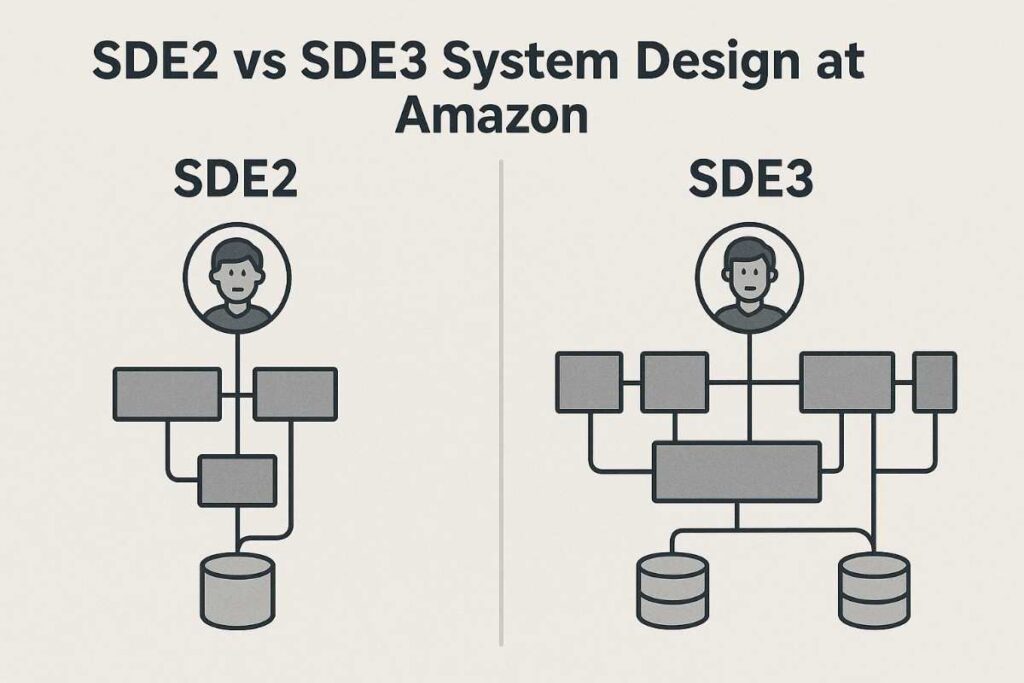
SDE2 vs SDE3: What Is the Real Difference?
Many engineers make the mistake of thinking the Amazon SDE2 to SDE3 promotion is about doing the same work faster or with fewer bugs. It is not. The shift is qualitative, not quantitative.
SDE2 is expected to:
- Own individual features or components end-to-end
- Deliver high-quality code with some mentorship
- Navigate ambiguous tasks with guidance from senior engineers
- Contribute meaningfully to team design discussions
SDE3 is expected to:
- Define what needs to be built, not just build what is defined
- Lead multi-engineer projects from ambiguity to completion
- Raise the technical bar of the entire team around them
- Be a force multiplier — meaning their presence makes other engineers better
The single biggest mindset shift for the Amazon SDE2 to SDE3 promotion is moving from “I deliver” to “I lead delivery.” Amazon wants to see that you can drive outcomes even when the path is unclear, when dependencies are messy, and when other engineers need to be coordinated.
What Amazon Actually Expects at SDE3 Level
Before you can plan your path to the Amazon SDE2 to SDE3 promotion, you need to understand exactly what SDE3 looks like — not in vague platitudes, but in concrete behavioral and output terms. Amazon’s internal promotion calibration evaluates candidates on three primary dimensions:
At SDE3, you are expected to own entire systems or subsystems end-to-end — not just features. You define architecture, make build-vs-buy decisions, and are accountable for multi-quarter technical roadmaps.
SDE3s raise the bar for those around them — through code reviews, mentorship, technical documentation, design review feedback, and establishing engineering best practices that others adopt and follow.
SDE3s take a loosely defined business problem and independently scope, design, and deliver a technical solution. They don’t need their manager to break down every task — they break it down themselves and bring others with them.
Amazon's Promotion Process Explained
At Amazon, promotions do not happen just because your manager likes you. The process is structured and involves multiple layers of review.
Step 1: Your Manager Identifies You as Promotion-Ready
Your manager will write a promotion document (often called a “promo doc”) that outlines your impact, your growth, and why you are ready for the next level. This document is crucial.
Step 2: Bar Raiser / Calibration Panel Review
Your promo doc goes to a calibration panel — typically a group of senior engineers and managers — who evaluate whether your work meets the SDE3 bar. This is where many SDE2 engineers get stuck. The panel is not your team. They do not know you personally. They only see what the document says.
Step 3: Written Feedback from Peers
360-degree feedback is collected from your peers, cross-functional partners, and stakeholders. Weak or generic peer feedback can kill a promotion even when the technical work is strong.
Step 4: Approval Chain
Senior managers and sometimes a director will approve the final decision.
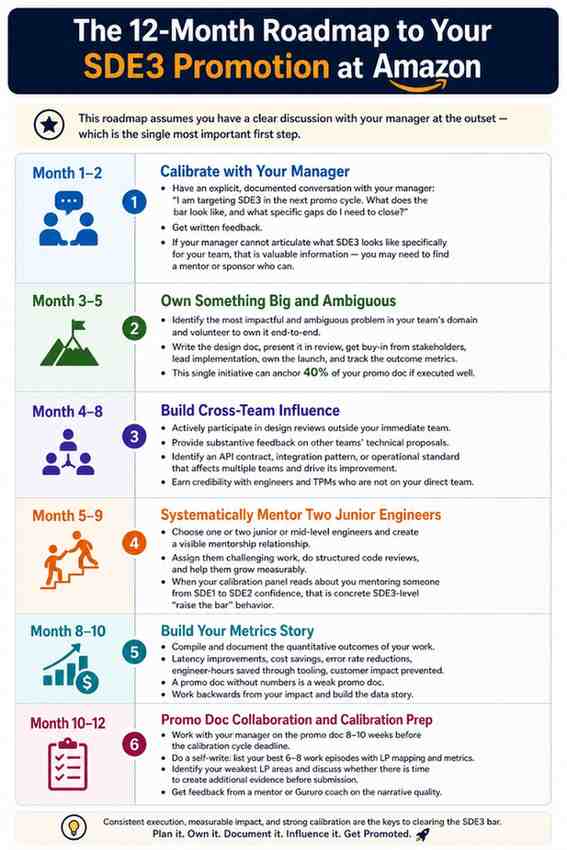
The key insight here: You are not being promoted for your best day — you are being promoted for consistently operating at the SDE3 bar over a sustained period, typically 6 to 12 months.
Leadership Principles: The Hidden Promo Scorecard
Amazon’s Leadership Principles are not just interview talking points — they are the literal evaluation rubric for the Amazon SDE2 to SDE3 promotion. Your promo doc, your manager’s write-up, your peer reviews, and your calibration panel discussion are all structured around LP evidence. Most engineers fail their promotion because they have strong LP evidence in 4–5 principles and weak or absent evidence in others.
Here are the Leadership Principles that are most heavily weighted in SDE2→SDE3 promotion calibrations, based on patterns from engineers who have gone through the process:
Do you own things beyond your assigned tickets? Have you driven a critical initiative end-to-end, including post-launch monitoring, incident response, and follow-up iterations — without being asked?
Can you demonstrate episodes where your technical depth prevented a production incident, saved significant cost, or uncovered a fundamental flaw in an approach that others had missed?
Do other teams proactively seek your technical opinion? Has your word in design reviews or architecture discussions carried weight that influenced decisions across team boundaries?
Have you simplified a system, reduced operational burden, or invented a better approach that was adopted beyond your immediate team? SDE3 candidates need at least one strong “invented something real” story.
Can you demonstrate that you think 2–3 years ahead on technical problems? Did you architect something with future scale in mind, or advocate for a bigger vision when others were focused on the immediate task?
Has your technical judgment proven reliable even in contested situations? Being right in data-driven disagreements and updating your position when wrong — both matter equally here.
Create a personal “LP evidence journal.” For every significant work episode — a system design decision, an incident response, a cross-team collaboration — write 3 bullet points mapping the situation to the relevant LP. Your promo doc writes itself when calibration time arrives, and you don’t rely on memory to reconstruct 18 months of work.
The Leadership Principles That Matter Most
Amazon’s Leadership Principles (LPs) are not just wall decorations — they are the actual evaluation framework for promotions. For the Amazon SDE2 to SDE3 promotion, certain LPs are weighted more heavily than others.
Think Big
SDE3s are expected to think beyond the immediate task. Are you proposing solutions that will scale for 3–5 years? Are you connecting your work to broader business goals? If your ideas are always incremental, that signals SDE2 thinking.
Ownership
This LP means you do not drop the ball when something falls outside your job description. SDE3s own outcomes, not just tasks. When something goes wrong in production — even if it is not your code — you step up.
Dive Deep
SDE3s are not just architects who write design docs and let others implement. You need to stay close to the details, catch issues in code reviews, and demonstrate both breadth and depth.
Earn Trust
The ability to influence across team boundaries without authority is a core SDE3 competency. Can you align stakeholders, resolve conflicts, and maintain credibility even when you push back?
Deliver Results
At the end of the day, impact is everything. Amazon cares about customer outcomes. Your promo doc will need concrete, measurable results — not just effort.
Technical Bar: What SDE3 Level Work Really Looks Like
The technical expectations for SDE3 are significantly higher than SDE2, but they are often misunderstood. Here is what actually matters:
System Design at Scale
SDE3s are expected to lead the design of systems that handle significant load, support future extensibility, and make the right tradeoffs between cost, latency, and reliability. You should be able to write design documents that other engineers, including senior ones, learn from.
Cross-Team Technical Influence
Are you attending architecture reviews for systems outside your team? Are you being consulted by other teams on design decisions? This kind of external reach is a strong signal for SDE3 readiness.
Technical Mentorship
An SDE3 makes the engineers around them better. This includes structured code reviews, pairing with junior engineers, writing internal documentation, and raising the overall quality bar of the team.
Operational Excellence
SDE3s understand the operational reality of their systems. They proactively instrument their services, respond to oncall incidents with clarity, and drive improvements that reduce future operational burden.
Complexity of Work
Look at the projects you have owned. Were they clearly defined with a well-understood solution? Or did you start from ambiguity, define the requirements, drive alignment across stakeholders, and deliver? SDE3 projects are almost always in the second category.
Common Mistakes That Delay Promotions
Many talented SDE2 engineers spend 3 to 5 years at the level not because they lack ability, but because they make avoidable mistakes.
Waiting for the Right Project
There is no perfect project that will magically get you promoted. Strong engineers find ways to demonstrate SDE3 behavior in whatever project they are assigned. Stop waiting and start leading.
Doing Without Documenting
You did great technical work but did not capture the impact? It essentially did not happen from a promotion perspective. Documentation is not optional — it is part of the job at SDE3 level.
Being a Solo Hero
Some SDE2 engineers try to look impressive by doing everything themselves. SDE3s look impressive by making the whole team more effective. The ability to delegate, coordinate, and amplify others is a key differentiator
Avoiding Conflict
SDE3s are expected to have strong technical opinions and to defend them respectfully. If you always go along with whatever the senior person in the room says, you are not demonstrating SDE3 thinking
Not Having the Promotion Conversation
Many engineers never explicitly ask their manager: “What do I need to do to get promoted and by when?” This conversation needs to happen early and often.
Gururo's Framework for Promotion Success
Gururo, a career coaching platform widely used by Amazon and FAANG engineers, has developed a structured framework that has helped many SDE2 engineers successfully make the Amazon SDE2 to SDE3 promotion within their target timeline.
The Gururo RISE Framework for promotion readiness stands for:
R — Results First Every story you tell about your work needs to start with results. Not “I built X” but “I built X which reduced latency by 40% and saved $200K annually.” Gururo coaches engineers to ruthlessly quantify their impact using the STAR method combined with business metrics.
I — Influence Beyond Your Team Gururo’s data shows that engineers who consistently contribute to cross-team technical discussions are promoted faster than those who operate in silos. Gururo’s mentors help you identify where to show up and how to add value in org-wide forums.
S — Scope Expansion Gururo tracks what they call “scope velocity” — how quickly an engineer is expanding the size and complexity of problems they own. If your scope has been flat for 12 months, that is a red flag. Gururo helps engineers identify and close this gap.
E — Evidence Packaging This is where Gururo particularly shines. Having great impact is not enough — you need to present it in a way that lands with a calibration panel that does not know you. Gururo’s coaches review promo docs, identify weak areas, and help engineers reframe their work in terms that resonate with Amazon evaluators.
Many engineers who had previously stalled at SDE2 for two or three years have credited Gururo’s structured approach with finally helping them crack the promotion code. If you are feeling stuck, consider reaching out to a Gururo mentor who has direct Amazon experience.
Final Tips to Accelerate Your Promotion

Here are the most actionable things you can do right now to accelerate your Amazon SDE2 to SDE3 promotion:
Start your brag document today. Open a Google Doc and start writing down every project you have touched in the past 6 months. Add numbers wherever possible.
Schedule a promotion-focused 1:1. Do not wait for your manager to bring it up. Be direct about your goals.
Find a senior mentor. Ideally someone who has been through the Amazon promotion process themselves. This could be an internal SDE3/SDE4 or an external coach from a platform like Gururo.
Identify your next “SDE3-scope” project. Talk to your manager about taking on a project with cross-team dependencies, ambiguous requirements, and significant business impact.
Study Amazon’s bar for SDE3. Look at what SDE3 engineers on your team are doing. Ask them directly: “What does your day look like? What kinds of decisions do you make?” Shadow them if you can.
Get better at writing. SDE3s produce design documents, strategy memos, and post-mortems that others read and learn from. Invest in your technical writing skills — they are underrated at every level.
Do not neglect oncall and operational work. It is unglamorous but it demonstrates ownership and operational depth — both critical for SDE3.
Track your progress against the promo doc regularly. Every month, review your draft promo doc and ask: “Is my recent work adding strong evidence here? What gaps remain?”
Frequently Asked Questions
Q: How long does the Amazon SDE2 to SDE3 promotion typically take?
Most engineers take 2.5 to 3.5 years at SDE2 before being promoted to SDE3. Starting early and operating with intentionality can bring this closer to 18–24 months in strong cases.
Q: Is the Amazon SDE2 to SDE3 promotion purely technical?
No. While technical depth matters, leadership, influence, and business impact are equally important. The calibration panel evaluates your Leadership Principles just as rigorously as your technical work.
Q: What if my manager is not supportive of my promotion?
This is a real challenge. If you believe you are operating at the SDE3 bar but lack managerial support, consider seeking lateral moves within Amazon to a team with better sponsorship, or working with an external mentor through platforms like Gururo to strengthen your case independently.
Q: What is the difference between SDE3 at Amazon and Staff Engineer at other companies?
Amazon SDE3 is roughly equivalent to Staff or Senior Staff Engineer at companies like Google or Meta. It is a senior individual contributor role with expectation of organizational influence and technical leadership.
Q: How important are metrics in the promo doc?
Extremely important. Qualitative descriptions of good work are far less compelling than quantified impact. Always aim to attach numbers: latency improvements, cost savings, revenue impact, reduction in incidents, team productivity gains.
Conclusion
The Amazon SDE2 to SDE3 promotion is genuinely hard — and it should be. SDE3 is a senior role that comes with significant trust, scope, and responsibility. But it is absolutely achievable if you approach it with clarity, intention, and the right support system.
The engineers who make this transition successfully are not necessarily the smartest coders. They are the ones who understand the game, play it with integrity, and consistently show up as the engineer their team cannot imagine operating without.
Start building that reputation today. Talk to your manager. Seek out platforms like Gururo for structured guidance. Document your work. Expand your scope. And above all, start operating like an SDE3 — before you have the title.
Because at Amazon, the promotion is the recognition of what you have already been doing. Make sure you are already there.