






How to Land Your First DS Job With No Experience-Everyone says “get experience to get a job” — but how do you get experience without the job? That’s the frustrating loop that stops most aspiring data scientists before they even start. This guide breaks that loop. It shows you exactly how to get a data science job with no experience in 2026 — using a proven playbook built around real skills, strategic projects, and smart positioning. No bootcamp hype. No false promises. Just a clear path forward..
The truth about "no experience" in data science
When hiring managers say they want “2 years of experience,” what they actually want is evidence that you can solve data problems in a structured, professional way. That evidence does not have to come from a job. It can come from projects, competitions, open datasets, freelance work, and structured programs.
The question of how to get a data science job with no experience is really a question of how to manufacture credible evidence — fast. That’s what this playbook is for.

11.5M
36%
Of DS hires came from non-traditional backgrounds in 2025
7mo
Average time to first DS job with structured preparation
68%
Of recruiters prioritize portfolio over degree
The 5-stage roadmap to your first data science role
This is the most direct path to answering how to get a data science job with no experience — five stages, each with concrete actions.
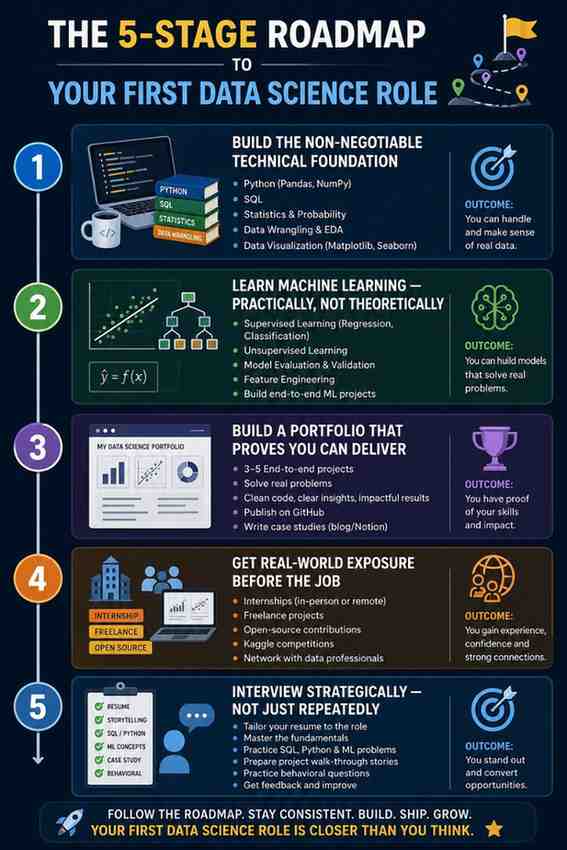
1. Build the non-negotiable technical foundation
Before anything else, you need a working toolkit. This isn’t about learning everything — it’s about learning the right things in the right order.
- Python fundamentals: data types, loops, functions, file handling
- Pandas and NumPy for data manipulation — these are used in every DS job
- SQL: joins, aggregations, window functions — non-negotiable for any data role
- Basic statistics: mean, median, distributions, hypothesis testing, p-values
- Matplotlib or Seaborn for data visualization
2. Learn machine learning — practically, not theoretically
You don’t need a PhD in statistics to use machine learning effectively. You need to understand what algorithms do, when to use them, and how to evaluate whether they’re actually working.
- Scikit-learn: regression, classification, clustering — the industry workhorse
- Model evaluation: confusion matrix, ROC-AUC, RMSE — know what these actually mean
- Feature engineering: this is where real-world DS skill lives, not in algorithm selection
- Basic NLP: TF-IDF, sentiment analysis — in demand across every industry in 2026
- Introduction to deep learning with TensorFlow or PyTorch — depth comes later
Gururo's structured ML track
Gururo offers a project-first machine learning curriculum where you apply every concept to real datasets from Indian industries — fintech fraud detection, e-commerce churn, healthcare diagnostics. This hands-on approach means you graduate with 3–4 deployable ML projects, not just a course certificate. For anyone figuring out how to get a data science job with no experience, this kind of structured, portfolio-building program compresses months of self-study into a focused cohort.
3. Build a portfolio that proves you can deliver
Your portfolio is your proof of work. It must show that you can take a messy dataset, ask the right question, apply the right technique, and communicate findings clearly. Three well-executed projects beat fifteen shallow ones every time.
- Project 1 — End-to-end EDA: Pick a Kaggle dataset in your domain, do deep exploratory analysis, write a detailed blog-style notebook
- Project 2 — Predictive model: Build, tune, and evaluate a classification or regression model. Deploy it with Streamlit or Gradio
- Project 3 — Real-world data: Scrape or use an API, clean dirty data, find a genuine insight — this shows maturity
- Publish everything on GitHub with clean READMEs — recruiters check these directly
- Write 2–3 posts on LinkedIn or Medium explaining your findings — writing = thinking
Portfolio project idea that actually impresses
4. Get real-world exposure before the job
Hiring managers worry that candidates without experience can’t handle messy, ambiguous real-world data. Your job in this stage is to prove them wrong — before the interview.
- Compete in Kaggle competitions — even finishing in the top 40% shows competitive awareness
- Contribute to open-source data projects on GitHub
- Offer free data analysis to a local business, NGO, or startup in your network
- Apply for internships, even if unpaid — a 2-month internship on your resume changes everything
- Look for “data analyst” or “junior data scientist” roles as entry points — these are bridges, not dead ends
5. Interview strategically — not just repeatedly
Most candidates treat job interviews like a lottery — apply to 100 companies and hope. Strategic candidates research the company, tailor their portfolio presentation, and practice the specific interview formats that company uses.
- Master the 4 DS interview categories: SQL rounds, case studies, take-home assignments, and behaviorals
- Practice explaining your portfolio projects out loud — clear verbal explanation is 50% of the technical interview
- Prepare a “data story” for each project: problem → approach → result → business impact
- Target companies actively hiring freshers: product-led startups, analytics consulting firms, and companies with rotational programs
- Use referrals aggressively — a referral increases your interview probability by 5–9x at most companies
Skills that actually get you hired in 2026
The data science skills landscape has shifted significantly. Here’s what matters most when you’re figuring out how to get a data science job with no experience this year.
Real examples: how others broke into data science
Sneha — English literature graduate to data scientist at a healthtech startup
The candidates who stand out aren’t the ones with the most algorithms memorized — they’re the ones who can tell me what business problem they solved and why their approach was the right one.
How Gururo helps you skip the trial-and-error phase
One of the biggest problems with self-taught data science is the wasted time — spending weeks on the wrong topics, building portfolio projects no recruiter cares about, or preparing for the wrong type of interviews.
Why Gururo works for career changers
Gururo’s data science program is specifically designed for people who are new to the field. Their curriculum is mapped to what Indian companies — Flipkart, Razorpay, PharmEasy, Urban Company — actually look for in junior DS hires. Mentors provide real-time feedback on your projects, your resume, and your interview positioning. For anyone asking how to get a data science job with no experience, having an experienced data scientist review your Kaggle notebook and tell you what’s weak is worth more than any online course.
- Structured curriculum that covers the right topics in the right order — no rabbit holes
- Live project sprints with mentor feedback on real datasets
- Mock interview prep from working data scientists at top companies
- A peer community of people at the same stage — accountability and collaboration built in
- Career placement support including resume review and referral networks
Frequently asked questions
What skills are required to land an entry-level data science job?
The most important data science skills in 2026 include Python, SQL, statistics, data visualization, machine learning basics, and data cleaning. Employers also look for communication and analytical thinking skills.
How long does it take to become job-ready in data science?
Most beginners can become job-ready within 6–12 months with consistent learning, project-building, and interview preparation. Your progress depends on practice quality and consistency.
What's the best way to write a data science resume with no experience?
Is a degree necessary for a data science career?
No, a degree is not always required for entry-level data science roles. Many self-taught learners and bootcamp graduates get hired by showcasing strong portfolios and real-world projects.
How can I improve my chances of getting shortlisted for data science jobs?
Optimize your LinkedIn profile, build an active GitHub portfolio, network with professionals, tailor your resume for each role, and consistently apply to entry-level data science positions.
Are remote entry-level data science jobs available in 2026?
Yes, many startups and global companies offer remote junior data science roles, especially for candidates with strong technical portfolios and practical project experience.
Your move: start today, not next Monday
Landing your first data science job in 2026 is not about having the perfect degree, expensive certifications, or years of experience. It’s about proving your skills through real projects, practical problem-solving, and consistent learning. The candidates who succeed are the ones who start building before they feel fully ready and focus on creating visible proof of their abilities.
If you want to know how to get a data science job with no experience, start small but stay consistent. Build Kaggle projects, practice SQL regularly, analyze public datasets, and connect with professionals on LinkedIn. In today’s competitive tech market, recruiters value hands-on skills, strong portfolios, and initiative far more than endless preparation. Small daily actions, repeated consistently, are what ultimately turn beginners into hired data scientists.