





Today’s Technical Delivery Managers play a critical role in bridging the gap between engineering teams, product managers, business stakeholders, DevOps teams, QA teams, and clients. They are responsible for driving end-to-end software delivery, coordinating cross-functional teams, managing release cycles, handling production risks, improving delivery efficiency, and ensuring projects are delivered on time with high quality and minimal business impact.
As software systems become increasingly complex, recruiters now evaluate candidates on much more than traditional project management skills. Interviewers expect Technical Delivery Managers to understand Agile and Scrum methodologies, Software Development Lifecycle (SDLC), CI/CD pipelines, cloud infrastructure, DevOps workflows, release management, system design fundamentals, engineering collaboration, and delivery metrics. Along with technical awareness, companies also assess leadership capabilities such as stakeholder management, communication skills, problem-solving ability, conflict resolution, decision-making under pressure, and team leadership.
Whether you are interviewing for a role at a SaaS company, fintech organization, product-based company, startup, enterprise technology firm, or global software company, preparation is essential. Technical Delivery Manager interviews in 2026 focus heavily on real-world delivery scenarios, Agile execution, release planning, production incident handling, risk mitigation strategies, and cross-functional coordination.
This complete guide to Technical Delivery Manager interview questions and answers for software companies in 2026 will help you understand exactly what recruiters expect from modern delivery leaders. You will learn how to confidently answer interview questions related to:
Agile and Scrum delivery
Software Development Lifecycle (SDLC)
CI/CD and DevOps fundamentals
Cloud-based delivery environments
Stakeholder communication
Risk and dependency management
Cross-functional team leadership
Release planning and deployment
Incident and escalation handling
Delivery metrics and reporting
Engineering collaboration strategies
If you want to crack high-paying Technical Delivery Manager interviews and stand out in today’s highly competitive software industry, this guide will help you strengthen both your technical understanding and leadership skills while preparing you for real-world interview scenarios used by top software companies in 2026.
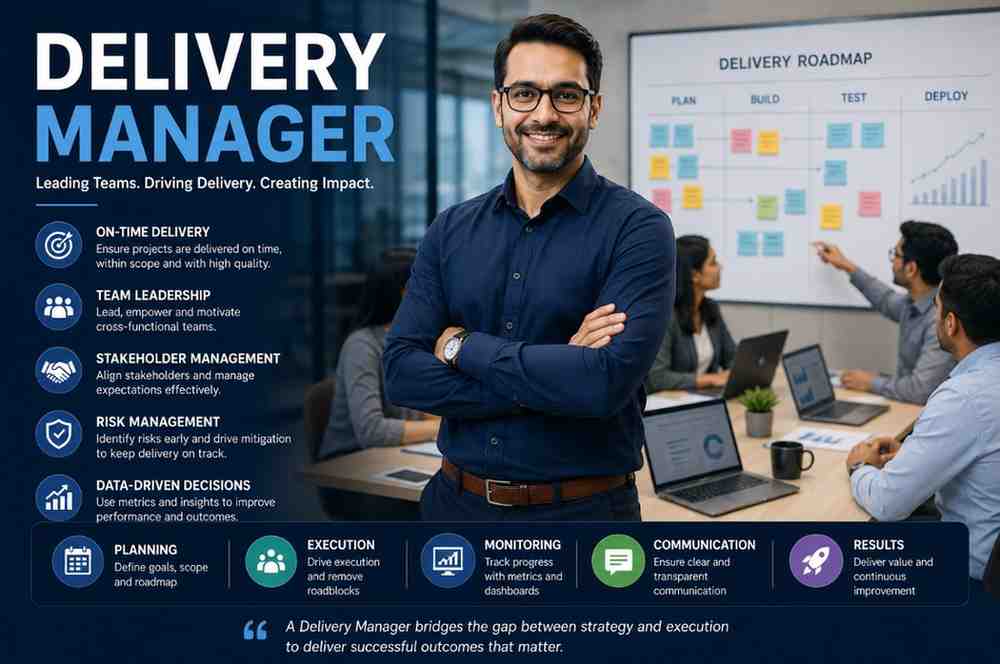
What Is a Technical Delivery Manager — and Why Is the Role So Hard to Hire For?
The role of a Technical Delivery Manager (TDM) sits at one of the most demanding intersections in modern software companies: business strategy, engineering execution, stakeholder communication, and agile leadership — all at once. That is precisely why interviews for this position are rigorous, multi-dimensional, and often unpredictable.
At Gururo, we have worked with hundreds of professionals preparing for TDM roles at companies ranging from early-stage startups to Fortune 500 enterprises. One pattern is consistent: candidates who walk in with only project management knowledge fail, while those who combine technical literacy with delivery excellence and people skills succeed.
This guide gives you the complete picture — organized by category, enriched with sample answers, and loaded with insider tips from the Gururo interview coaching team. Whether you are a seasoned program manager stepping up or an engineering lead transitioning into delivery, these questions will prepare you for everything the panel can throw at you.
68%
3–5
$140K+
50+
Core Competency Framework for TDM Interviews
Before diving into specific technical delivery manager interview questions, understand the competency matrix interviewers use to score you:
| Competency Area | What Interviewers Look For | Priority |
|---|---|---|
| Delivery Excellence | On-time delivery, risk mitigation, dependency management | Critical |
| Technical Understanding | System design awareness, development lifecycle knowledge, CI/CD basics | Critical |
| Agile & Process | Scrum, Kanban, SAFe, sprint planning, retrospectives | Critical |
| Stakeholder Management | Executive communication, conflict resolution, expectation setting | Important |
| Team Leadership | Motivation, accountability, cross-functional collaboration | Important |
| Metrics & Reporting | Velocity tracking, DORA metrics, burndown charts, KPIs | Good to Have |
Delivery & Project Management Questions
These are the backbone of every Technical Delivery Manager interview. Expect at least 4–6 questions from this category. Your answers must demonstrate real delivery experience, not textbook knowledge.
Walk me through how you would manage the end-to-end delivery of a complex software project involving multiple teams.
Tell me about a time when a project was severely off-track. What did you do to recover it?
How do you manage scope creep while keeping stakeholders satisfied?
Sample answer: “I use a change control process — every new request is assessed for impact on timeline, budget, and team capacity. I present stakeholders with trade-offs: add this feature, but we defer X. This keeps them in control while protecting the delivery contract.”
How do you prioritize work when multiple high-priority items compete for the same team's bandwidth?
What delivery metrics do you track, and how do you use them to make decisions?
Agile & Engineering Process Questions
Software companies expect TDMs to be fluent in agile methodology — not just as a framework, but as a culture. These technical delivery manager interview questions go beyond theory.
How do you run sprint planning when the team consistently over-commits?
What is the difference between Scrum and Kanban, and when would you choose one over the other?
How do you handle a situation where the engineering team and the product team constantly clash on priorities?
Have you worked with SAFe or scaled agile frameworks? What challenges did you face?
How do you run a retrospective that actually drives change — not just produces a list of complaints?
— Gururo Senior Interview Coach, 14 years in software delivery
Technical Acumen & Architecture Questions
You are not expected to write code, but you must speak the language of engineers. These questions test whether you can earn the respect of a technical team.
How do you assess technical debt and factor it into your delivery planning?
Explain CI/CD to a non-technical executive. How does it affect delivery speed?
How do you manage dependencies between teams building microservices that need to integrate?
A production incident occurs mid-sprint. How do you handle it without derailing the team?
Leadership & Behavioral Questions
Software companies — especially those with strong engineering cultures — want TDMs who lead without authority, build trust across disciplines, and grow teams alongside products.
Describe a time you had to make a high-stakes delivery decision with incomplete information.
How do you motivate an engineering team that is burned out after a long, difficult project?
What is your approach to continuous improvement in delivery processes?
- Understand the SDLC stages and where TDM involvement is highest
- Know DORA metrics and what “elite” performance looks like
- Be able to explain microservices, API gateways, and cloud deployment in plain English
- Study common DevOps tools: GitHub Actions, Jenkins, Terraform, Docker basics
- Learn to read a system architecture diagram and identify delivery risk points
Your Pre-Interview Checklist — Curated by Gururo

Use this checklist in the week before your Technical Delivery Manager interview to ensure you walk in fully prepared:
- Prepare 5–7 STAR stories covering delivery recovery, stakeholder conflict, team leadership, and process improvement
- Research the company’s tech stack, engineering blog, and recent product launches
- Review the job description and map each requirement to a specific story or example
- Practice explaining CI/CD, microservices, and agile frameworks to a non-technical friend
- Prepare 3 intelligent questions to ask the interviewer about delivery culture and tooling
- Know your delivery metrics from past roles — numbers make stories credible
- Have a clear articulation of your leadership philosophy in under 90 seconds
- Review DORA metrics, velocity trends, and how you’ve used data to drive decisions
- Be ready to whiteboard a delivery plan or dependency map if asked
- Get a mock interview session — Gururo’s coaching program simulates real panel formats
You're Closer to That Role Than You Think
The Technical Delivery Manager role is competitive — but it is absolutely winnable with the right preparation. The candidates who succeed are not the ones who memorize answers; they are the ones who have deeply reflected on their experience and can articulate it with clarity, confidence, and data.
At Gururo, we have helped professionals land TDM roles at companies including Amazon, Microsoft, Atlassian, Thoughtworks, and dozens of high-growth startups. Our interview coaching is built around real hiring panel feedback — not guesswork.

Conclusion
The role of a Technical Delivery Manager in 2026 has become far more strategic and business-critical than ever before. Modern software companies are no longer looking for professionals who only manage timelines and track project status. Instead, organizations want delivery leaders who can combine technical understanding, Agile execution, stakeholder management, operational excellence, and business alignment to ensure successful software delivery in highly competitive environments.
Today’s Technical Delivery Managers act as the bridge between engineering teams, product leadership, business stakeholders, DevOps, and clients. They are expected to drive end-to-end delivery excellence while managing complex software ecosystems, distributed teams, cloud-based infrastructures, and rapidly changing business priorities. From sprint planning and release coordination to risk mitigation and production stability, Technical Delivery Managers play a key role in ensuring products are delivered efficiently, reliably, and at scale.
Preparing for Technical Delivery Manager interviews therefore requires much more than basic project management knowledge. Recruiters evaluate candidates on a wide range of competencies, including Agile methodologies, software development lifecycle (SDLC), CI/CD pipelines, cloud delivery models, engineering collaboration, metrics tracking, incident management, and stakeholder communication. At the same time, companies also assess leadership qualities such as decision-making, conflict resolution, accountability, adaptability, and the ability to lead high-performing cross-functional teams under pressure.
As businesses continue accelerating digital transformation and expanding global engineering operations, the demand for highly skilled Technical Delivery Managers will continue to grow across product companies, SaaS organizations, fintech firms, enterprise IT companies, and technology startups. Professionals who can balance technical awareness with leadership, execution, and strategic thinking will have a strong competitive advantage in the evolving software industry.
By mastering these Technical Delivery Manager interview questions and understanding what modern software companies truly expect in 2026, you can confidently prepare for interviews, strengthen your delivery leadership skills, and position yourself as a high-impact technology leader capable of driving successful software outcomes in fast-paced Agile environments.