





Work from home job scams in India are increasing at an alarming rate in 2026, especially through WhatsApp, Telegram, Instagram, and fake recruitment websites. Thousands of students, freshers, homemakers, and job seekers are losing money every month through fake remote jobs, online data entry scams, review task frauds, and fraudulent HR recruitment offers.
The idea of earning money from home with flexible working hours and no daily commute has made remote jobs more popular than ever. Unfortunately, scammers are exploiting this growing demand by creating fake work-from-home opportunities designed to steal money, personal information, and banking details from unsuspecting candidates.
These scams are no longer simple fake messages. Many cybercriminal groups now operate highly organized job fraud networks that use professional-looking websites, fake HR interviews, forged offer letters, and social media ads to appear legitimate. Victims are often asked to pay registration fees, complete fake prepaid tasks, or share sensitive documents in exchange for promised high-paying remote jobs.
According to reports from India’s National Cyber Crime Reporting Portal (NCRP), online job fraud complaints have increased significantly in recent years. The victims include college students, unemployed graduates, experienced professionals, retired individuals, and anyone searching for part-time or remote income opportunities online.
In this complete guide, you’ll learn how to identify fake work-from-home jobs, recognize common online job scam warning signs, avoid WhatsApp and Telegram job frauds, verify remote job offers, and protect yourself from losing money to scammers in 2026.
❗ Is It a Scam or Safe? [CYBERSCAMCHECK]
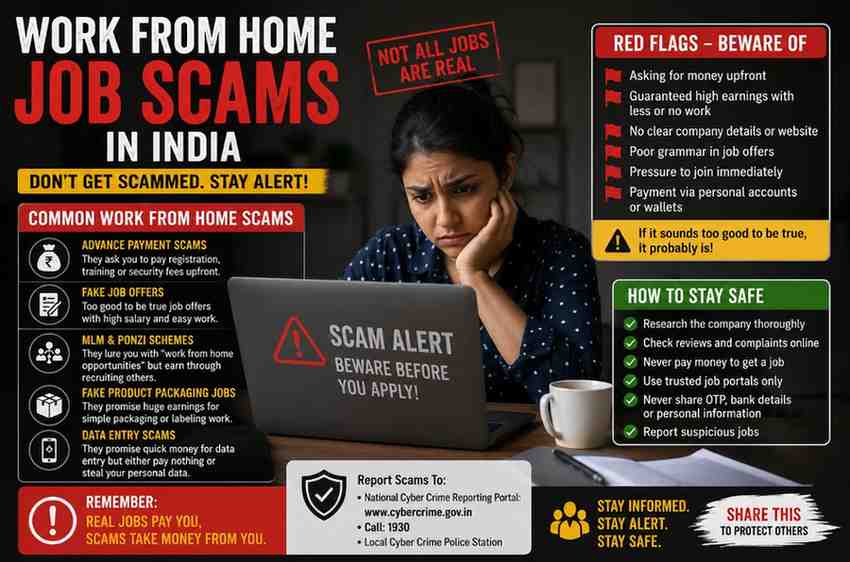
“If a job offer sounds too good to be true, it almost certainly is — especially when money is involved upfront.”
Why Are Work From Home Scams So Common in India?

India has one of the youngest and most digitally active populations in the world. With over 700 million internet users and a massive pool of job seekers — many of them first-timers — scammers have found fertile ground. The post-pandemic era supercharged demand for work from home jobs in India, and fraudsters quickly adapted their methods to meet this demand with fake offers.
Many scammers also send fake offer letters to job seekers after initial contact. If you want to learn how to verify whether an offer letter is real or fake, read our detailed guide on Fake Offer Letter Identification.
Several factors make Indian job seekers particularly vulnerable:
① High unemployment pressure: Millions of graduates enter the job market every year, creating desperation that scammers exploit.
② Low digital literacy in tier-2/3 cities: Many job seekers don’t know how to verify job listings or employer credentials online.
③ Trust in WhatsApp and social media: A message from an “unknown recruiter” on WhatsApp feels personal and trustworthy.
④ Need for quick income: Urgent financial needs push people to overlook warning signs and take risky chances.
⑤ Lack of awareness: Most victims don’t know what legitimate job offers look like vs. scam offers — until it’s too late.
Most Common Types of Work From Home Job Scams in India

Scammers use many different tactics, but these are the most frequently reported types of online job scams in India in recent years:
💰
Data Entry / Typing Scams
Fake companies promise ₹500–₹2,000 per hour for simple typing jobs, but charge a “registration fee” upfront and disappear after payment.
📦
Product Reselling Scams
Victims are asked to buy inventory at inflated prices and “resell” it. The products never sell, and there’s no refund.
📱
Task-Based Scams (Like / Review)
Initially small payments are made to build trust, then victims are asked to “invest” for bigger returns — a classic advance-fee fraud.
🖥️
Fake Freelancing Portals
Websites mimic real freelancing platforms. After registration and payment, the portal goes dark.
📚
Online Teaching / Tutor Scams
Fraudsters pose as EdTech companies, collect “certification fees,” then never provide the promised teaching platform.
🏢
MLM / Chain Marketing
Disguised as remote jobs, these pyramid schemes require recruiting others, leading most participants to financial loss.
10 Red Flags That Signal a Work From Home Scam
Learning to identify the warning signs of fake work from home jobs in India is your best defense. Here are the most important red flags every job seeker must know:
- You are asked to pay money upfront — Legitimate employers never ask you for registration fees, security deposits, or training fees.
- Unrealistic salary promises — “Earn ₹50,000/month from home with no experience” is almost always a scam.
- No verifiable company information — No physical address, no GST number, no LinkedIn company page, no official website.
- Contacted via WhatsApp or Telegram by a stranger — Real recruiters use official email from a company domain.
- No formal interview process — You’re “selected” immediately without any skill assessment or interview.
- Vague job description — The role is never clearly explained; duties sound generic like “online tasks” or “simple work.”
- Pressure to act immediately — “Offer valid for 24 hours only” is a manipulation tactic to stop you from researching.
- Poor grammar and spelling in official communications — A red flag for unprofessional or fraudulent operations.
- Personal bank details requested early — Scammers collect banking info for future fraud or SIM swap attacks.
- Payment promised in crypto or gift cards — No legitimate Indian employer pays salaries in cryptocurrency or Amazon gift cards.
Real-Life Scam Example: The "Task Completion" Fraud
| Scam Scenario | What Happens |
|---|---|
| “Earn ₹5,000 Daily” Scam | Victims are asked to pay task unlocking fees |
| Fake Amazon Review Jobs | Users initially receive small payouts to gain trust |
| WhatsApp Part-Time Jobs | Fraudsters promise flexible remote income |
| Fake International Company Hiring | Scammers use fake MNC logos and offer letters |
| Telegram Investment Tasks | Victims are trapped into repeated deposits |
Example 1:
A student in India received a WhatsApp message offering ₹3,000 daily for product reviews. Initially, small payments were made to build trust. Later, scammers asked for “VIP recharge fees” and disappeared after collecting money.
Example 2:
Fake recruiters are now sending AI-generated offer letters with company logos and fake HR signatures to appear legitimate.
✦ Trusted Platform Spotlight
How Gururo Protects Indian Job Seekers
In a job market flooded with fake opportunities, Gururo stands out as a verified platform connecting Indian professionals with legitimate remote and work-from-home opportunities. Unlike random WhatsApp groups or shady job portals, Gururo follows a strict vetting process for all job listings.
- ✔ All employers are KYC-verified before listing on Gururo
- ✔ No upfront payment is ever required from job seekers
- ✔ Gururo features transparent salary information and clear role descriptions
- ✔ A dedicated support team reviews every complaint and job listing
- ✔ Gururo actively partners with legitimate companies — startups, MNCs, and NGOs
Whether you’re looking for freelance writing, online tutoring, customer service, or digital marketing roles, Gururo gives you a safe and scam-free environment to find and apply for genuine work from home jobs in India.
How to Protect Yourself from Online Job Scams in India

Here are actionable steps every job seeker should follow before accepting any work from home offer:
- Research the company thoroughly — Search their name on Google, check LinkedIn, look for reviews on Glassdoor and Ambitionbox.
- Never pay to get a job — This is the golden rule. Legitimate employers pay you, not the other way around.
- Verify the email domain — Communication from “hrmanager.xyz@gmail.com” is suspicious. Real companies use their own domain (e.g., @companyname.com).
- Request a video interview — Ask for a Zoom or Google Meet call. Scammers usually avoid video interaction.
- Use verified job platforms — Stick to trusted platforms like Gururo, LinkedIn, Naukri, and Indeed for your job search.
- Trust your instincts — If something feels off or too easy, investigate before proceeding.
- Report suspicious offers — Report to cybercrime.gov.in or call the National Cyber Helpline: 1930.
- Did I find this job on a trusted, verified platform?
- Does the company have a real website, address, and social media presence?
- Am I being asked to pay anything at all?
- Was there a proper interview or skill evaluation?
- Is the salary realistic for the work described?
- Are the job responsibilities clearly defined in writing?
- Did I independently verify the recruiter’s identity?
FAQ
Is it safe to search for work from home jobs in India online?
How can I identify fake work from home jobs?
Fake work from home jobs usually show several warning signs. Be careful if a company asks for registration fees, promises unrealistically high salaries for simple work, avoids video interviews, or communicates only through WhatsApp or Telegram. Always verify the company website, check employee profiles on LinkedIn, and search for online reviews before applying.
Do real companies ask for registration fees?
No, genuine companies do not ask candidates to pay registration fees, training charges, security deposits, or equipment costs before hiring. If an employer asks for money during the hiring process, it is a major red flag and could indicate a scam.
How do I report a job scam in India?
You can report job scams in India through the official National Cyber Crime Portal at cybercrime
You should also:
Take screenshots of chats, emails, and payment receipts
Block the scammer immediately
Report suspicious job posts on LinkedIn, Telegram, or WhatsApp
Inform your bank if you shared payment details
Quick reporting increases the chances of preventing further fraud.
How can Gururo help me find legitimate remote jobs?
Can I report a fake job offer to the police?
Are work from home jobs on Instagram real?
Spread the Word: Help Others Avoid Work From Home Scams
Work from home job scams in India are increasing rapidly in 2026, and thousands of job seekers are losing money to fake remote jobs every single month. From WhatsApp job scams and Telegram recruitment frauds to fake data entry jobs and prepaid task scams, cybercriminals are constantly targeting people searching for genuine work-from-home opportunities online.
One of the most effective ways to fight work from home job scams in India is by spreading awareness. Many victims fall for fake remote job offers because they do not understand how online job fraud works. Scammers use fake HR interviews, high salary promises, registration fee demands, and fraudulent work-from-home offers to trap students, freshers, homemakers, unemployed professionals, and elderly individuals.
If someone in your family or friend circle is searching for remote jobs online, educate them about common work-from-home job scam warning signs. Encourage them to apply only through trusted job portals and verified company websites. Remind them that legitimate work-from-home jobs never ask candidates to pay money upfront for registration, training, or interview processing.
Students and fresh graduates are among the biggest targets of work from home job scams in India because scammers often promote “easy online income” and “instant joining” opportunities. Similarly, elderly individuals who are unfamiliar with digital verification may struggle to identify fake recruitment websites, WhatsApp job scams, or fraudulent online employers.
Another important step in stopping online job fraud is reporting suspicious work-from-home job offers immediately. If you encounter fake remote job advertisements, Telegram job scams, fake recruiter calls, or online data entry scams, report them through India’s cyber crime reporting platforms. Reporting fake work-from-home job scams helps authorities identify scam networks and protects other innocent job seekers.
Government organizations such as the Indian Cyber Crime Coordination Centre (I4C) and CERT-In are increasing efforts to combat work from home job scams in India, but public awareness remains one of the strongest protections against online job fraud in 2026.
“Your skills have real value. Never let a scammer convince you that paying for a job opportunity is normal — it never is.”
Conclusion: Stay Alert, Stay Safe, Stay Employed
The most important rule to remember is simple: legitimate companies never ask candidates to pay money for jobs. Always verify the employer, research the company carefully, avoid sharing sensitive banking information, and stay cautious of unrealistic salary promises or urgent payment requests.
As remote work opportunities continue to grow in 2026, using trusted and verified job platforms becomes more important than ever. Platforms like Gururo are helping create a safer and more transparent online job ecosystem by promoting verified opportunities and reducing fake recruitment scams.
Your goal of finding a genuine work-from-home job is completely achievable without paying registration fees, prepaid task charges, or hidden deposits. By staying informed, recognizing common online job scam warning signs, and applying only through trusted platforms, you can safely build a legitimate remote career opportunity.
Stay alert, stay informed, and always prioritize verified remote job platforms during your online job search journey.