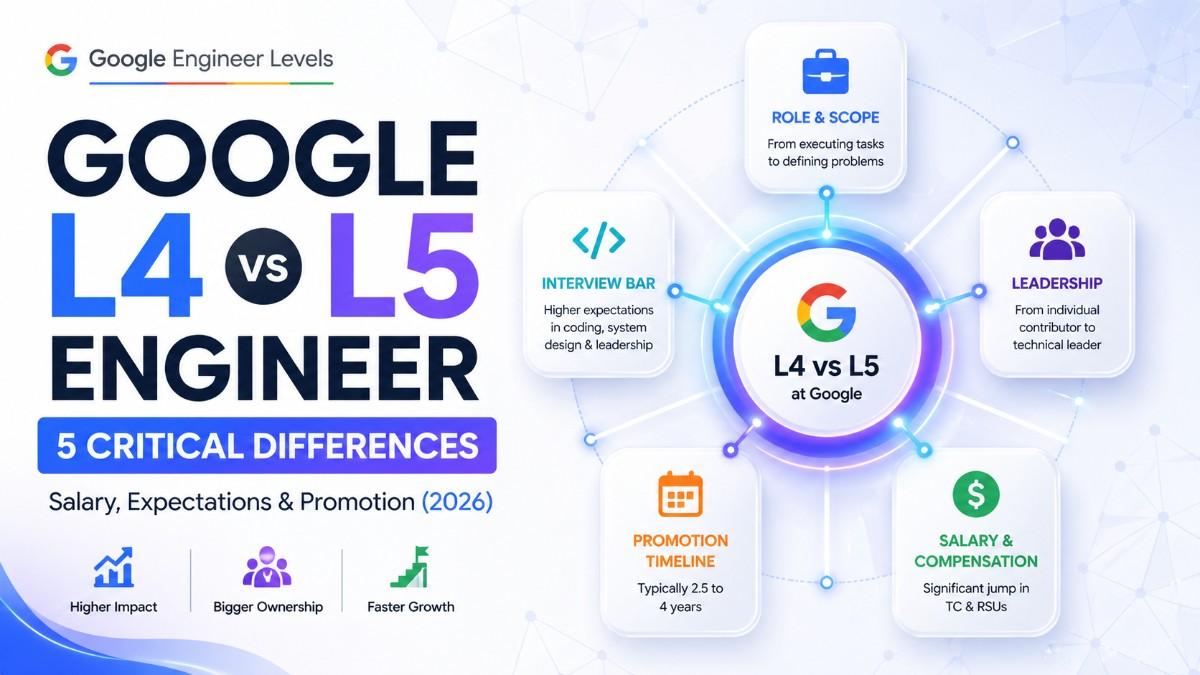






The jump from L4 to L5 at Google isn’t just a title bump. It’s a different job. Here’s what actually separates the two levels — and what it takes to make the move.
Most engineers at Google spend their first few years with their heads down, shipping features and learning the codebase. The feedback cycle is clear, the expectations tractable. But somewhere around the two or three-year mark, a new question surfaces, quietly at first and then all at once: what does it actually take to get to L5?
It’s deceptively hard to answer. Google doesn’t publish an explicit rubric, and the gap between L4 and L5 is — by design — less about what you do and more about how you do it and at what scope. The result is that many talented L4s spend years slightly off-target, optimizing for the wrong things.
This guide cuts through the noise. We’ve synthesized anonymous self-reported data from Levels.fyi, internal Google documents that have circulated on the web, and conversations with engineers who’ve made the L4→L5 jump. What follows is as concrete as this topic gets.
Table of Contents
Google L4 vs L5 Engineer: Why One Level Executes and the Other Defines the Work
The most persistent misconception about Google’s ladder is that L5 is “better L4 work.” It isn’t. The transition is qualitative, not quantitative — and understanding that distinction is the first step to accelerating it.
At L4, Google expects you to own well-defined projects end-to-end. The key word is defined. Someone else — usually a staff engineer, a tech lead, or a product manager — has already framed the problem and determined the solution space. Your job is execution: high-quality, on-time, with good engineering judgment within those guardrails. That’s not a knock on L4; Google’s standards for “good L4 execution” are extremely high. The interview process alone filters for that rigorously.
L5 shifts the locus of responsibility upstream. The expectation is that you can take a fuzzy business or technical problem and define the project yourself. You’re not waiting for scope to be handed to you — you’re generating it. Engineers at this level are expected to identify what the team should be working on, not just work on what’s been identified.
“At L4, you execute a well-defined project well. At L5, you’re expected to figure out what the project should be in the first place.”
— Staff Engineer, Google Cloud (shared anonymously, 2024)
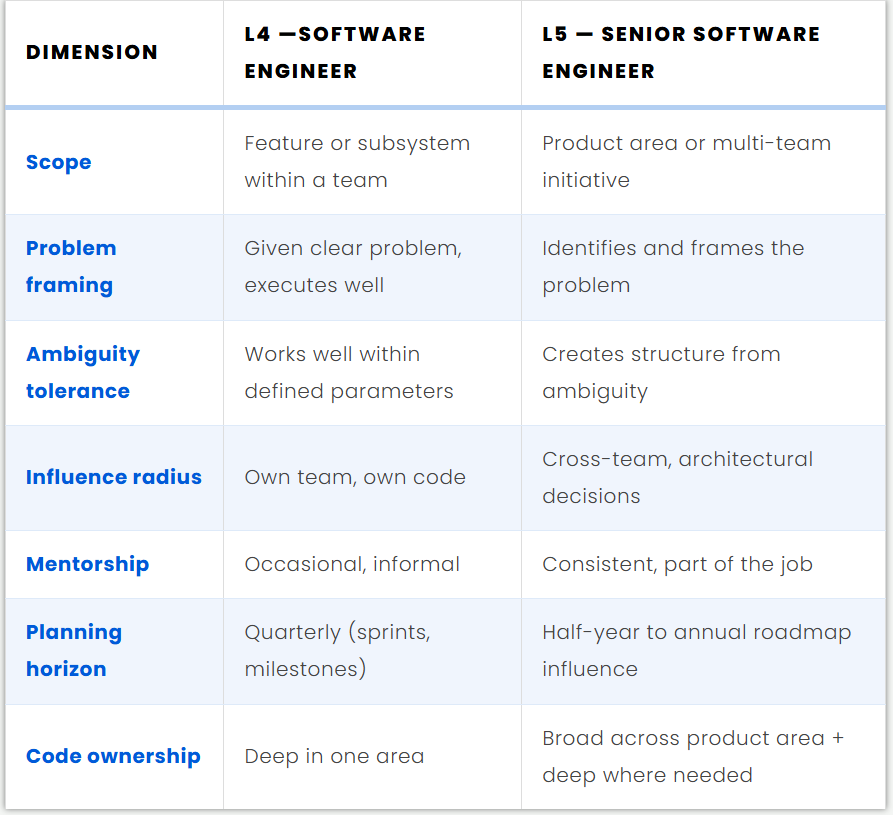
This manifests practically in three dimensions Google internally calls scope, impact, and leadership. For an L4, scope is typically one feature or one system. For an L5, scope spans a product area or a significant cross-team initiative. Impact at L4 is usually measurable within a quarter; at L5, Google expects engineers to drive impact that compounds over a longer horizon — things that affect how the team operates or how future engineers will build.
The leadership dimension is the one that catches most L4s off guard. L5 doesn’t require managing people, but it does require technical leadership: setting direction, raising the quality bar across a codebase, mentoring more junior engineers effectively, and influencing decisions across team boundaries. If you’re not doing that, you’re not performing at L5 — even if your individual output is outstanding.
The fastest way to grow toward L5 is to stop waiting for your tech lead to define your next project. Start writing technical proposals. Spot gaps in the roadmap and propose how to fill them. Even if they get rejected, the act of doing it signals the ownership mindset that L5 requires.
The practical implication? An L4 who is technically brilliant but waits for direction will stall. An L4 who occasionally ships a slightly messier solution but consistently proactively identifies what the team should work on next will get to L5 faster. Google knows you can code. What they need evidence of at the next level is judgment.
Google L4 vs L5 Salary — The Base Pay Gap Is Not the Real Story
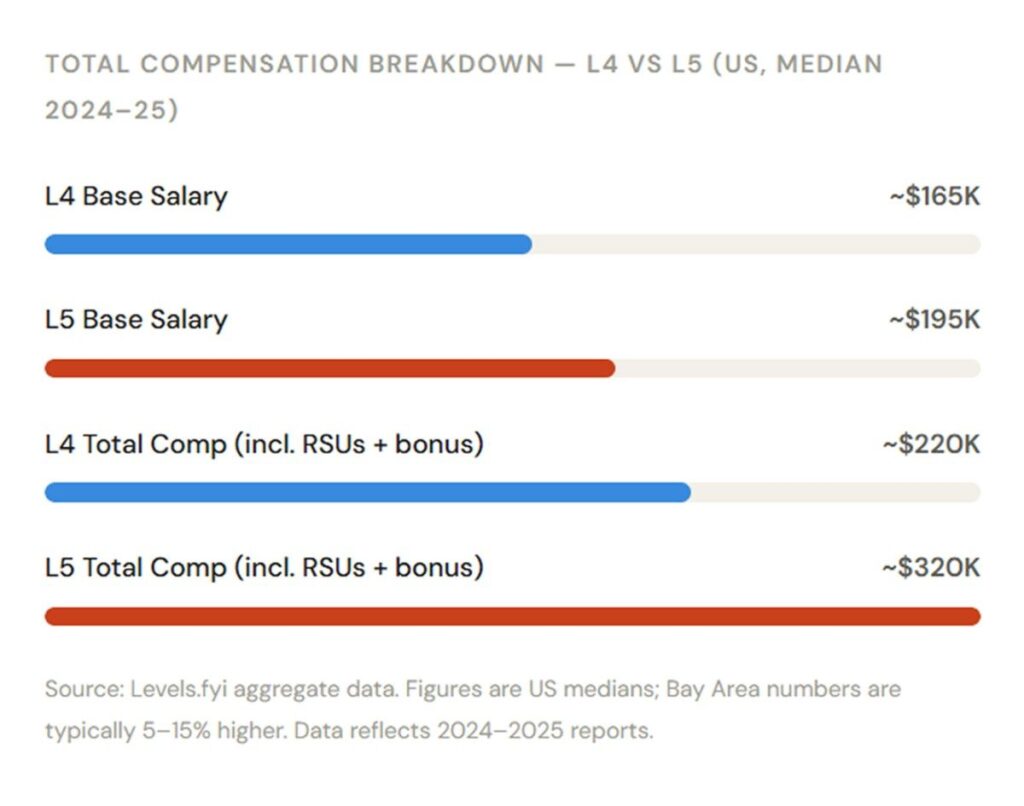
The salary difference between L4 and L5 at Google is real, but the base salary delta is the least interesting part of the story. The place where the levels actually diverge — financially — is in RSU refreshers, sign-on structures, and the compounding effect of equity over time.
$220K
Median L4 TC, US
(2024–25, Levels.fyi)
$320K
Median L5 TC, US
(2024–25, Levels.fyi)
~45%
Median TC increase
L4 → L5
60–70%
RSU share of total
comp at L5
Google’s compensation structure has three components: base salary, annual bonus (typically 15–20% of base), and RSU grants that vest over four years. At L4, base salaries in major US tech hubs (Bay Area, Seattle, New York) typically land between $145K and $185K, with total comp in the $190K–$250K range depending on team, location, and the negotiation quality at hire. At L5, base typically runs $175K–$220K, but the RSU grants jump significantly — and it’s the RSU number that drives the total comp gap to roughly 40–50% between the median figures for each level.
Google L4 vs L5 Salary Compensation Breakdown
There’s a subtler dynamic worth understanding. At L5, Google’s performance review process — called Perf — has more upside. A high-performing L5 who receives an “Exceeds Expectations” or “Strongly Exceeds” rating gets significantly larger RSU refreshers than the equivalent L4 performer. The floor is higher at L5, but the ceiling is also higher. Over a four-year vesting cycle, that compounds meaningfully.
One thing that surprises many external hires: engineers who are brought in directly at L5 — often from competing companies — frequently negotiate substantially above the median figures above. Google’s internal promotion to L5 moves on a structured timeline (more on that below), but external hires can sometimes command L5 packages that would be at or above the 75th percentile for internal promotions. This is one reason why some L4s with competing offers use them as leverage — not necessarily to leave, but to surface a re-leveling conversation.
How Long Does It Actually Take to Get Promoted from L4 to L5 at Google?
The official Google answer to “how long does it take to get from L4 to L5?” is essentially “it depends on performance.” The unofficial answer, borne out by aggregated self-reports, is somewhere between 2.5 and 4 years — with a meaningful cluster around the 3-year mark for engineers who make a deliberate effort to grow into the level’s expectations.
-
1. Onboarding and orientation 0-6 months
Learning the codebase, internal tooling, and culture. Delivering small, well-defined tasks. Not yet expected to operate independently on complex projects. Promo is not on the horizon here.
-
2. Established L4 performance 6–18 months
Consistently hitting expectations on project delivery. Beginning to own larger features end-to-end. Promos from this period exist but are uncommon — and usually require exceptional scope or impact.
-
3. The growth zone — where L5 prep begins 18–30 months
Engineers start proactively seeking larger scope. Tech lead mentors begin explicitly discussing L5 criteria. This is when the “sustained performance at next level” clock typically starts, in practice.
-
4. Promo packet window for most L4s 30–42 months
The majority of L4→L5 promotions occur here. Manager nominates the engineer, peer and cross-functional feedback is gathered, a promo committee reviews the packet. Promotion is not guaranteed by time — it requires documented evidence of sustained L5-level contributions.
-
5. Extended timeline or trajectory change 42+ months
Engineers still at L4 after 3.5–4 years are typically either in a team with limited scope for L5 visibility, have received feedback they haven’t yet acted on, or are on a performance trajectory that warrants a conversation. Some also laterally transfer to a team that offers better promo opportunity.
The single most underestimated variable in the promotion timeline is team fit. A brilliant engineer on a team with limited visibility into company-level priorities — a deep infrastructure team, a maintenance-mode product — will almost always take longer to promote than an equally capable engineer on a high-priority product with abundant scope for L5-level contributions. This is why internal transfers before the promo push are sometimes strategically smart.
Google L5 Interview Prep: What Changes at the Senior Level
Whether you’re targeting L5 as an external hire or navigating an internal promotion, the interview bar deserves its own analysis. The L5 interview at Google is structurally similar to L4 — coding, system design, Googleyness/leadership rounds — but the evaluation criteria are meaningfully different in two of those three areas.
Coding rounds at L5 and L4 use similar problem types (graph traversal, dynamic programming, string manipulation), but L5 candidates are expected to demonstrate not just correctness but engineering intuition. Interviewers at L5 weight the quality of your problem decomposition, your proactive identification of edge cases, and your discussion of trade-offs. A candidate who produces the optimal solution but can’t articulate why it’s optimal — or what would break it in production — will score lower than one who arrives at a good-enough solution and discusses its limitations clearly.
System design is where the real differentiation happens. At L4, a competent system design answer involves naming the right components (load balancer, CDN, database, cache layer) and connecting them sensibly. At L5, interviewers push for depth and judgment. They want to understand how you’d handle failure modes, how you’d scale specific bottlenecks, what you’d trade off under different constraints. The classic tell of an underprepared L5 candidate is a confident high-level answer that falls apart under the first follow-up question.
Frequently Asked Questions
Can you be hired directly into L5 at Google?
Yes. External candidates with 5+ years of relevant experience and strong interview performance are frequently leveled at L5 during the hiring process. Google’s recruiter screen and pre-interview calibration typically give candidates a target level, but the final level is confirmed after interviews. It’s worth having a direct conversation with your recruiter about your leveling expectations before interviews begin.
What's the fastest documented L4 → L5 promotion?
Anecdotally, the fastest internal promotions have occurred around the 18-month mark, though these are genuinely exceptional cases that typically involve either unusually high-impact projects or engineers who joined as L4s somewhat underleveled relative to their actual abilities. The modal (most common) promotion timing remains 2.5–3 years.
Does switching teams reset your promotion clock?
Not formally. Google’s official policy is that your performance history and demonstrated impact follow you across internal transfers. In practice, a new manager needs time to see your work and build confidence to sponsor you for promotion — so a transfer at the wrong time can effectively delay things by 6–12 months. Timing a transfer after a strong performance review and early in a new half-year cycle tends to minimize the delay.
How does the L4 vs L5 distinction affect day-to-day work?
In well-functioning teams, L5s naturally operate differently: they’re the ones driving technical design docs, running design reviews, noticing cross-team dependencies before they become problems, and connecting junior engineers to the right resources. On some teams, the distinction is less visible day-to-day — which is part of why the promo process requires explicit documentation of impact rather than just peer validation.
What's L6 (Staff Engineer) like relative to L5?
The L5→L6 jump is widely considered even harder than L4→L5, and it’s rarer. L6 at Google is a Staff-level role where the expectation is org-wide or multi-org scope — defining what large groups of engineers should be building, not just a single team’s direction. Many highly effective L5 engineers stay at the level for 5+ years, and some never pursue L6 because the trade-offs (much broader ambiguity, significant cross-org political dynamics) don’t align with what they want from the job.