





How Does the Spotify Discover Weekly Algorithm Read Your Mind?
Every Monday morning, millions of listeners engage in a digital ritual: opening their “Discover Weekly” playlist. Often, the experience is startling—it feels as if the app has peered into your soul, finding that obscure indie track or 80s synth-wave hit you didn’t know you needed. This ritual is actually powered by the Spotify discover weekly algorithm, a sophisticated hybrid recommendation system that has set the gold standard for Machine Learning (ML) in the entertainment industry.
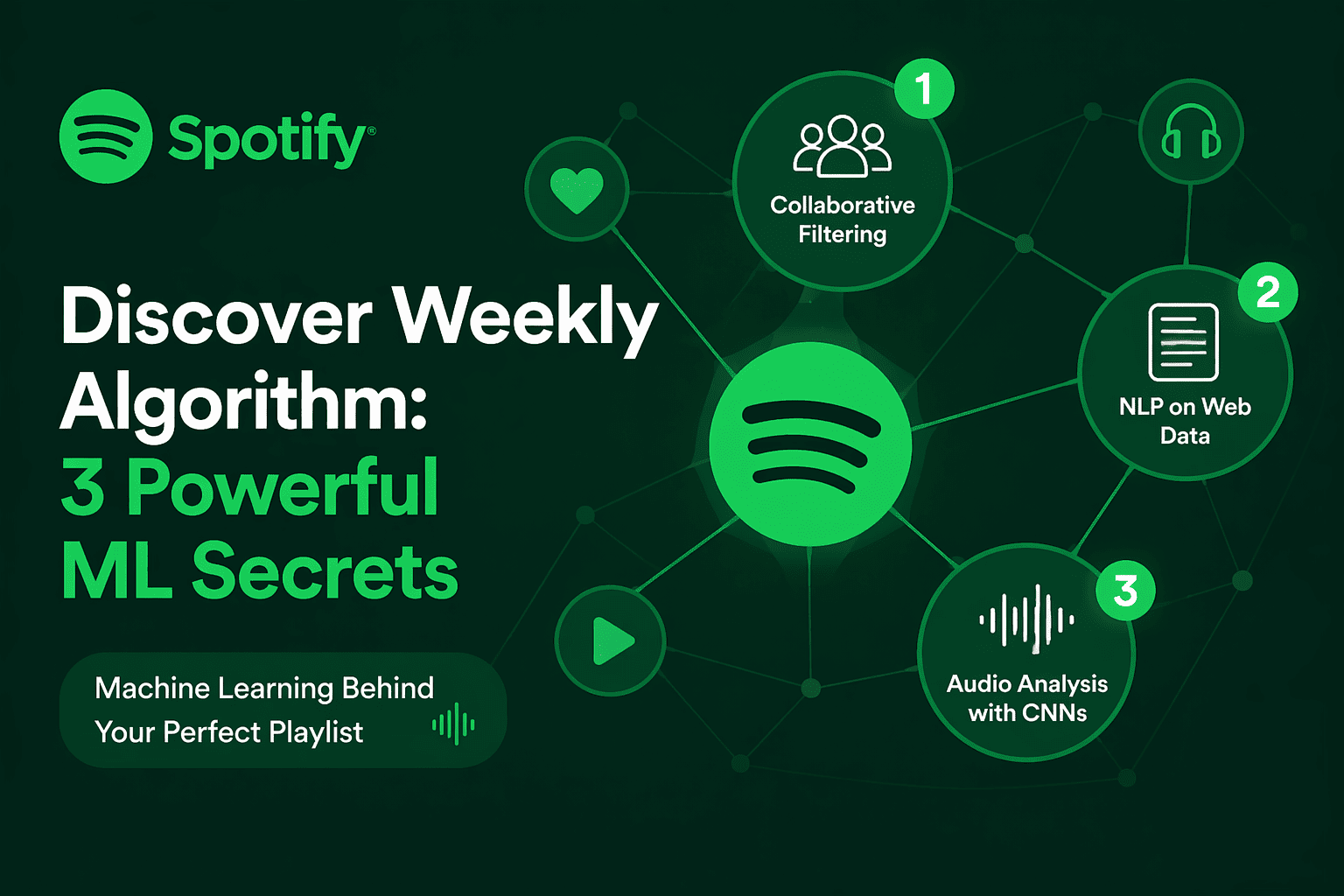
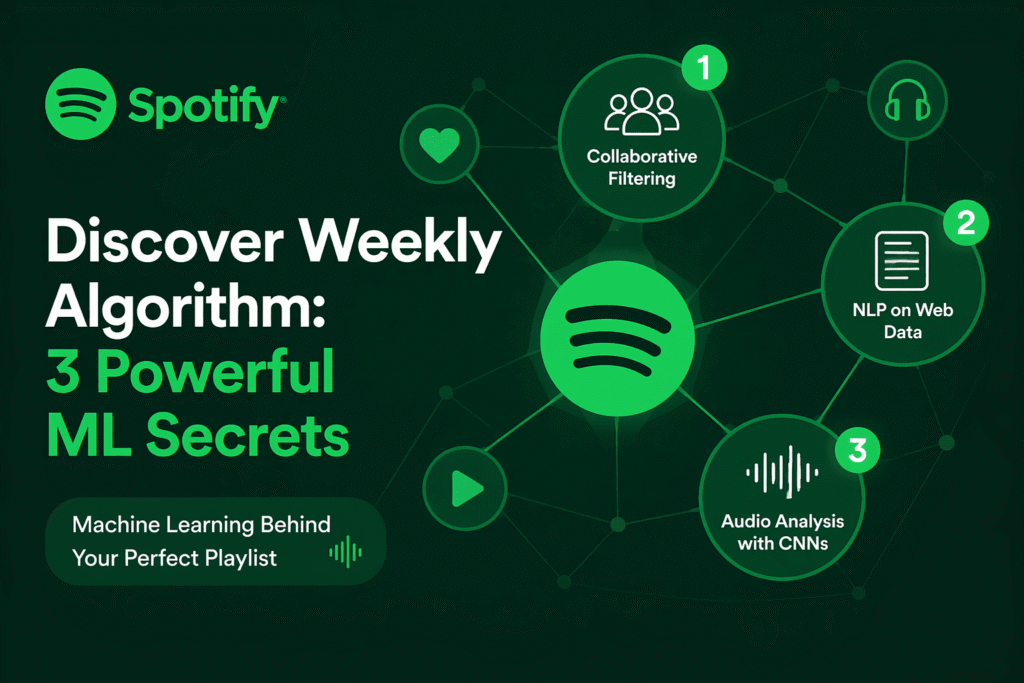
For data scientists and AI professionals, this system is the gold standard for solving the “Cold Start” problem and scaling personalization to over 600 million users. Let’s deconstruct the three core pillars that make this magic possible.
Table of Contents
Latent Factor Modeling: The Hidden Math Behind Your Musical Twins
Imagine you and a stranger both love In Rainbows by Radiohead and Currents by Tame Impala. If that stranger starts obsessing over a new track by Unknown Mortal Orchestra, the algorithm assumes you’ll probably like it too.
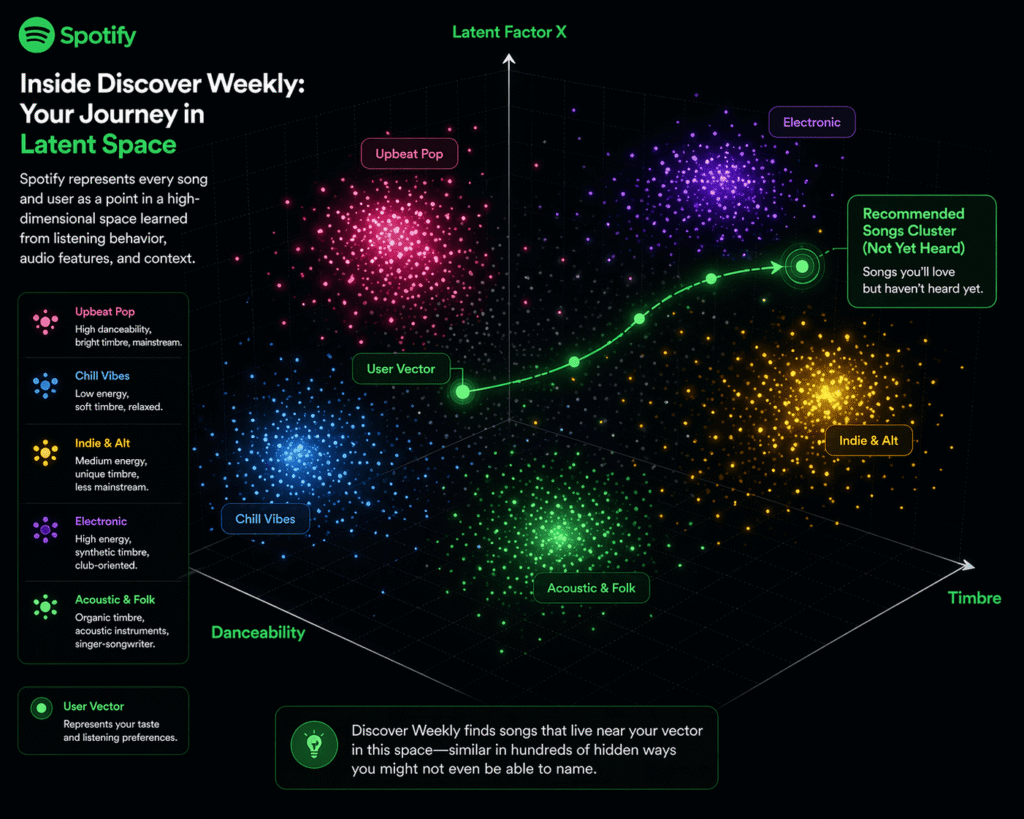
This is Collaborative Filtering. Unlike content-based filtering (which looks at the song’s properties), collaborative filtering looks at user behavior. While most people call it “Collaborative Filtering,” the actual engine under Spotify’s hood is Latent Factor Modeling. Think of it as a multidimensional map where every song and user is a tiny coordinate.
How the User-Item Matrix works?
Imagine a giant spreadsheet. The rows are users, and the columns are the 100 million+ tracks on Spotify. Spotify doesn’t just look at what you “Like.” It tracks Implicit Feedback—did you listen to the whole song? Did you skip it in under 30 seconds?
Using a technique called Matrix Factorization, the algorithm breaks this massive grid into “vectors.” If your vector (your musical DNA) overlaps with a stranger’s vector, the algorithm assumes that the songs they love—which you haven’t heard yet—are perfect candidates for your next playlist.
Natural Language Processing: Decoding the "Cultural Vibe" of the Internet
What happens when a song is brand new? It has no “listening history,” so collaborative filtering fails. To solve this, Spotify’s NLP models act as digital anthropologists, constantly “reading” the internet.
The Methodology: Cultural Embeddings
Spotify’s crawlers scan music blogs, news articles, track descriptions, and even social media discussions. The goal is to identify “adjectives” and “entities” associated with a song.
If the internet describes a track as “ethereal,” “crunchy bass,” or “perfect for a rainy day in Seattle,” the NLP model assigns these terms to the song’s profile. Using models similar to Word2Vec, Spotify creates embeddings where words and songs exist in the same mathematical space. If the term “lo-fi beats” is constantly found near the artist “Nujabes” in blog posts, the algorithm learns they are semantically linked.
Did you know?
Spotify’s NLP models are trained on a massive dataset called the “Cultural Vector.” This includes billions of data points scraped from the web, ranging from professional Rolling Stone reviews to obscure Reddit threads and track descriptions on personal public playlists. This is why Spotify knows that “Shoegaze” and “Dream Pop” are cousins, even if the audio frequencies are nearly identical.
How Spotify "Listens" to the Raw Soul of a Song?
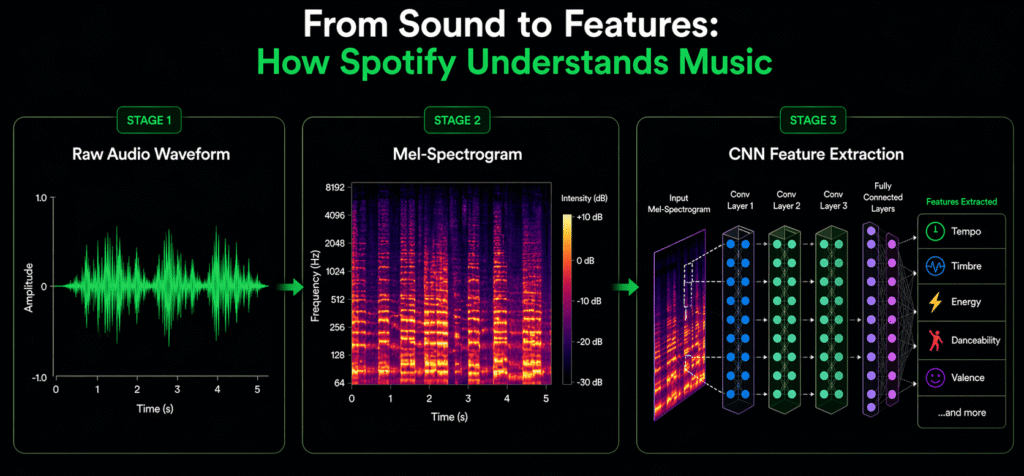
This is perhaps the most impressive feat. Spotify uses Convolutional Neural Networks (CNNs)—the same architecture used in facial recognition—to “listen” to the raw audio file of every track.
From Waves to Spectrograms
A CNN cannot “hear” a .mp3 file directly. Instead, the audio is converted into a Spectrogram (a visual representation of frequencies over time).
The Input: The CNN “looks” at the spectrogram images.
The Extraction: It identifies patterns in tempo, loudness, key, and even “danceability.”
The Benefit: This is the ultimate solution to the Cold Start Problem. Even if a song was uploaded five minutes ago and has zero plays or blog mentions, the CNN can identify that it sounds exactly like a high-energy “Post-Punk” track, allowing it to be categorized instantly.
The Hybrid Masterclass: Orchestrating the Perfect Weekly Discovery
The true genius of the Spotify recommendation system isn’t any one of these models—it’s how they are weighted.
Spotify uses a Hybrid Model approach. On Monday morning, the system generates a “candidate set” of thousands of songs you might like. It then runs these through a final ranking model (often using Boosted Trees or Neural Networks) that balances:
- Familiarity: Songs similar to what you know.
Exploration: Songs that push your boundaries (to avoid the “filter bubble”).
Context: Recent shifts in your taste (e.g., if you suddenly started listening to Jazz last week).
Key Insights for the ML Professionals
If you are studying for a Machine Learning certification or designing your own system, Spotify’s architecture offers three vital lessons:
Don’t rely on Explicit Data: Users rarely “heart” every song they like. Use implicit signals (time spent listening) for a truer dataset.
Dimensionality Reduction is King: Handling 100 million songs requires efficient embeddings to keep latency low.
Hybrid beats Pure: Every model has a blind spot (Collaborative filtering hates new items; CNNs hate cultural context). Combining them creates a robust, fail-safe system.
The next time a song on your Discover Weekly stops you in your tracks, remember: it took a global web of user behavior, millions of blog posts, and a machine “eye” looking at soundwaves to put that melody in your ears.
FAQ: Spotify Discover Weekly Algorithm
What is the core technology behind the Spotify Discover Weekly algorithm?
The system is a hybrid ML pipeline that orchestrates Latent Factor Modeling, NLP, and CNN-based audio analysis to predict user preference.
How does Spotify Discover Weekly use Latent Factor Modeling?
It uses Matrix Factorization to map user behaviors into a multidimensional vector space, identifying “musical twins” with similar hidden taste patterns.
Does the Spotify Discover Weekly algorithm analyze raw audio files?
Yes, it utilizes Convolutional Neural Networks (CNNs) to “listen” to spectrograms, extracting technical features like tempo and timbre to solve the “Cold Start” problem.
How does NLP help the Spotify Discover Weekly algorithm understand music?
Spotify employs Natural Language Processing to scrape web text and build Semantic Embeddings, linking artists to cultural vibes and real-world contexts.
For more deep dives into real-world system designs, check out the resources at Gururo, where we deconstruct the world’s most complex AI systems into exam-ready insights.