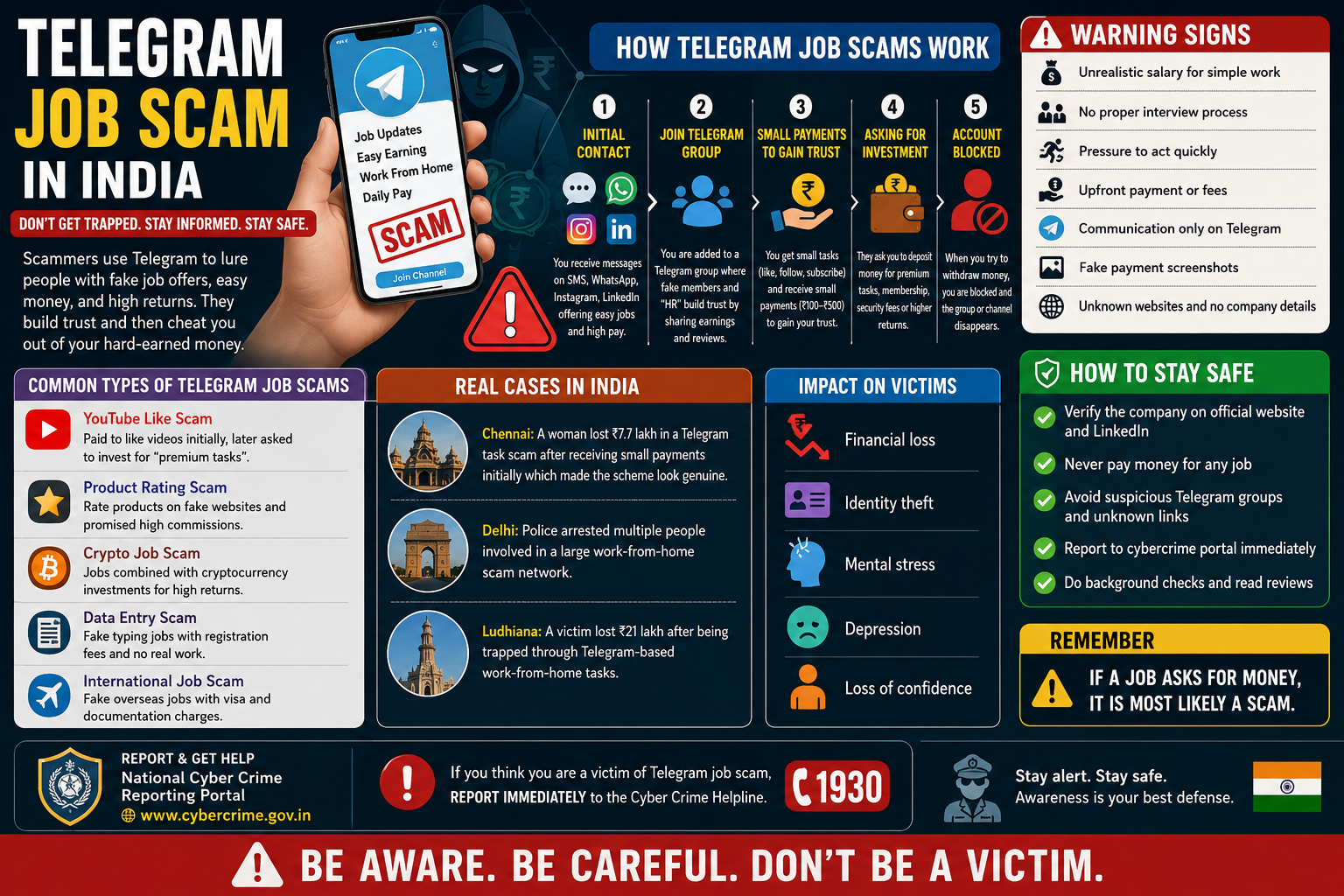






Telegram Job Scams in India is becoming one of the fastest-growing online frauds targeting students, job seekers, freelancers, and unemployed individuals. Scammers use Telegram groups and fake recruiters to promise easy money, work-from-home opportunities, and high daily earnings. Many victims initially receive small payments to build trust, but later lose large amounts of money through fake investment tasks, prepaid jobs, and fraudulent schemes. Understanding how these scams work, their warning signs, and the best safety measures can help people avoid becoming victims of online job fraud in India.
- These scams mainly target:
- College Students
- Fresh graduates
- Housewives
- Unemployed individuals
- Freelancers
- People looking for side income
- Scammers promise:
- Easy money
- Flexible working hours
- Daily Payments
- Remote jobs
- No experience required
In reality, victims are manipulated into paying money, sharing bank details, or completing fake tasks. Many people lose thousands or even lakhs of rupees.
Indian police and cybercrime authorities have repeatedly warned people about Telegram-based employment frauds.
How Telegram Job Scams Work
Step 1: Initial Contact
- Victims usually receive:
- SMS messages
- WhatsApp texts
- Instagram DMs
- LinkedIn messages
- The message may say:
- “Earn ₹5,000 daily from home”
- “Part-time online work available”
- “Like YouTube videos and earn money”
- “Simple data entry work”
- After showing interest, victims are asked to join Telegram.
Step 2: Joining a Telegram Group
- Once inside Telegram:
- Fake HR executives contact victims
- Multiple fake members pretend to earn money
- Screenshots of profits are shared
- Fake testimonials build trust
- Scammers create an illusion of legitimacy.
Step 3: Small Payments to Gain Trust
- Initially, victims are given tiny tasks like:
- Liking YouTube videos
- Rating products
- Following Instagram pages
- Subscribing to channels
- Victims may actually receive ₹100–₹500 in the beginning. This is done intentionally to gain trust.
Step 4: Asking for Investment
- After trust is established, scammers ask victims to:
- Deposit money
- Buy prepaid tasks
- Upgrade membership
- Pay "security" or "processing" fees
- Promises include:
- Double returns
- High commissions
- VIP access
- Victims keep paying in hopes of recovering earlier money.
Step 5: Account Blocked
- Eventually:
- Withdrawals stop
- Telegram admins disappear
- Victims are blocked
- Groups get deleted
- The scam ends with financial loss.
Common Types of Telegram Job Scams in India
1. YouTube Like Scam
Victims are paid small amounts to like videos initially. Later they are asked to invest money for “premium tasks.”
2. Product Rating Scam
Victims rate products on fake websites and are promised commissions.
3. Crypto Job Scam
Fraudsters combine jobs with cryptocurrency investments.
4. Data Entry Scam
Victims are promised typing work but asked to pay registration fees.
5. International Job Scam
Fake overseas jobs are offered with visa and documentation charges.
Warning Signs of Telegram Job Scams
Unrealistic Salary
High salary for simple work is suspicious.
No Proper Interview
Legitimate companies conduct structured interviews.
Pressure to Act Quickly
Scammers create urgency
Upfront Payment
Real employers never ask candidates to pay money.
Communication Only on Telegram
Professional companies use official emails and HR systems.
Fake Screenshots
Fraudsters use edited payment screenshots.
Unknown Websites
Scam websites usually have poor design and no company details.
Experts and cyber authorities repeatedly state that legitimate employers do not demand advance payments.
Real Cases in India
A Chennai woman reportedly lost ₹7.7 lakh in a Telegram task scam after initially receiving small payments that made the scheme appear genuine.
Police in Delhi also arrested multiple individuals involved in a large work-from-home scam network.
Another victim from Ludhiana lost ₹21 lakh after being trapped through Telegram-based work-from-home tasks.
Psychological Tricks Used by Scammers

- Scammers manipulate emotions such as:
- Financial stress
- Urgency
- Fear of missing out
- Trust in authority
- Greed
- They create fake success stories to convince victims.
Impact on Victims
- Victims may suffer:
- Financial loss
- Identity theft
- Mental stress
- Depression
- Loss of confidence
- Students and unemployed individuals are especially vulnerable.
How to Stay Safe
Verify Companies
Check official websites and LinkedIn pages.
Never Pay for Jobs
No genuine employer asks for money.
Avoid Suspicious Telegram Groups
Be careful with unknown invitations
Use Cybercrime Portals
Report suspicious activity immediately.
Do Background Checks
Search company reviews online.
Government and Cybercrime Actions

- Indian cybercrime authorities actively investigate:
- Fake recruiters
- Task scams
- Telegram fraud groups
- The National Cyber Crime Reporting Portal helps victims file complaints.
Conclusion
Telegram job scams are increasing rapidly in India because scammers exploit unemployment and the demand for remote jobs. These scams often begin with small rewards but eventually result in heavy losses. Awareness, verification, and caution are the best defenses.
People should remember one important rule:
If a job asks for money, it is most likely a scam.
- Read our guide on Internship Scams in India
FAQs
Are Telegram jobs real?
Some are genuine, but many Telegram job offers are scams.
Why do scammers use Telegram?
Telegram offers anonymity and easy group management.
Can I recover lost money
Recovery is difficult but immediate cybercrime reporting improves chances.
Is liking YouTube videos for money genuine?
Mostly these are scam schemes.
Where can I report Telegram scams?
You can report them on National Cyber Crime Portal